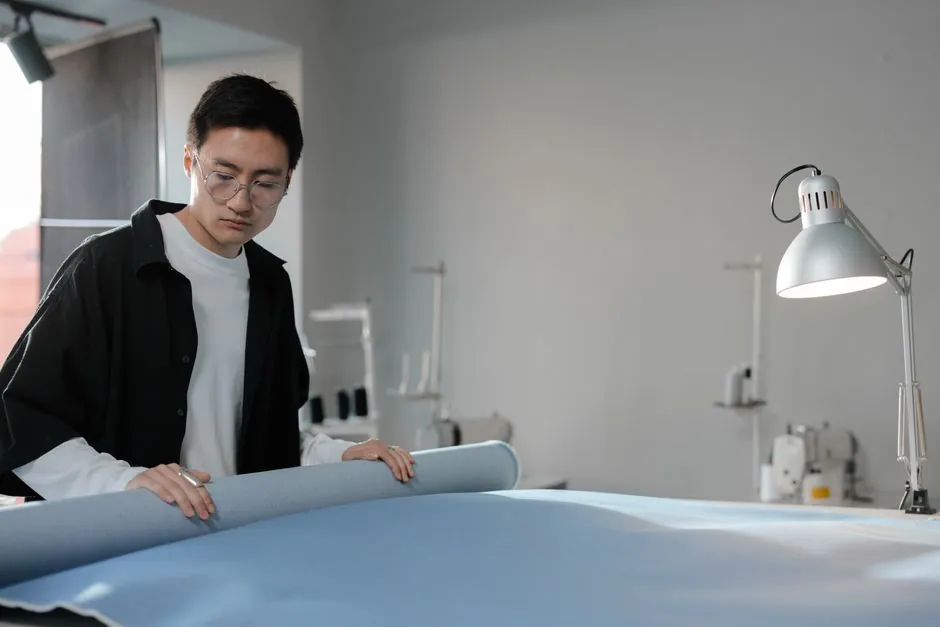
A slewing drive is rarely the right answer on a spinning or weaving island, but it is a defensible one on cloth-pallet turntables, stenter-frame transfer tables, and dye-bath transfer carousels where 90-degree index motion, static torque hold, and IP65 lint sealing have to coexist on a single axis [S5].
The 2026 textile mill is built around compact helical and worm gearboxes covering 0.12 kW to 200 kW input power, 5:1 to 100:1 reduction ratios, IP54 to IP65 sealing, and 60 to 78 dB noise ceilings at 1 m, with a carding machine carrying up to 50 independently controlled rolls and a sizing machine up to 30 [S2][S4]. A slewing drive drops into this envelope only when the duty cycle is a slow index step rather than continuous rotary motion.
Where a Slewing Drive Actually Fits on a Textile Line
A slewing drive indexes a load through a defined arc and then holds it statically, which is exactly what cloth-pallet turntables, stenter transfer tables, and dye-bath transfer carousels need during lot change, and the textile worm-gear tradition is the closest analog: worm units at ratios of 30:1 and above are self-locking, meaning the package holds position after the motor de-energizes [S5]. The same logic extends to a slewing bearing and worm-gear pair sized for slow index duty, where a 90-degree step every 8 to 15 seconds replaces continuous rotation.
Selection on these nodes is dominated by three numbers: hold torque under worst-case fabric load, IP65 sealing against airborne fiber concentrations of 3 to 8 mg/m³ measured on textile floors, and backlash held to 20 arc-minutes or less so the cloth edge does not drift on a dye line [S2][S5]. The reference framing for a slewing drive sits inside the broader right-angle family that already dominates winding and small loom duty, and the same selection logic that drives helical-bevel units on stenter frames carries over when the motion is index rather than continuous [S3].
Spec Envelope: What a Textile-Line Slewing Drive Datasheet Must Carry
A textile-qualified slewing drive datasheet in 2026 should carry six hard numbers borrowed from the textile gearbox spec map: hold torque in the 15 to 95 Nm band typical of textile worm units at 30:1, ratio range 30:1 to 100:1 for static hold, gear surface hardness HRC 37 to 62 on 20CrMnTi alloy steel, IP65 sealing with a lint-deflector ring on each shaft seal, noise under 60 dB at 1 m for mill ambient compliance, and operating temperature +5°C to +50°C to match mill HVAC envelopes [S2][S5].
The unit should also follow the standard ISO 14521 worm gear load capacity methodology used for textile worm reducers, deliver an L10 service life exceeding 35,000 hours at 1.5× service factor for 12 to 14 hour single-shift duty, and accept standard IEC motor frames 63B5, 63B14, and 71B5 so it drops into the same motor inventory as the rest of the mill [S5]. The slewing bearing inside the assembly must be sized for axial load from the cloth pallet plus moment from off-center fabric weight, and the worm gear must be bronze-on-steel with a Q7 (DIN 3974) worm finish to match the precision envelope used on textile worm reducers [S5].
Comparison: Slewing Drive vs Continuous Gearbox on a Textile Index Node
The two options line up against four decision criteria as follows. A slewing drive wins on static hold (true self-locking at 30:1 and above, no electromagnetic brake), on right-angle packaging (90-degree output in a compact envelope), on indexing duty (designed for intermittent arc motion), and on integration with position feedback (worm gear holds arc within backlash limits), but loses on continuous rotary duty where a helical-bevel or worm gearmotor at 0.18 to 7.5 kW and ratios of 5:1 to 250:1 is the right tool [S4][S5].
A continuous textile gearmotor, by contrast, wins on efficiency (94 to 96 percent on helical stages versus the 60 to 80 percent sliding-contact efficiency of a worm stage), on cost per kW at fixed mount, on S1 continuous duty thermal envelope, and on noise ceiling below 58 dB at 1 m for compact worm units sized for frame machines [S2][S4][S5]. The decision is therefore not which gearbox family is "best" but which combination of duty cycle, hold requirement, and right-angle packaging fits the specific node, and on cloth-pallet turntables and stenter transfer tables the index-and-hold signature points straight at a slewing drive [S3][S5].
Selection Criteria by Machine Island
Spinning frames (ring, roving, draw) and carding machines favor helical or helical-bevel units for 94 to 96 percent stage efficiency and torsional stiffness at 1.5 to 200 kW, and these islands have no business using a slewing drive because the duty is continuous and high-cycle [S2]. Looms, winders, and knitting machines favor right-angle helical-bevel or worm units at 60 dB for shop-floor noise compliance with self-locking torque where a vertical shaft must hold position, again continuous rotary, not index [S3].
Cloth-pallet turntables, stenter transfer tables, and dye-bath carousels are the three islands where a slewing drive earns its slot, because the duty is index-and-hold rather than continuous, the right-angle packaging is mandatory, and the static hold replaces an electromagnetic brake that would otherwise sit in the panel [S5]. The same family taxonomy that drives slewing drive selection for packaging lines carries over with the swap of seal class for lint-laden sheds and acoustic ceiling for mill ambient, and the broader slewing ring bearing reference frames the axial and moment load case that a cloth pallet imposes on the bearing race.
Standards, Duty Cycles, and Failure Modes on Textile Duty
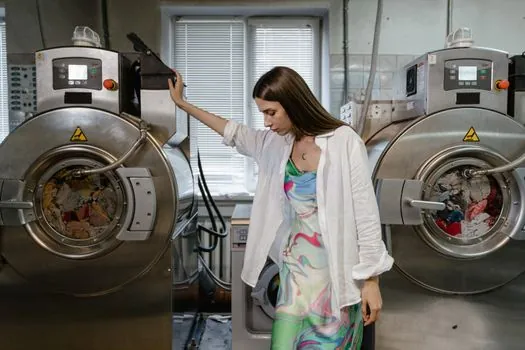
Textile mill drives are specified for continuous S1 duty without stops, with yarn tension accuracy of ±0.5% on warping and sizing machines, ±1% speed-holding accuracy on stenter frames, and IP65 protection against aggressive dye liquors at bath temperatures of 95 to 135°C on dyeing jiggers and jet dyeing machines [S4]. Ex-rated equipment is required at carding and beating stations under Zone 22 textile dust classification, and forced circulation lubrication becomes mandatory above 45 kW on dryer and stenter main drives [S4].
Failure modes specific to textile duty include fiber accumulation around shaft seals, which is why a lint-deflector ring plus FKM (Viton) double-lip seal is now standard on textile-class worm units, and oil-temperature rise above 50°C on continuous duty, which is why helical units on carding and spinning are held to vibration of 20 micrometres or less and maximum oil-temperature rise of 50°C on continuous duty [S2][S3][S5]. A slewing drive on a cloth-pallet turntable inherits the same seal and thermal envelope, and the L10 service life of 35,000 hours at 1.5× service factor matches the 8 to 10 year typical mill operating window [S5].
Limits: When a Slewing Drive Is the Wrong Choice on a Textile Line
A slewing drive is the wrong tool on spinning, carding, weaving, winding, knitting, and stenter main-drive islands, because the duty is continuous S1 at 6,000 to 25,000 rpm on ring and roving spindles, 60,000 to 120,000 rpm on OE rotor spinning, and 400 to 1,100 rpm on loom main shafts with up to 150,000 cycles per shift, which is the wrong regime for an index-and-hold worm architecture [S4]. The same applies to dryer and stenter section drives rated 30 to 250 kW and to dyeing range drives at 75 to 355 kW with IP65 sealing against humidity and aggressive liquors, which is fixed-mount continuous gearmotor territory, not slewing drive territory [S4].
A slewing drive also loses on cost per kW above approximately 7.5 kW, where a continuous helical-bevel K-series gearbox at 30 to 110 kW with a 1.5 service factor and forced-lube oil filtration is the standard stenter-frame drive [S4]. The selection rule is therefore narrow: a slewing drive is specified on a textile line only when the motion is a slow 90-degree index, the load must hold position statically, the envelope is right-angle, and the seal has to keep airborne fiber out of the worm mesh, which describes cloth-pallet turntables, stenter transfer tables, and dye-bath transfer carousels, and nothing else on a 2026 mill floor [S2][S4][S5].
Sourcing and Reference Pages
The textile worm-reducer reference at gearboxesworm.net supplies the ISO 14521 worm gear load capacity methodology, the L10 35,000-hour service-life calculation, and the FKM double-lip seal plus lint-deflector detail that a slewing drive on textile duty must inherit [S5]. The Swiss Drive Systems textile reference supplies the S1 continuous duty envelope, the 95 to 135°C dye-bath thermal limit, the Zone 22 Ex classification at carding and beating stations, and the ±0.5% yarn tension accuracy on warping and sizing that frame any drive on a 2026 mill line [S4].
The KEB Automation overview confirms that a textile machine is dozens or hundreds of synchronized drives on a single frame, which is why the slewing drive appears only on a handful of index nodes, not across the line [S1]. The 2026 helical gear reducer spec map and the 2026 gearbox selection spec map supply the IP54 to IP65 sealing band, the 60 to 78 dB noise ceiling, the 20 arc-minute backlash limit, and the 50°C oil-temperature rise limit that any textile-class drive, including a slewing drive, must respect [S2][S3].
Trackable signals for the next spec cycle: (1) whether mill builders standardize on a 30 mm or 40 mm center-distance slewing drive for cloth-pallet turntables, mirroring the FRV030 NMRV030 envelope now used on winders and small looms [S5]; (2) whether IP66 sealing displaces IP65 on dye-house turntables as humidity envelopes tighten around 95 to 135°C bath temperatures [S4]; (3) whether the 60 dB mill ambient ceiling is pushed down toward 55 dB as ILO occupational health guidance tightens, which would force slewing drive worm finishes from Q7 toward Q6 (DIN 3974) [S5].