
Linear motor modules list on Chinese B2B portals for US$100-10,000 per piece at FOB terms with a 1-piece minimum order, a 100:1 price band that reflects stroke, force and feedback differences rather than uniform list pricing [S4]. Suzhou Ticbel Direct Drive Motor Co., Ltd. quotes that range for its Ironlens series, Precision series, and Industrialforce LMU 50-129 advanced direct-drive motor, all marked at the same published price point but aimed at different duty classes [S4].
Integrated linear motor stages from European OEMs — Steinmeyer Mechatronik's LA85-SM (45 N, 30 mm/s, ±0.6 µm flatness, 25-50 mm stroke) and SINADRIVES' rotary-table combined axis — are positioned as precision assemblies, with the German unit explicitly marketed for "optimum price-performance ratio" at high and low volumes [S1][S2]. M&D (Dalian) separately supplies both LIM (asynchronous) and LSM (synchronous) linear motors as part of a wider motorized roller and EC motor portfolio [S3].
Price Bands by Product Tier
Bench-level iron-core linear motors from Chinese direct-drive motor manufacturers publish a FOB range of US$100-10,000 per piece across catalog entries dated 10 July 2026, with identical ceilings across Economy, Precision and High-Performance SKUs [S4]. In practice, the realized price per piece lands closer to the lower bound for uncooled ironless units sold in single-piece MOQs, and toward the upper bound for water-cooled, encoder-integrated ironcore modules.
For pre-engineered stages, the benchmark is not the motor alone but the integrated axis. The Steinmeyer LA85-SM bundles the linear motor with a positioning system rated for 45 N load, 30 mm/s, and flatness of up to ±0.6 µm — cleanroom- and vacuum-ready — and is explicitly aimed at "large and small series" production [S1]. The SINADRIVES combined linear axis plus rotary table targets standard-precision cell integration, sold through RFQ rather than list [S2]. For motion platforms with cross-roller or linear-bearing guidance, the cost premium versus a standalone motor typically runs 2-5x before the encoder is added — see linear motor and linear bearing for the engineering breakdown.
Spec Drivers Behind the 100:1 Price Spread
Three parameters do most of the work on the price tag: continuous force, peak force, and feedback resolution. The Steinmeyer LA85-SM specifies a 45 N continuous load and a 25-50 mm stroke window with optional linear scale, DC/stepper variants and cleanroom/vacuum options [S1] — that configuration is precision-stage territory and not directly comparable to a bare motor.
For catalog motors, suppliers like M&D distinguish LIM (linear induction motor, asynchronous) from LSM (linear synchronous motor), where the synchronous variant with ironcore or ironless secondary typically costs more at the same force rating because of the magnet track [S3]. Encoder class is the hidden cost driver: an open-loop stepper-driven LA85-SM at 25 mm stroke lists much lower than the same axis with a linear scale option, and adding a vacuum/cleanroom version adds further unit cost [S1]. For a deeper look at how encoder resolution drives total cost, see linear encoder.
Ironcore vs Ironless vs Tubular: Decision Matrix
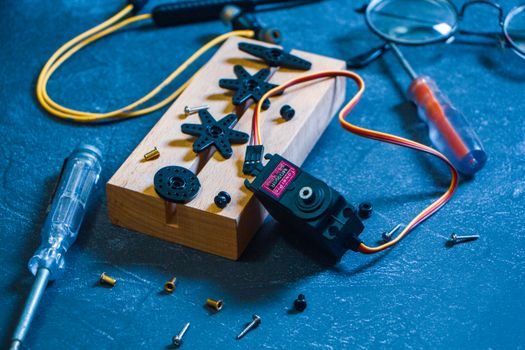
Three topologies dominate the price lists: ironless (U-channel), ironcore (flat primary with magnet track), and tubular. Ironless U-channel designs eliminate cogging and are the default for optical, scanning and laboratory microscope focusing on stages like the LA85-SM [S1]. Ironcore flat motors deliver higher continuous force per dollar but require a magnetic track in the working envelope, which complicates cleanroom and vacuum integration [S3]. Tubular linear motors — visible in profiles like Fuyu's FXZ series on DirectIndustry — are positioned for horizontal profile units and benefit from a sealed forcer, trading peak force for ingress protection [S2].
A decision-maker picking between these should weigh four criteria: (1) force density, where ironcore wins on N/$ at the cost of cogging; (2) cleanroom/vacuum compatibility, where ironless and tubular sit ahead of ironcore with exposed magnet tracks; (3) stroke length, where flat ironcore scales linearly with magnet-track cost while tubular motors use a per-meter rod; (4) integration with linear guides, where crossed-roller guidance is the common match for ironless stages in metrology, and profiled linear rails suit higher-force ironcore cells — the crossed-roller guide reference is the natural read for the latter case. For a sealed-forcer or rod-style option driving a thrust-only load, a linear actuator integration typically absorbs the same motor at lower total cost than a stage.
Who Should Buy a Linear Motor (and Who Shouldn't)
Linear motor-driven stages are the right answer for moves above 1 m/s, accelerations above 1 g, or sub-micrometre repeatability where backlash from a ballscrew or rack-and-pinion cannot be tolerated. The Steinmeyer LA85-SM at ±0.6 µm flatness and 30 mm/s is the low-speed extreme of that envelope — used for sensor and optics focusing where smoothness matters more than velocity [S1]. At the high end, force-controlled direct-drive stages feed semiconductor lithography, FPD inspection and additive-manufacturing printheads, where the absence of mechanical transmission is the procurement rationale.
Buyers who should NOT specify a linear motor first: applications below 0.5 m/s with stroke under 300 mm and positioning tolerance above 5 µm, where a stepper-driven ballscrew or belt axis is typically 3-10x cheaper per unit. Belt-driven profile units from Fuyu (FBL60 series) and isel Germany's ILE 20/20 sit in that space and are routinely quoted as a lower-cost alternative on DirectIndustry product pages [S2]. The same logic applies to applications where the duty cycle is short and idle time dominates — a servomotor with a gearbox often beats a linear motor on TCO at low utilization, similar to the logic in Screw Conveyor TCO: 5 Cost Levers That Beat the Quote Price for mechanical powertrains.
Standards, Sourcing and Supply-Chain Realities
There is no single international standard that fixes linear motor pricing or model nomenclature; the CE marking for European installations, the IEC 60034 series for rotating-machine safety principles that suppliers extend by analogy to linear topologies, and UL listing for North American panel integration are the common compliance gates. Newport (China) lists its linear motor linear translation stages under a dedicated product family, with technical specifications distributed across a downloadable guide — a pattern typical of US-headquartered motion suppliers serving R&D and OEM customers [S5].
On sourcing, the divergence between the Chinese catalog range (US$100-10,000, 1-piece MOQ) [S4] and European stage builders (RFQ-only, no public price, cleanroom/vacuum variants) [S1][S2] is structural: Chinese suppliers expose list pricing because they sell motor kits and bare forcers in volume, while European and Spanish suppliers quote fully integrated axes. For buyers running a 5- or 10-year cost model, the rule of thumb is that the motor itself is typically 30-50% of the integrated stage cost — the rest sits in bearings, encoder, cables, and the cleanroom-ready mechanical frame. Related cost-governance logic for industrial procurement is laid out in VFD-Duty Motor Buying Guide 2026: Spec, Cable and Cost Gates.
Limitations, Failure Modes and Sourcing Risks
Linear motors are not maintenance-free. The exposed magnet track of ironcore designs attracts ferromagnetic contamination — a documented risk in cleanroom and additive-manufacturing cells, which is why the LA85-SM ships a vacuum/cleanroom option and a linear scale option as engineered variants rather than field retrofits [S1]. Cable flex life is the second failure mode: in high-acceleration pick-and-place, the forcer-to-amplifier cable is the planned replacement part, with a typical service interval one to three years depending on bend radius.
On pricing risk, a 100:1 published band [S4] means a buyer who specs from the catalog header alone will over-provision on force and under-provision on feedback. The mitigation is a fixed RFQ with a written spec — stroke, peak/continuous force, encoder resolution, IP class, cleanroom class, cable exit, and amplifier match — and a 2-3 supplier comparison. The published Alibaba-style FOB numbers do not include delivery, customs duty, encoder option premiums, or cleanroom testing, all of which add 15-40% to the headline figure.
Two signals worth tracking over the next 1-2 quarters: (1) whether Chinese direct-drive motor suppliers split the current US$100-10,000 single-band listing into tiered price rows for ironless versus ironcore versus encoder-integrated SKUs — the current single-band practice is unusual for B2B catalogs and may be a placeholder [S4]; (2) whether European stage builders begin publishing indicative price bands for the LA85-SM-class product, in line with how SINADRIVES and Fuyu already expose entry-level product pricing on DirectIndustry [S1][S2]. The first will sharpen the cost-engineering baseline; the second will compress RFQ lead times for buyers comparing EU and CN supply.