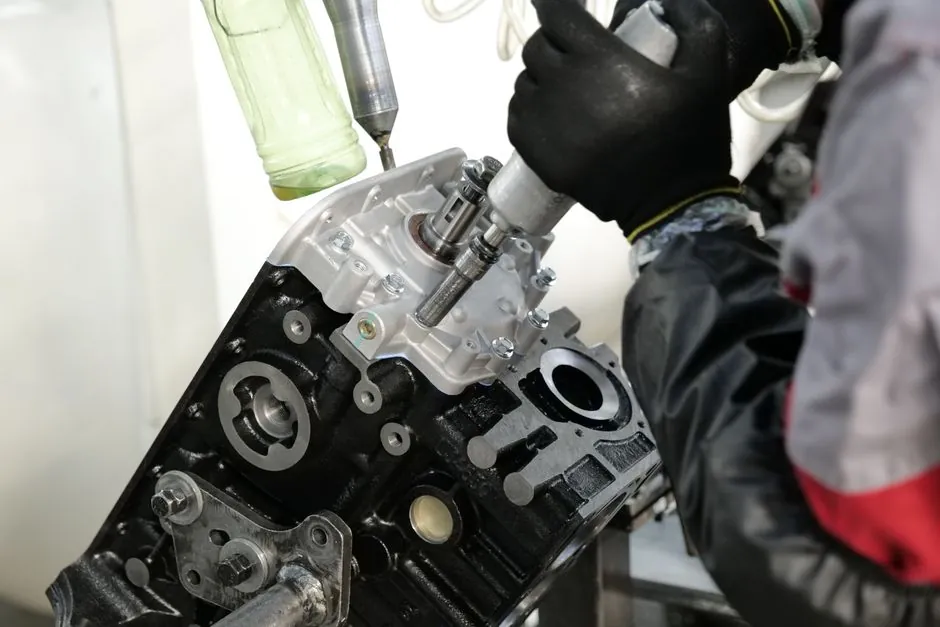
Direct drive linear motors are built as either iron-core, ironless, or tubular topologies, with continuous force in supplier catalogues spanning roughly 24 N to 2,520 N and peak force reaching 7,560 N, based on product pages from Smartwin [S4], KML [S2], and Kollmorgen [S5].
Suppliers cluster into three groups: European direct-drive specialists (Fischer Elektromotoren, KML, LinMot, Kollmorgen) offering iron-core and ironless flat motors, tubular specialists (LinMot MagSpring-style designs, HansMotor) for compact axes, and Chinese iron-core vendors (Smartwin/Zhiying) competing on thrust-per-cost. For background on the actuator family, see the linear motor reference and its companion linear actuator entry.
Iron-Core Flat Motors: Smartwin CFS/CFW Family
The Smartwin CFS and CFW iron-core flat motor series, published on 2026-07-02 [S4], show continuous thrust of 24–1,322 N across frame widths 35–125 mm (CFS035 to CFS125) and 90–2,520 N in the wider CFW family (CFW030 to CFW135), with peak thrust ratios of roughly 2.2–3.0× continuous. The CFW045 entry, for example, lists continuous thrust 280–560 N and peak thrust 840–1,680 N at 110–560 VDC bus voltage [S4].
Iron-core designs trade zero cogging smoothness for higher force density; the magnetic attractive force between the iron-laminated primary and the magnet track is significant and must be accommodated by the guidance system. Pairing a KML or Smartwin iron-core stage with a precision linear bearing is typical in high-accuracy pick-and-place builds.
Ironless Flat Motors and Modular Stacks: KML and Kollmorgen
KML Linear Motion Technology rates its flat primary/secondary stacks at continuous force 60–2,280 N, peak force 630–6,000 N, intermediate circuit voltage 110–560 VDC, with package widths 50 x 40 mm to 130 x 47 mm and accelerations up to 100 m/s², all stated at ±10% tolerance [S2]. Kollmorgen's DDL (Direct Drive Linear) line covers IC11/IC22/IC33/IC44 coil assemblies in 30–250 mm widths, reflecting the modular iron-core and ironless split the supplier documents in 2D/3D model files [S5].
The structural difference is decisive: an ironless (iron-free) coil has no laminated teeth, so cogging force is near zero, which suits scanning, laser processing, and metrology where nanometre-scale smoothness matters. Iron-core coils, by contrast, push higher continuous force per ampere at the cost of a measurable cogging signature. For related sizing logic that engineers cross-check on VFD-driven lines, see VFD-duty motor sizing: match FLA, overload, and insulation before HP.
Tubular and Stainless Motors: LinMot P-Series
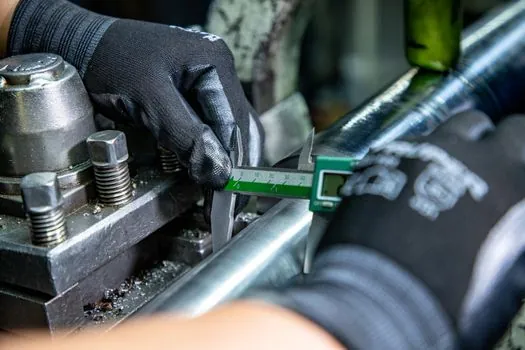
LinMot documents a stainless-steel P01 series alongside the standard P01, P10-54, and P10-70 ironless tubular lines, with a separate P01 ATEX variant for hazardous areas [S3]. The tubular form factor is preferred where IP rating, washdown, or footprint dominate, common in food, pharmaceutical, and semiconductor handling. Force density is lower per unit volume than a flat iron-core stack, but the encapsulated stator makes thermal management simpler.
LinMot pairs the motors with its own DC and AC servo drives and fieldbus interfaces, which is the typical integration model: suppliers rarely sell a linear motor without naming a matched drive. The same modularity argument shows up in linear motor selection: force, cogging, and feedback specs.
Customer-Specific and Encapsulated Designs: Fischer
Fischer Elektromotoren builds customer-specific linear motors with windings laid on a flat track, tested pre-delivery against EN 50178 and EN 60204, with high-voltage, partial discharge, insulation (VDE), pole position, phase resistance, inductance, and EMF measurements as part of the standard QA flow [S1]. The stator excitation is user-specific, and termination can be a plug, open-ended ferrule cable, or a built-in socket, with dual-cable exits for feedback and temperature sensors.
Fischer's "always customer-specific" stance places it as a build-to-print supplier rather than a catalog vendor, which suits small-to-medium OEM runs where KML or Kollmorgen catalog models do not fit a frame constraint. The encapsulation described in the same product narrative also serves as thermal conditioning for water-cooled or heat-sink-mounted builds.
Han's Motor: Linear Stages for Semiconductor and Robotics
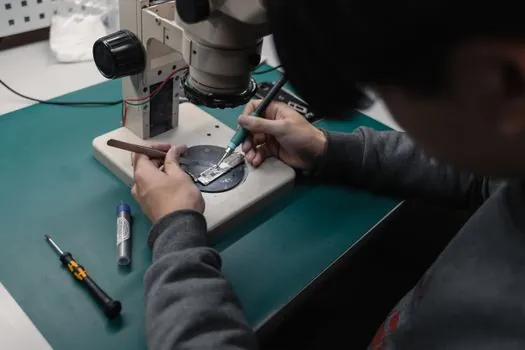
Han's Motor (HansMotor), documented in a 2026-06-29 application note [S7], positions its linear motor stages for semiconductor manufacturing, robotic joints, and medical equipment, including Huawei AI robotics end-effectors. The article frames the motor as a combined measurement-and-control module paired with a control board to reduce cabinet space, a common design target in semiconductor handler retrofit projects.
The supplier focus is integration rather than catalog thrust ranges; an engineer specifying a HansMotor stage typically receives force/acceleration ratings only after the supplier reviews the application envelope. This contrasts with Smartwin or KML, which publish continuous and peak force tables directly on the product page.
Comparison: Topology, Force, and Use-Case Fit
A four-criterion comparison from the suppliers reviewed: (1) Topology, (2) Continuous force range, (3) Peak-to-continuous force ratio, (4) Typical use case. Ironless flat (KML) gives 60–2,280 N continuous, 630–6,000 N peak, 8–10× peak/continuous ratio, ideal for semiconductor and metrology axes where zero cogging is required. Iron-core flat (Smartwin CFS/CFW) gives 24–2,520 N continuous, 53–7,560 N peak, roughly 2.2–3.0× peak/continuous, suited to general automation where higher static stiffness is acceptable. Tubular (LinMot P-series) offers compact encapsulated packages, with ratings defined per model and matched LinMot drives. Customer-specific flat (Fischer) gives bespoke frames meeting EN 60204 and EN 50178, suited to OEM-specific machine builders. [S2]
Topology choice typically reduces to two engineering questions: does the axis need zero cogging, and does the guidance system absorb the iron-core attractive force? Engineers specifying KML or Kollmorgen ironless models for high-precision motion often cross-reference general motion-bearing practice in the linear bearing entry, and confirm bus voltage compatibility with the existing drive.
Selection Criteria, Sourcing Standards, and Failure Modes
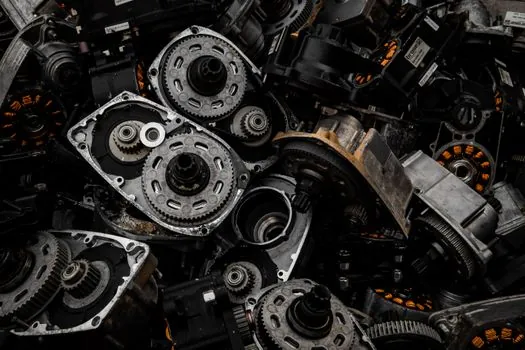
Efficient direct drive linear motor selection, per Smartwin's 2026-07-02 guidance, depends on four factors: force matching to the load inertia and cycle, motion performance (peak velocity and acceleration, often tied to 5 m/s and 10 g targets in catalog flat motors), control system integration (fieldbus, drive topology, feedback resolution), and system-level design (thermal path, cable routing, encoder selection) [S8]. The same article states that "efficiency" in a direct-drive axis is defined by how reliably and consistently the system delivers rated force, not by nameplate watts [S8].
Common failure modes: thermal derating when the heat sink is not kept at 20°C (the KML datasheet is explicitly normalized to that condition) [S2]; cable flexure on long-stroke iron-core machines where the primary part must move; and contamination of ironless air-gap coils by conductive debris, which is why LinMot's stainless and P01 ATEX variants are specified in food and hazardous areas [S3]. Safety-critical testing at the supplier typically follows EN 60204 (electrical equipment of machines) and EN 50178 (power electronic converters), as documented by Fischer [S1].
Two trackable signals to monitor next: (a) supplier publication of standardized ATEX/IECEx-certified linear motor lines beyond LinMot's P01 ATEX, which would expand the catalog for hazardous-area OEM builders, and (b) updates to Kollmorgen's DDL IC-stack widths beyond 250 mm, since catalog coverage currently tops out at the IC44-250 coil assembly per the 2D/3D model index [S5]. Engineers sourcing 2026 builds should request latest datasheet revisions for force-vs-temperature curves, since 24–2,520 N continuous figures in published tables are de-rated as soon as the heat-sink temperature deviates from the 20°C reference condition used in supplier test benches.