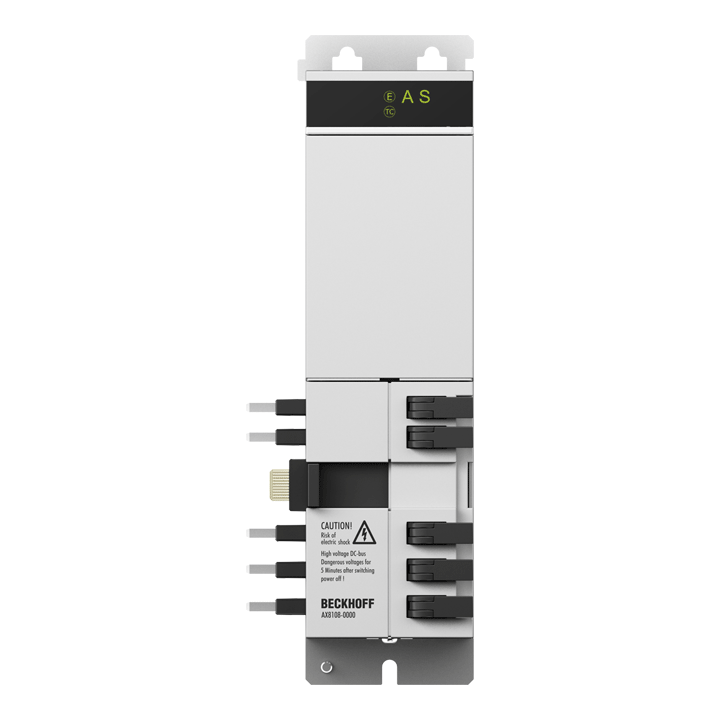
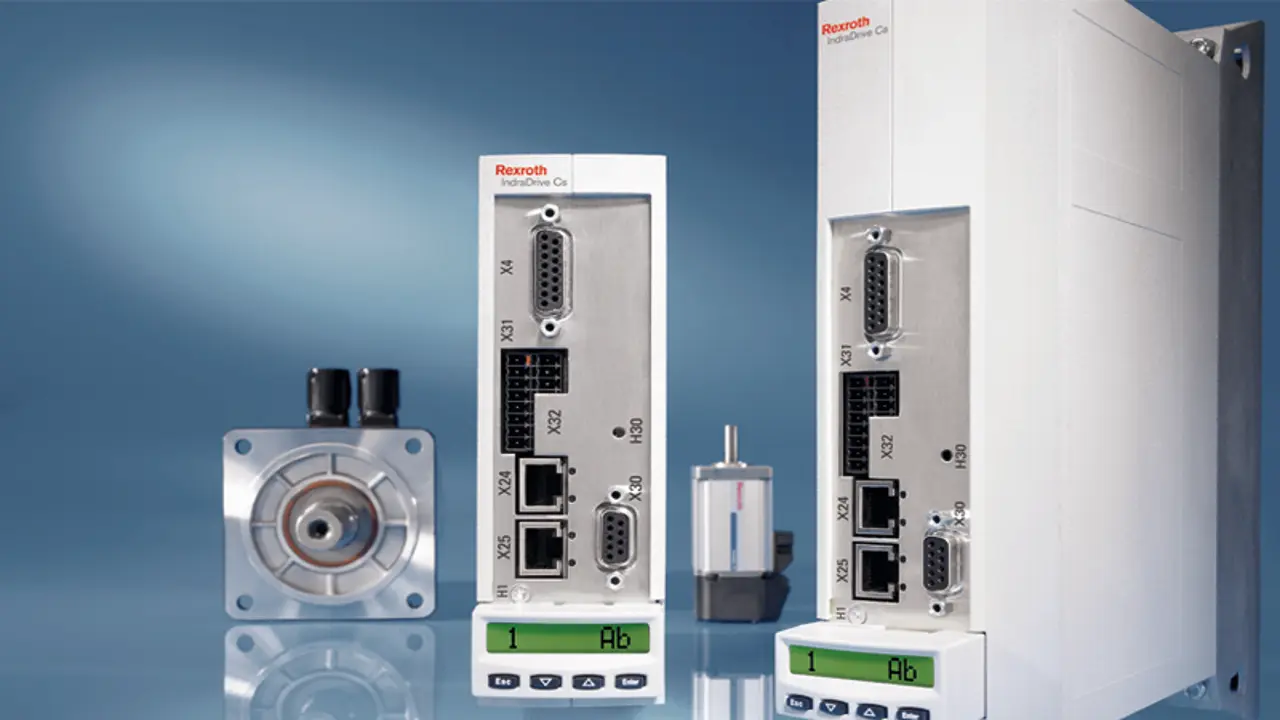
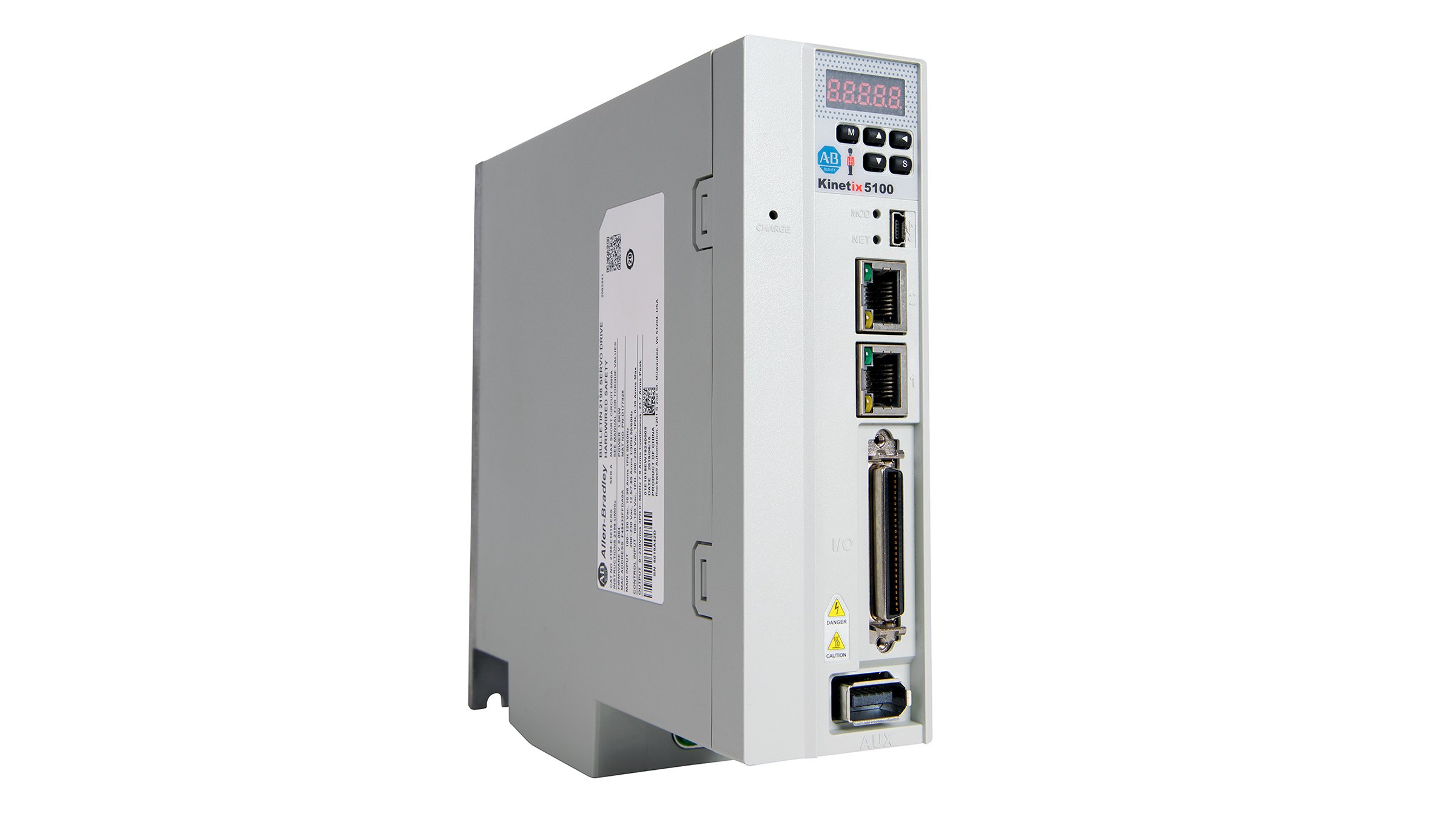
A servo drive, also called a servo amplifier, is the power electronic controller that turns a motion command into the precise current and voltage a servo motor needs to reach a target position, speed, or torque. It is the active half of a closed-loop motion axis: the controller issues a setpoint, the drive commutates the motor and continuously corrects its output using feedback from an encoder or resolver mounted on the motor shaft.
Where a variable frequency drive simply varies the speed of an induction motor, a servo drive closes a high-bandwidth position loop around a permanent-magnet motor, delivering full torque at standstill, rapid acceleration, and repeatable positioning that machine tools, robots, packaging lines, and semiconductor equipment depend on. This guide decodes how the drive works, the device types, the feedback and network interfaces, the power topology, the specification sheet, and the selection logic.
Photo: Steelerdon, CC BY 3.0, via Wikimedia Commons
This guide is written for industrial purchasing engineers and design engineers. It covers 6 chapters from the three nested control loops, drive types, feedback and network interfaces, power topology and braking, to spec-sheet decoding and selection decisions, with 7 FAQs and manufacturer comparisons, so you can build a complete servo-axis knowledge framework in 30 minutes. Parameters and function names reference the IEC 61800 series: IEC 61800-2 (ratings), IEC 61800-3 (EMC), IEC 61800-5-1 (electrical safety), and IEC 61800-5-2 (functional safety: STO, SS1, SS2, SLS), together with ISO 13849-1 for machine safety and the CiA 402 drive profile.
Chapter 1 / 06
What is a Servo Drive
A servo drive is the electronic power converter that sits between a motion controller and a servo motor, supplying the current and voltage required to make the motor follow a commanded position, velocity, or torque. It is one element of a closed-loop control system: the drive measures the motor's actual state through a feedback device, compares it against the command, and corrects its output many thousands of times per second. This continuous correction is what separates a servo axis from a simple open-loop drive, and it is why a servo motor cannot run at all without its matched drive and feedback device.
The defining feature of a servo drive is its three nested control loops, arranged from the inside out as current (torque), velocity, and position. The current loop is the innermost and fastest; it forces the motor's phase current, and therefore its torque, to track the command from the loops above it. The velocity loop wraps around the current loop, comparing commanded speed against speed derived from the feedback device and outputting a torque command. The position loop is the outermost and slowest, comparing commanded position against feedback position and outputting a velocity command. Each loop commands only the loop nested directly inside it, and the inner loop must run substantially faster than the loop around it for the system to stay stable.
To commutate a permanent-magnet synchronous motor, the drive must know the rotor's angular position at every instant, which is why a feedback device (encoder or resolver) is mandatory: the drive uses that angle to orient the stator field correctly, a technique called field-oriented control or vector control. A variable frequency drive on a squirrel-cage induction motor needs no such feedback to run, and this single difference, electronic commutation of a permanent-magnet rotor, is the root of nearly every other distinction between a servo drive and a VFD.
Historically, motion control began with hydraulic and DC servo systems, where a DC motor's brushes provided mechanical commutation and a separate amplifier supplied armature current. The arrival of power transistors and, later, the insulated-gate bipolar transistor (IGBT) made it economical to commutate brushless AC permanent-magnet motors electronically, and modern digital signal processors made it possible to close all three loops in firmware at kilohertz rates. Today the servo drive is a compact digital device combining a rectifier, a DC bus, a transistor inverter, current and position sensing, the control firmware, an industrial-network interface, and increasingly integrated functional-safety hardware.
Four engineering metrics frame servo-drive quality: control-loop bandwidth (how fast the axis responds and settles), continuous and peak output current (how much torque it can sustain and how hard it can accelerate), feedback resolution and protocol (how smoothly and repeatably it positions), and the integrated safety and network features that determine how it fits into a machine. The remainder of this guide treats each in turn so that a procurement engineer can translate a machine requirement into a specific drive model.
Chapter 2 / 06
Drive Types and Classification
Servo drives are classified along several axes: by the motor type they commutate, by the control mode they expose to the controller, by axis count, and by the way the power and feedback wiring is arranged. Mixing up these categories is the most common selection error, because a drive built for one motor family or one command interface will not simply work with another. The table below summarizes the main classifications used in datasheets.
Classification basis
Main variants
Typical use
Motor commutated
Rotary AC PMSM, brushless DC, linear, torque (direct drive)
General machinery, conveyors, gantries, rotary tables
Networked (EtherCAT, PROFINET), step/dir pulse, ±10 V analog
Coordinated motion vs simple standalone axis
Power architecture
Standalone (own rectifier), shared DC-bus modular
One axis vs many axes sharing braking energy
By motor type, the dominant servo motor today is the rotary permanent-magnet synchronous motor (PMSM, often labeled brushless AC servo), and most general-automation drives are built to commutate it. Brushless DC (trapezoidal) variants exist in lower-cost OEM builds. Linear servo drives commutate ironcore or ironless linear motors directly, eliminating the screw or belt for high-speed, high-precision stages. Torque (direct-drive) motors are large-diameter, low-speed PMSMs that drive a rotary table without a gearbox, and they demand a drive with very smooth current control because any current ripple shows up directly as torque ripple at the load.
By control mode, the same drive usually supports all three loops, and a parameter selects which loop receives the external command. In torque (current) mode the controller commands a torque setpoint, useful for tension and force control. In velocity mode the controller commands a speed, common for spindle-like axes and electronic gearing. In position mode the controller commands a target position and the drive closes the full cascade internally, which is the normal mode for indexing and interpolated motion. Networked drives running the CiA 402 profile expose these as standardized operating modes such as cyclic synchronous position, velocity, and torque.
By axis count, a single-axis drive is one self-contained unit per motor, simple to wire and replace. Dual-axis drives, such as Yaskawa's SGD7W two-axis SERVOPACK, control two motors from one housing to save panel width and cost. Multi-axis modular systems use a common line (supply) module feeding several single- or double-axis modules over a shared DC bus, the standard architecture for machines with many coordinated axes, because regenerated braking energy from a decelerating axis can be reused by an accelerating one on the same bus.
By command interface, modern drives prefer a real-time industrial-Ethernet network for coordinated motion, while a standalone axis can still take legacy pulse-and-direction (step/dir) or a plus-or-minus 10 V analog torque or velocity reference. The trend is firmly toward networked drives because the network carries not just the cyclic command but also configuration, diagnostics, and safety data on the same cable, which Chapter 3 examines in detail.
Chapter 3 / 06
Feedback and Network Interfaces
Two interfaces define a servo drive's performance envelope: the feedback interface to the motor, which sets how finely and reliably the drive knows rotor position, and the network interface to the controller, which sets how deterministically the position loop is updated. Both are decided early in a machine design because they constrain the motor, the cabling, and the controller. The table below compares the common feedback devices.
Feedback device
Typical resolution
Power-off memory
Strengths and notes
Resolver
12 to 16 bit/turn
Single-turn only
Rugged, high temperature, shock and radiation tolerant
Restart in place on long travels and vertical axes
The resolver is an electromagnetic sensor with no electronics in the rotor; an excitation winding and two output windings let the drive derive shaft angle from the sine and cosine of the rotor position. Because there are no semiconductors or optics on the rotor it tolerates high temperature, vibration, shock, and radiation, which is why it persists in military, aerospace, and harsh industrial duty. After resolver-to-digital conversion the effective resolution is typically 12 to 16 bits per turn, lower than a modern optical encoder, so low-speed smoothness is more limited.
Incremental optical encoders output quadrature square waves (TTL) or 1 Vpp sine-cosine signals and are inexpensive and high in resolution, but they count pulses from an arbitrary starting point, so the axis loses its absolute position whenever power is removed and must run a homing move at every start-up. Absolute encoders remove that homing move by reporting a unique code for every position. Modern digital absolute encoders use serial protocols such as EnDat 2.2 (Heidenhain), BiSS-C (an open interface from iC-Haus), and HIPERFACE DSL (originated by SICK and later opened for licensing), reaching 22 to 24 bits of single-turn resolution. Multi-turn versions add a revolution counter, commonly 12 to 16 bits of turns, so the machine can restart in place even on a long screw or a vertical lift.
A practical modern feature is the single-cable or one-cable connection, in which the digital absolute-encoder protocol and the motor power share a single hybrid cable, halving the wiring and connector count. Siemens markets this as One Cable Connection on the SINAMICS S210, and HIPERFACE DSL was designed specifically to enable single-cable feedback. Encoder functional, electrical, and environmental requirements are addressed by IEC 61800-5-3.
On the network side, coordinated multi-axis motion needs deterministic, low-jitter cyclic communication so that every axis updates its position loop in lock-step. The table below compares the common real-time buses. EtherCAT, running the CAN-application-over-EtherCAT (CoE) variant of the CiA 402 drive profile, dominates new high-axis-count machines for its distributed-clock synchronization and low hardware cost. PROFINET IRT is common where a Siemens controller is already specified, SERCOS III is established in machine tools, and MECHATROLINK-III is widely used on Yaskawa systems. Slower or lower-axis-count machines still use CANopen (CiA 402), and many drives also accept EtherNet/IP for third-party PLCs.
Network
Typical cycle time
Drive profile
Typical ecosystem
EtherCAT (CoE)
125 us to 1 ms
CiA 402
Beckhoff, Omron, broad multi-vendor
PROFINET IRT
250 us to 1 ms
PROFIdrive
Siemens-led machines
SERCOS III
250 us to 1 ms
SERCOS / CiA 402
Bosch Rexroth, machine tools
MECHATROLINK-III
250 us to 1 ms
MECHATROLINK
Yaskawa systems
CANopen
1 to 10 ms
CiA 402
Low-axis-count, cost-sensitive
Chapter 4 / 06
Power Topology, Braking and Standards
Inside the housing, a servo drive follows a three-stage power chain. Incoming single- or three-phase AC enters a rectifier that converts it to direct current. The DC is smoothed onto a low-impedance internal rail called the DC bus, buffered by electrolytic capacitors. A transistor inverter, built from IGBTs (or MOSFETs at lower voltages and currents), then draws from the bus and synthesizes precise three-phase variable-frequency voltage using pulse-width modulation, commonly space-vector PWM at an 8 to 16 kHz switching frequency. The control firmware orients this output to the rotor angle from the feedback device, the field-oriented control that lets the drive command torque directly.
The DC-bus voltage class follows the supply: a 200 V-class drive runs on roughly 230 V single- or three-phase input and produces a bus near 320 V DC, while a 400 V-class drive runs on 400 to 480 V three-phase and produces a bus near 540 to 680 V DC. The motor's rated voltage must match the class, and the motor's back-EMF at top speed must stay below the bus voltage or the drive will lose current control at high speed.
Braking and regeneration are central to servo sizing. When the motor decelerates a high-inertia load or lowers a vertical axis it acts as a generator and pushes energy back into the DC bus, raising the bus voltage. Left unchecked the drive trips on overvoltage to protect its capacitors and transistors. A brake chopper inside the drive senses the bus and switches a transistor that dumps the surplus energy into an external braking (shunt) resistor as heat. The resistor is sized from the regenerated power and the duty cycle, because its average power rating, not the peak, sets its thermal limit. Machines that brake frequently use a regenerative line module (active front end) that returns the energy to the mains instead of burning it, improving efficiency and removing the resistor's heat from the cabinet, at higher cost.
Functional safety is increasingly integrated rather than wired externally. The relevant standard is IEC 61800-5-2, which defines drive-based safety functions. The table below lists the common ones. Safe Torque Off (STO) is the base function: it hardware-blocks the gate-driver signals so the inverter cannot create torque, through redundant channels, allowing the STO-rated drive to replace the motor contactors that were traditionally wired in. Higher functions, Safe Stop 1 (ramp then STO), Safe Stop 2 (ramp then Safe Operating Stop), Safe Operating Stop (hold at standstill with monitoring), and Safe Limited Speed (trip to STO above a speed limit), all fall back to STO as their final safe state.
Safety function
Abbrev.
Action
Safe Torque Off
STO
Remove torque-producing energy at the gate driver
Safe Stop 1
SS1
Controlled ramp to stop, then activate STO
Safe Stop 2
SS2
Controlled ramp to stop, then hold (SOS)
Safe Operating Stop
SOS
Hold position under monitoring, torque retained
Safe Limited Speed
SLS
Monitor speed below a limit, trip to STO if exceeded
The safety integrity of these functions is rated as SIL 2 or SIL 3 per IEC 61800-5-2 and IEC 61508, or as Performance Level d or e (Category 3 or 4) per ISO 13849-1; a fully redundant, self-monitoring safety path is required to reach SIL 3 or PL e. Beyond safety, a complete servo drive carries electrical-safety approval to IEC 61800-5-1 and electromagnetic-compatibility compliance to IEC 61800-3, the latter classifying the drive into environment categories (for example C1 to C3) according to where it may be installed and the filtering it requires.
Chapter 5 / 06
Key Specification Parameters
Reading a servo-drive datasheet is a core purchasing skill, because two drives of the same nameplate kilowatt rating can behave very differently in a fast motion profile. A drive may list dozens of parameters, but a manageable set truly drives selection: input supply and bus class, continuous and peak output current, control-loop bandwidth, feedback interface, command and network interface, switching frequency, braking capability, and the safety and environmental ratings. Each is explained below.
Input supply and bus class set what mains the drive accepts and what motor voltage it pairs with: typically 200 V-class (single- or three-phase 230 V) for small axes and 400 V-class (three-phase 400 to 480 V) for larger ones. As a real-world reference, the Siemens SINAMICS S210 spans roughly 0.05 to 0.75 kW on 1AC 230 V and up to about 7 kW on 3AC 400 V, illustrating how one product family is split across both classes.
Continuous and peak output current are the two numbers that matter most, and they should be matched to the motor's continuous and peak currents rather than to rated power alone. The continuous (rated) current sets the torque the axis can hold indefinitely; the peak current sets how hard it can accelerate, commonly 2 to 3.5 times the rated current for a short overload window of a few seconds. A drive whose peak current cannot cover the move profile's acceleration torque will current-limit and the axis will fall behind its commanded path.
Control-loop bandwidth quantifies responsiveness. The current loop is the fastest, often quoted at a 2 to 4 kHz bandwidth; the velocity loop reaches several hundred hertz to a few kilohertz on high-end drives (Yaskawa cites a 3.1 kHz speed-loop bandwidth for the Sigma-7 family); the position loop is slower still. Higher bandwidth means faster settling and stiffer disturbance rejection, but it also demands higher feedback resolution and a clean mechanical transmission, since backlash and compliance limit how aggressively the loops can be tuned.
Switching frequency, commonly 8 to 16 kHz, trades off current-ripple smoothness and audible noise against transistor switching losses; higher frequencies smooth low-speed motion but derate the drive's current. Feedback interface must match the motor's encoder or resolver protocol exactly (EnDat 2.2, BiSS-C, HIPERFACE DSL, resolver, or incremental), and modern absolute encoders reach 22 to 24 bits of single-turn resolution. Command and network interface determines integration: networked drives carry the standardized output modes below.
EtherCAT (CoE, CiA 402): deterministic cyclic motion with distributed-clock sync; dominant on new high-axis-count machines.
PROFINET IRT (PROFIdrive): real-time motion in a Siemens-led control architecture.
SERCOS III / MECHATROLINK-III: established machine-tool and Yaskawa motion buses.
Step/dir pulse or ±10 V analog: legacy standalone single-axis command for simple retrofits.
Braking capability covers the internal brake-chopper rating, whether an external braking resistor is required, and whether a regenerative line module is available for high-duty machines. Safety and environmental ratings close the sheet: integrated STO and higher functions to IEC 61800-5-2 with their SIL or Performance Level, electrical safety to IEC 61800-5-1, EMC category to IEC 61800-3, enclosure protection (commonly IP20 for panel-mount drives), and the rated ambient temperature with its derating curve.
Chapter 6 / 06
Selection Decision Factors
To translate the preceding five chapters into a specific model, follow the decision sequence below. Most selection mistakes come not from a single wrong number but from deciding the network or the motor before the load and move profile are understood. These eight steps can serve as a fixed RFQ template for a servo axis.
Define the load and move profile first: reflected inertia, peak and RMS torque, top speed, acceleration time, and required positioning accuracy and settling time. Everything downstream sizes from these numbers, so resolve them before touching a catalog.
Select the motor, then the drive to match it: the drive continuous current must meet the motor rated current, the drive peak current must cover the acceleration torque (commonly 2 to 3.5x rated), and the bus voltage class must match the motor voltage so back-EMF at top speed stays below the bus.
Verify thermal duty on RMS, not peak: compute the duty-cycle RMS current and keep it within the drive's continuous rating, applying any switching-frequency and ambient-temperature derating from the datasheet curve.
Choose the feedback interface: absolute multi-turn for vertical and long-travel axes that must restart in place, resolver for extreme environments, incremental only where cost dominates and a homing move is acceptable. The motor and drive must share the same protocol.
Choose the command and network interface: a deterministic bus (EtherCAT, PROFINET IRT, SERCOS III, MECHATROLINK-III) for coordinated multi-axis motion; CANopen or step/dir or analog only for a simple standalone axis. Confirm the drive profile (CiA 402 or PROFIdrive) matches the controller.
Size braking and the DC-bus architecture: calculate regenerated energy from deceleration and any vertical lowering, then specify the brake-chopper rating and external resistor, or a regenerative line module and shared DC bus for high-duty or multi-axis machines.
Specify safety and certification: the required STO and higher functions (SS1, SS2, SOS, SLS) with their SIL or Performance Level per IEC 61800-5-2 and ISO 13849-1, plus electrical safety (IEC 61800-5-1), EMC category (IEC 61800-3), and any regional approvals (CE, UL).
Total cost of ownership (TCO): drive plus motor plus cabling, commissioning time, and the cost of spares and downtime. A networked single-cable system costs more per unit but cuts wiring, commissioning, and diagnostic time across the machine's life.
One last commonly overlooked dimension is manufacturer serviceability: local engineering support for tuning, availability of replacement drives that auto-load parameters from the network so an axis can be swapped without a laptop, firmware update path, and spare-part lead time. These matter little at purchase but determine repair response after years of production. Siemens (SINAMICS S210), Yaskawa (Sigma-7 SGD7S and SGD7W), Mitsubishi (MELSERVO MR-J5), Rockwell (Kinetix), Bosch Rexroth (IndraDrive), Beckhoff (AX8000), Omron (1S-series), Kollmorgen (AKD), and Elmo Motion Control all maintain regional engineering and stock, while Inovance, Estun, and Leadshine cover cost-sensitive volume machinery, increasingly with EtherCAT and CiA 402 support.
FAQ
What is the difference between a servo drive and a VFD?
Both are power electronic converters that reconstruct variable-frequency three-phase voltage, but the servo drive closes a high-bandwidth position loop around a feedback device and is built for fast, precise point-to-point moves on a permanent-magnet motor. A VFD (variable frequency drive) is optimized for steady or gently varying speed on a squirrel-cage induction motor and usually runs open-loop V/f or sensorless vector control. Servo current-loop bandwidth typically reaches 2 to 4 kHz and velocity-loop bandwidth several hundred hertz, while a standard VFD velocity loop is an order of magnitude slower. A servo drive cannot commutate a permanent-magnet motor without an encoder or resolver, whereas a VFD runs without any feedback device. Practical rule: if the application demands accurate position, fast settling, or full torque at zero speed, use a servo drive; if it only needs adjustable speed on a fan, pump, or conveyor, a VFD is cheaper and sufficient.
How do the three control loops (current, velocity, position) work together?
A servo drive nests three feedback loops. The innermost current (torque) loop is the fastest, often running at a 2 to 4 kHz bandwidth with a PWM switching frequency of 8 to 16 kHz; it forces the motor phase current, and therefore torque, to match the command from the outer loops. The velocity loop sits in the middle: it compares commanded speed against the speed derived from the feedback device and outputs a current (torque) command. The position loop is outermost and slowest: it compares the commanded position against feedback position and outputs a velocity command. Each loop only commands the loop directly inside it, and stable tuning requires the inner loop to be roughly 5 to 10 times faster than the loop wrapped around it. Setting torque, velocity, or position mode simply chooses which loop accepts the external command.
Which feedback device should I choose: resolver, incremental encoder, or absolute encoder?
A resolver is a rugged electromagnetic sensor with no electronics in the rotor, tolerating high temperature, shock, and radiation; resolution after digital conversion is typically 12 to 16 bits per turn, which suits harsh or military duty but limits smoothness at low speed. An incremental optical encoder (TTL or 1 Vpp sine-cosine) is inexpensive and high-resolution but loses position on power-off and needs a homing move at every start-up. A single-turn or multi-turn absolute encoder with a digital protocol (EnDat 2.2, BiSS-C, HIPERFACE DSL) retains position through power cycles, removing the homing move; modern absolute encoders reach 22 to 24 bits single-turn resolution with up to 12 to 16 bits of multi-turn count. Choose absolute for vertical axes, robots, and any machine that must restart in place; resolver for extreme environments; incremental only where cost dominates and homing is acceptable.
What is Safe Torque Off (STO) and why does it matter for servo drives?
Safe Torque Off is the most basic drive-integrated safety function defined in IEC 61800-5-2. STO removes the energy that creates torque by hardware-blocking the gate-driver signals to the power transistors, so the motor cannot produce a turning force even though the drive remains powered and communicating. Because it acts at the gate driver through redundant channels, an STO-rated drive can replace the contactors that were traditionally wired between the drive and motor, saving panel space and wiring. A properly certified servo drive achieves SIL 3 per IEC 61800-5-2 and IEC 61508, or Performance Level e (Category 3 or 4) per ISO 13849-1, with the internal safety path fully redundant and self-monitoring. Higher functions such as Safe Stop 1, Safe Stop 2, and Safe Limited Speed all fall back to STO as their final state.
How do I size a servo drive to its motor?
Match the drive to the motor on three currents, not just rated power. First, the drive continuous output current must equal or exceed the motor rated (continuous) current at the working bus voltage. Second, the drive peak current must cover the highest torque transient in the move profile, commonly 2 to 3.5 times the rated current for acceleration; a drive that cannot deliver the peak will current-limit and the axis will lose its move. Third, check the bus voltage class (typically 230 V single or three-phase for 200 V-class motors, 400 to 480 V three-phase for 400 V-class) so the motor back-EMF at top speed stays below the rated bus. Then verify thermal duty against the RMS current of the actual duty cycle, not the peak, and size any external braking resistor for the regenerated energy of deceleration and vertical lowering. Always confirm the motor and drive share a compatible feedback interface.
What industrial network should I run to the servo drive?
For coordinated multi-axis motion, a real-time industrial Ethernet bus is standard: EtherCAT (CoE with the CiA 402 drive profile), SERCOS III, PROFINET IRT, and MECHATROLINK-III all provide deterministic, low-jitter cyclic updates down to 125 microseconds to 1 millisecond, which the position loop needs for synchronized interpolation. EtherCAT dominates new high-axis-count machines because of its distributed-clock synchronization and low hardware cost; PROFINET is common where a Siemens controller already exists; CANopen (CiA 402) remains practical for slower, lower-axis-count machines. Many modern drives also accept EtherNet/IP for third-party PLCs. For a single standalone axis you can still use pulse-and-direction (step/dir) or an analog plus-or-minus 10 V torque or velocity command, but new designs increasingly prefer a networked profile for diagnostics and remote configuration.
Why does a servo drive need a braking resistor or regenerative unit?
When a servo motor decelerates a high-inertia load or lowers a vertical axis, it acts as a generator and pumps energy back into the drive's DC bus, raising the bus voltage. If the bus rises past a safe threshold the drive trips on overvoltage to protect its capacitors and transistors. A brake chopper inside the drive senses the bus voltage and switches a transistor that dumps the surplus energy into an external braking (shunt) resistor as heat, holding the bus in range. Size the resistor from the regenerated power and the duty cycle, not just the peak, because the resistor's average power rating sets its thermal limit. For machines that brake frequently, a regenerative (active front end) line module returns the energy to the mains instead of burning it, improving efficiency and removing the resistor's heat from the cabinet, at higher unit cost.
Servo Drive Manufacturers
Source-backed product routes. Open a company dossier for procurement scope and cited evidence.