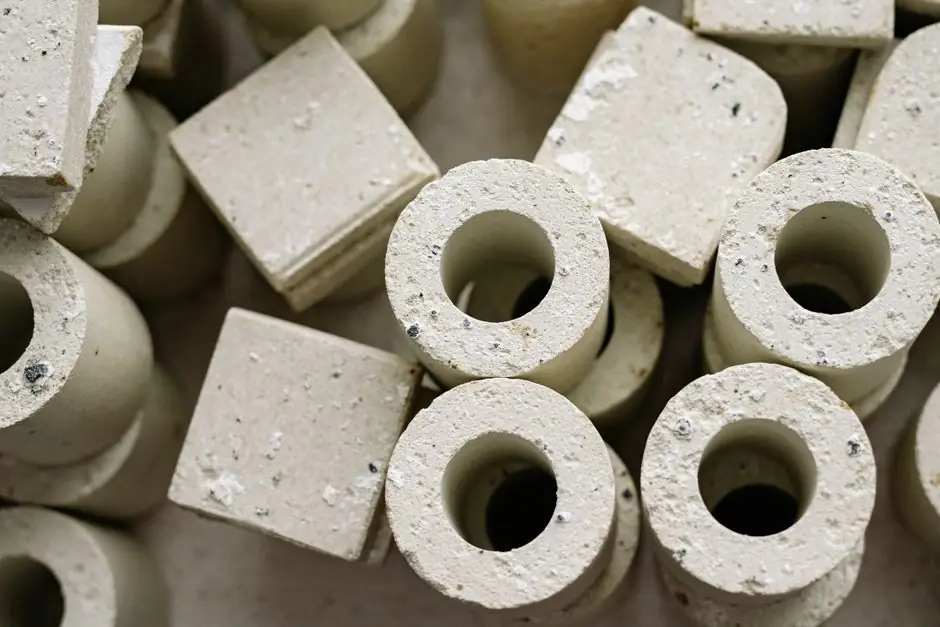
Loam molding is a one-off, sweep-pattern sand process for very large castings such as bronze bells, large cylinders, and round-bottomed kettles, where conventional molding line tooling cannot deliver an economical flask [S1][S2].
The loam itself is a paste of sand, water, and a high clay fraction, sometimes blended with horse dung, animal hair, straw, or coke to keep the mold permeable to steam and gas during pour [S1][S3].
What the loam mix actually is and why each additive is there
Loam (pronounced "low-m") is defined as a mixture of sand and clay with water, with optional horse dung valued specifically for its straw content [S1]. The base recipe is roughly a sand-and-clay paste in a workable, plaster-like consistency, with the clay fraction deliberately high so the wet mold holds its shape on a vertical brick surface without a flask [S2].
Organic additives are not decorative: dung, hair, straw, and coke are burned out during the mold-firing step, leaving a microporous network that lets steam and trapped air escape when molten bronze or iron enters the cavity [S1]. Without that permeability, a thick loam wall would blow out or crack from internal steam pressure, a failure mode bell founders have managed for centuries by controlling organic loading rather than by adding vents [S3].
The material therefore sits between green-sand molding and true ceramic-shell work: bonded by clay and sintered in place, not by chemical curing like an automatic molding line resin-bonded sand [S2].
Step-by-step: how a bell mold is actually built
The standard sequence starts with a rough brick skeleton, not a wooden pattern, because no full pattern exists for a 5-ton bell [S2]. A sweep pattern (a strickle board revolved on a spindle) is then used to true the loam against the brickwork to the required contour of the bell's inner or outer surface [S1][S2].
For bells specifically, the inner mold (the core that shapes the sound bow) is built first from brick and molding sand, then a "false bell" of clay is made to occupy the volume the real bell will fill; inscriptions and the founder's mark are struck into that false bell before the outer mold is laid up [S4]. An iron cage is then added externally to resist the buoyancy of the molten charge, after which the outer mold is lifted, the false bell broken out, and the two mold halves cleaned and sealed together for pouring [S4].
For cylindrically symmetrical work such as cannon or steam-engine cylinders, a straw rope is wound on the spindle, coated in friable material to the exterior profile, and the strickle is rotated to enforce a true cylinder before decorative trunnion models and the loam layer go on [S1]. In every case the assembled mold is then dried or fired before the straw rope is pulled, leaving the cavity for the casting [S1].
Metallurgy, pouring temperature, and the slow-cool regime
Large bells are cast in bronze, nominally four parts copper to one part tin by composition, with smaller bells carrying a slightly higher tin fraction to sharpen the upper partials [S4]. The charge is heated to roughly 2,000 degrees F (about 1,093 degrees C) before pouring into the assembled mold [S4].
Once filled, the mold is buried in a casting pit so the casting cools slowly and evenly for up to three weeks, a controlled cooldown that avoids thermal shock across a wall section that can exceed 100 mm in heavy tower bells [S4]. Cooling rate also drives the as-cast grain structure of the bronze, which is why foundries resist shortcuts such as forced-air cooling even on smaller bells.
Cast iron and bronze cannon historically followed the same loam route, and the same recipe family is documented for large cylinders of steam engines; cannon founding is now defunct, but the large-cylinder application persists in heavy chemical-pan and gear-blank work [S1][S2].
Where loam molding wins, and where it does not
Loam molding is the right answer when the casting is too large for a wooden pattern and flask set, when only one or a few pieces are needed, and when surface finish and dimensional tolerance can be sacrificed for sound and structural integrity [S2]. It also allows cores to be made in the same process, which simplifies very large hollow shapes that would otherwise need dry-sand core handling.
It is the wrong answer for high-volume runs, tight dimensional tolerances, thin sections, or any casting where a modern molding line with reusable flasks would amortize its pattern cost across hundreds of pours. The process is labor-intensive, weather-sensitive (loam hates freezing during drying), and offers limited geometric complexity compared with resin-bonded sands or investment casting.
For comparison, the main large-casting routes line up roughly as: loam molding for one-off bells, kettles, and large cylinders (low pattern cost, long lead time, single-piece focus); green-sand floor molding for medium heavy castings where a wooden pattern is still feasible; and resin-bonded molding line work for high-mix production at the upper end of flask size. A useful related reference for picking die-grade tooling for any sand-mold hardware (cores, boxes, strickle arms) is the grade selection logic in H13 vs H11 tool steel specification for casting molds.
Standards, sourcing, and what to ask a bell foundry

There is no single ISO or ASTM standard that prescribes a bell bronze composition or a loam recipe; the four-to-one copper-tin nominal is a long-standing foundry convention rather than a codified requirement [S4]. What an engineer should pin down with the foundry before release is: target bronze composition and any impurity caps (especially for church and carillon bells that must sound specific partials), required wall-section uniformity after tuning, maximum acceptable defect type and size per a foundry inspection standard, and the cooling-pit protocol that will be used.
Tolerance after tuning is a moving target: cast bells are intentionally poured slightly thick so a tuner can machine the inside on a lathe or boring mill until the strike note lands at the right pitch, which means the as-cast drawing is a starting point, not a final dimension [S4]. The process is also inherently artisan, with the National Bell Festival noting that bellmakers follow methods broadly similar to those used a thousand years ago, with each foundry applying its own stylistic and procedural variations [S3].
For process engineers mapping loam molding to modern flow lines, the practical takeaway is that it remains a viable, low-capex route for very large symmetrical castings; for everything else, conventional molding tooling outranks it on cycle time, repeatability, and tolerance.
Trackable signals: foundry-level announcements on new bell commissions (the National Bell Festival page lists active commissions such as the Emancipation Bells and the U.S. Semiquincentennial bell), and any technical paper from bell founders such as Taylors of Loughborough that revises loam recipes or firing schedules [S1][S3].