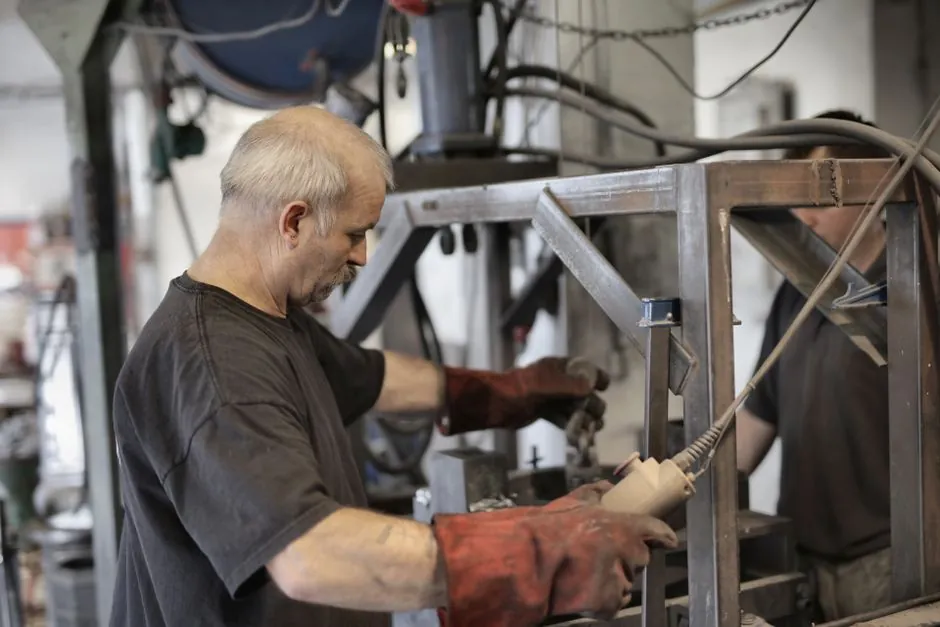
Integrating a shot blasting machine with the trim press of a die casting cell is a one-robot, one-fixture way to consolidate deburr, flash shear, and surface prep, with cycle-time and labour savings of 50–60% reported on automated aluminum cells [S2].
Reference cells in 2025–2026 use a cold-chamber aluminum die casting machine, a hydraulic 3- or 4-column trim press up to 150 t closing force, a tumble wash with ceramic media for burr knock-off, and an abrasive blast cabinet fed by overhead conveyor [S1][S2][S4].
Cell Layout: From Casting to Packaged Part in One Flow
A reference cold-chamber aluminum cell runs the casting robot, quench tank, dryer, trim press, CNC mill, tumble wash, and final conveyor under one supervisory controller, with the biscuit and overflows returned to the furnace for re-melt and external recycling of the balance scrap [S2].
Dynacast's Lake Forest cell tracks part count, yield, and conveyor status on a dashboard viewable from a phone, and the project document explicitly states a 60% cost reduction versus a batch-style decoupled line, achieved by removing the CNC operator, the wash loader, and the wash unloader [S2]. Acme Alliance operates 19 high-pressure die casting machines with locking force up to 1000 metric tons, each equipped with automated ladling, robotic spray and extraction, and a program-specific automated trim press, so the trim-and-blast step is engineered per program rather than shared [S1].
Trim Press Sizing and Robotic Hand-Off
Hydraulic 3- or 4-column trim presses are the standard workhorse for aluminum, magnesium, and zinc die castings, with commercial series topping out at 150 t closing force for deburring operations [S4].
The hand-off is straightforward on an automated cell: the extractor robot places the as-cast shot directly on the lower die of the trim press, the press cycles automatically, and the casting is removed by the same or a downstream robot, while a chute below the press segregates chips and circulation material for remelt [S4][S5]. Modern trim press controls expose a robot interface, side-cylinder controls, ejection devices, and tool-lube and inspection peripherals, allowing the press to act as a node on a higher-level cell or master-computer bus rather than a stand-alone station [S4]. The same robot-to-press interface pattern is documented in Zinc Die Casting's engineering properties, where the extractor robot places the extracted shot on the press trim tool and the press is started automatically on every cycle [S5].
Why Shot Blasting Sits After the Trim Press, Not Before

Sequencing shot blasting after press trimming is the dominant pattern, because the trim die shears gates, overflows, and flash in one stroke and the abrasive blast only has to handle the remaining parting-line witness, oxide scale, and quench residue [S5].
Removing the heavy gates and biscuit first means the blast cabinet sees a smaller, lighter workpiece, the abrasive cut wire or steel shot stays on size longer, and downstream filtration does not have to cope with slug-shaped trim scrap. The Rosler reference die-cast shot blasting machine, for example, includes a special screening system to remove flashes from the blast media, a feature only sensible on a cell where flashes have already been sheared off and a residual amount still reaches the wheel [S7]. Hypertherm's automotive cast-trimming plasma cell packages the same logic in a different medium: integrate the cut into the robotic cell so the cast part never sits in a queue between casting and finishing [S3].
Media, Cabinet, and Conveyor Choices for the Blast Station
Cut wire, steel shot, and ceramic media are the three abrasive families seen in cast-cell blast cabinets, with media selection driven by the surface-finish target, the alloy, and whether burr removal or scale removal is the dominant duty [S6][S7].
For an aluminum cell aimed at cosmetic or near-cosmetic surfaces, ceramic media in a tumble wash is commonly specified for the burr knock-off step, and a wheel-blast cabinet with steel shot is added downstream for uniform surface texture [S2]. Rosler's die-cast blast machine uses a flash-screening system on the media return conveyor, sized to the typical flash chip generated after a press trim, so the abrasive stays in spec across a full shift [S7]. The Transmet guidance is to keep shot blasting in-house on a cast cell rather than outsourcing it, because the cell owner controls media life, dust collection, and maintenance intervals directly, and the per-part cost is lower than a contract finisher once volume crosses a few thousand pieces per month [S6].
Cycle-Time and Labour Math for an Integrated Cell
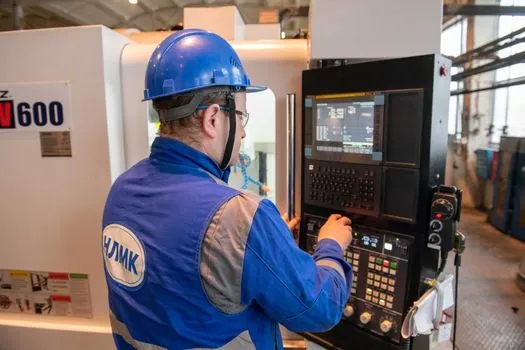
A continuously-flowing cast-trim-blast cell typically retains one operator only at the packaging station at the end of the line, because every intermediate hand-off is robotic [S2].
Dynacast's documented cell drops three job roles (CNC operator, wash loader, wash unloader) by replacing the inter-station queues with conveyors and robots, and reports a 60% cost reduction against the equivalent batch line; the same cell tracks yield and downtime live so any station drift surfaces within one cycle [S2]. Acme Alliance applies the same logic across 19 high-pressure machines and reports repeatable dimensional performance and stable cycle parameters as the main engineering gains, with safety improved because manual handling of hot castings between press and blast is eliminated [S1]. For plants evaluating the move, the break-even is tied to annual volume and program mix: a high-mix job shop rarely justifies a fully integrated cell, while a dedicated program at sustained tonnage recovers the cell capital quickly through the labour and queue reductions alone [S1][S2].
Failure Modes, Constraints, and What the Cell Does Not Fix
Press trimming is a metal-shearing operation, so the casting needs enough strength and rigidity to survive the punch load without deforming, and the trim die typically costs around 10% of the associated die cost, which is small enough to keep the cell economics intact even when the trim station is dedicated [S5].
Where the trim press leaves a thin parting-line witness, or where the casting has critical cosmetic surfaces, the blast cabinet has to do more work and the dust collection has more load, so a poorly designed gate or an irregular parting line shifts cost from the press to the blaster and from the blaster to manual fettling [S5]. Robotic extraction also constrains the cell: the extractor robot has to reach the lower die, the press opening height has to clear the part on the exit conveyor, and the blast cabinet's conveyor has to accept the same part presentation that the trim press delivers, otherwise an extra reorient station slips into the line and erases the labour saving [S4]. The other constraint is media contamination: the screening system on the blast machine has to be sized for the actual flash chip after the trim press, not for general shop flash, otherwise cut wire rounds over and surface finish drifts shift by shift [S7].
Standards, Sourcing, and Selection Cues

Cell builders typically match press tonnage to the projected flash area (rule-of-thumb 3–5 t per square inch of trim, applied conservatively on thin-walled aluminum castings), and the 150 t upper bound on commercial trim-press series cited by Foundry-Lexicon is the practical ceiling for most die casting deburring work [S4].
On the blast side, the engineering decision is in-house versus outsourced, and the consensus is that in-house shot blasting pays off above a few thousand parts per month because media life, dust collection, and uptime become controllable process variables rather than service-contract line items [S6]. Trim die cost at roughly 10% of die cost, and the availability of multi-stage trim dies that eliminate downstream fettling, are the two financial levers that decide whether the cell needs a separate blast station or whether a tumble wash with ceramic media alone is enough [S5]. For a broader view of how gravity die casting machine cells solve the same hand-off problem with a different metal-shear arrangement, the comparison in Hydraulic vs Pneumatic vs Manual Die Operation on Gravity Die Casting Machines is a useful cross-reference, while Hot Box vs Cold Box Core Shooter: Tooling Cost Compared covers the upstream tooling-cost logic that gates the whole cell ROI.
Track the next node by watching (a) whether trim press builders extend robot-interface options into Ethernet/IP or PROFINET cell buses, and (b) whether blast machine builders offer flash-screening as a standard option rather than a custom add-on, since both moves would lower the integration cost for new cells in 2026–2027.