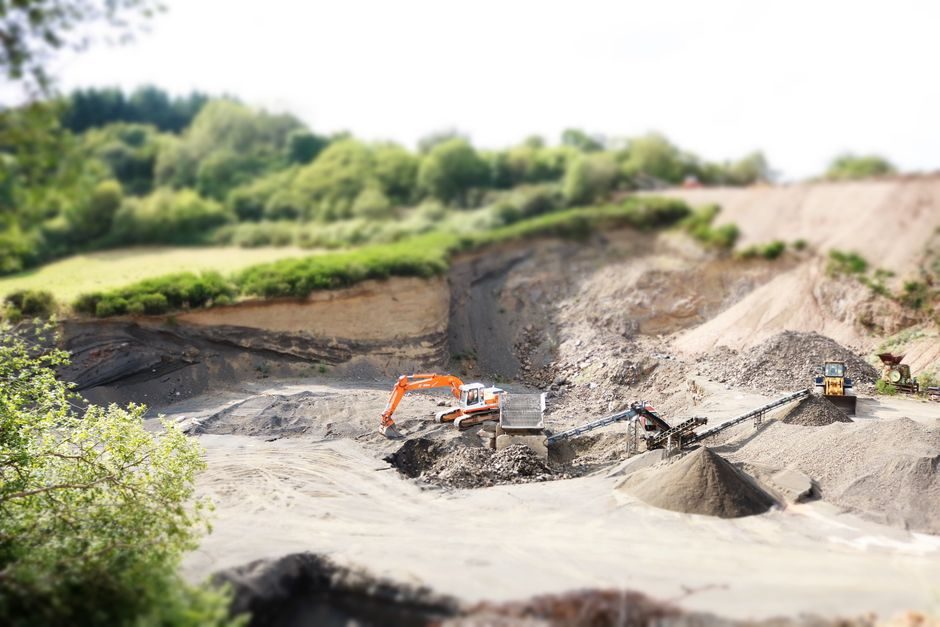
The Cat 352 LRE pairs an 11.5 m (37 ft 9 in) LRE boom with an 8.5 m (27 ft 11 in) stick to hit 13,040 mm (42.8 ft) maximum digging depth and roughly 19.6 m (64 ft) horizontal reach, riding on a 12.0 mt (26,455 lb) counterweight with variable-gauge high/wide undercarriage [S3][S4].
Across the LRE class, operating weight spans 48–58 t, net power runs 170–449 hp, and the longest-frond models from Komatsu reach 17.2 m (56 ft 7 in) dumping height on the PC360LC-10 Super Long Front arm [S7][S9]. Selection is therefore less about "more reach = better" and more about matching boom length, stick tip radius, undercarriage gauge and hydraulic pressure to the cycle.
Define the LRE envelope before chasing max-reach numbers
The Cat 340 LRE hits 13.04 m (42.8 ft) maximum digging depth at 96,500 lb (43.8 t) operating weight, a different carrier class than the heavier 352 LRE at 128,100 lb (58.1 t) with the same published dig depth [S3][S10].
On Komatsu's Super Long Front line, the PC210LC-10 reaches 13,564 mm (44 ft 6 in) max digging height and 11,836 mm (38 ft 10 in) max dumping height with the long arm, while the PC360LC-10 pushes dumping height to 15,545 mm (51 ft 0 in) and digging height to 17,247 mm (56 ft 7 in) — the same model code carries very different envelopes depending on arm selection [S7]. Hyundai's HX220A LR sits at the lower end with 56,040 lb operating weight, 0.68 yd³ standard bucket and 170 hp (Cummins) [S9].
A useful working definition: LRE = base carrier + extended boom + extended stick + often a high/wide undercarriage + extra counterweight + lift-mode hydraulic pressure up-rating. If a quote omits any of those, you are looking at a standard arm, not a true LRE.
Selection criteria that actually change productivity
Four criteria dominate the buying decision once reach is fixed: stick-tip radius, lift-mode pressure, transport length and shipping height. On the 352 LRE, stick tip radius combined with the 8.5 m stick dictates the working envelope, and Maximum Pressure – Equipment – Lift Mode is raised to 5,511 psi (38,000 kPa) versus 5,076 psi (35,000 kPa) in normal equipment mode — a ~7.4% pressure boost specifically for handling heavier bucket loads at full extension [S3].
Transport geometry constrains site delivery. The 352 LRE ships at 16,450 mm (53.9 ft) overall length and 3,390 mm (11.1 ft) top-of-cab height, with a 3,760 mm (12.3 ft) tail swing radius and 1,445 mm (4.7 ft) counterweight clearance; the variable-gauge undercarriage retracts for transport and extends on site to widen the track gauge to 3,220 mm (10.5 ft) for stability at full reach [S3]. The 340 LRE carrier offers track gauge from 2,930 mm (9 ft 7 in) up to 3,780 mm (12 ft 5 in) depending on shoe width (600 / 700 / 850 mm), giving the same machine three stability footprints without changing boom [S5].
Bucket sizing on a long arm is non-intuitive: the 352 LRE catalog matches a 1.00 m³ (1.31 yd³) HD bucket as standard, but Pin-On (No Quick Coupler) General Duty buckets drop to 0.55–0.95 m³ (0.72–1.24 yd³) on the 8.5 m stick to keep swing loads inside the lift-mode envelope [S4]. Over-bucketing an LRE is the single most common cause of tip-over incidents at full reach.
Comparison: three LREs on reach, weight, power and lift-mode pressure
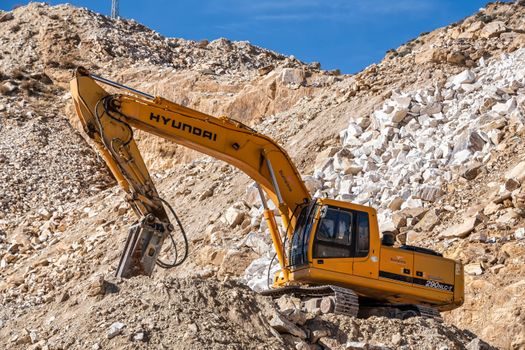
Putting the documented candidates on a single grid for a specifier: [S1]
Cat 352 LRE (50 t+ class) — operating weight 58,100 kg (128,100 lb), net power 330 kW (443 hp) ISO 9249, max dig depth 13,040 mm, reach ≈19.6 m, lift-mode pressure 38,000 kPa, 12.0 mt counterweight, variable-gauge high/wide undercarriage [S3].
Cat 340 LRE (40 t class) — operating weight 43.8 t (96,500 lb), max dig depth 13,040 mm, "nearly 35% more reach" than standard 340 arm, available 600/700/850 mm shoes, gauge range 2,930–3,780 mm [S5][S10].
Komatsu PC360LC-10 Super Long Front — operating weight in the 36 t class, max digging height 17,247 mm (56 ft 7 in), max dumping height 15,545 mm (51 ft 0 in), max digging reach figures quoted in the Super Long Front spec sheet for the PC360LC-10 arm [S7].
Hyundai HX220A LR — operating weight 56,040 lb (25.4 t), 0.68 yd³ standard bucket, 170 hp Cummins, positioned as the lighter-class LRE for utility-scale ditch and pond work [S9].
Decision logic: choose the 352 LRE envelope when lift-mode pressure and 12 mt counterweight are needed (deep dredging, settling pond clean-out); choose the 340 LRE when transport weight below 45 t matters and dig depth is the priority; choose the PC360LC-10 Super Long Front when dump height above 15 m is the binding constraint; choose the HX220A LR when the job is below 10 m reach and a 25 t trailer is the delivery constraint.
Who an LRE is for — and who should rent a standard arm
LREs pay back on jobs with reach or dump height that a standard arm cannot reach: settling-pond clean-out, waterway and canal maintenance, ditch cleaning, steep-slope general excavation, dredging, vegetation control with mulcher attachment at height, and loose-material transfer where a higher dump point shortens the truck cycle [S3]. The 352 LRE is rated to "steep slope capability reaching out to 19.6 m (64 ft)" — that is a stability claim backed by the variable-gauge undercarriage and extra counterweight, not a marketing line [S3].
LREs are NOT for: tight urban sites under 4 m working radius (the tail swing and shipping length are punitive), finish grading where the long stick destroys fine-grade accuracy, rock trenching where peak breakout force at the tip is the metric (long sticks trade tip force for arc), and any haul where total transport weight must stay under 40 t without permits. A standard 336/349-class arm beats an LRE on cycle time in those conditions.
Engine, hydraulics and emissions: spec the carrier, not just the arm
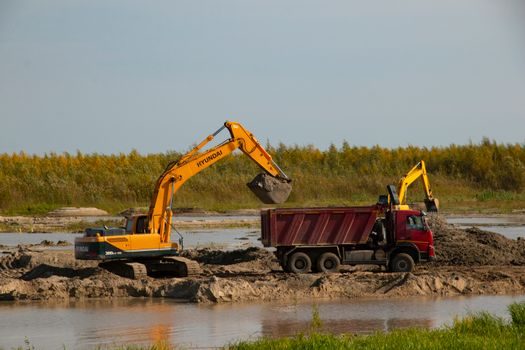
Under the sheet metal, the 352 LRE is powered by a Cat C13B, 12.5 L displacement, 130 mm bore × 157 mm stroke, 332 kW (445 hp) per ISO 14396:2002, certified to U.S. EPA Tier 4 Final, EU Stage V and Japan 2014 emissions, with B20 biodiesel compatibility on ULSD [S3]. Maximum main-system flow is 779 L/min (206 gpm) at 35,000 kPa equipment pressure, with swing torque rated at 189 kN·m (139,000 lbf·ft) — the swing figure matters because long-reach cycles swing loaded buckets through wider arcs [S3].
For non-road mobile machinery that crosses borders, EU Stage V is regulated under Regulation (EU) 2016/1628 (Stage V) for NRMM, and U.S. EPA Tier 4 Final is the 40 CFR Part 1039 / Part 1065 regime for ≥130 kW engines — the 352 LRE's Stage V + Tier 4 Final dual statement means a single machine can be deployed on both sides of the Atlantic without a re-engine [S3]. Biodiesel compatibility is rated up to B20 FAME per the spec sheet, with renewable diesel, HVO and GTL also listed as compatible; the 188.9 gal (715 L) fuel tank and 21.1 gal (80 L) DEF tank define the shift length between refuels [S3].
Sourcing, standards and pre-shipment checks
Buying checklist tied to verifiable spec-sheet lines, not brochure language: (1) confirm the LRE boom length is 11.5 m (37 ft 9 in) and the stick is 8.5 m (27 ft 11 in) — anything shorter is a standard arm re-marketed; (2) confirm the 12.0 mt (26,455 lb) counterweight, not the standard 7–8 mt unit; (3) confirm the variable-gauge undercarriage, not the fixed-gauge carrier; (4) confirm lift-mode pressure of 38,000 kPa (5,511 psi) and the cab switch that activates it; (5) confirm bucket matched to the long-stick table, not the standard-arm table; (6) confirm emission statement matches destination market (Tier 4 Final + Stage V for transatlantic fleets); (7) confirm transport dimensions (16,450 mm length, 3,390 mm height) against your trailer and permit envelope [S3][S4].
Standards to insist on in writing: ISO 9249 for net-power declaration, ISO 14396:2002 for gross engine power, SAE J1097 / ISO 7455 for hydraulic lift-capacity ratings at full reach, and ISO 6015 for lifting-capacity tables — each of these is the basis on which a manufacturer can claim a 19.6 m reach and 38,000 kPa lift-mode figure without ambiguity [S3]. Bucket-tip-radius and bucket-family compatibility are documented on the manufacturer's "Bucket Specifications and Compatibility" page, and that page — not the marketing PDF — is the contract-grade reference for which buckets the warranty covers on the LRE stick [S4][S6].
Pre-shipment inspection (typical OEM protocol, applicable to any LRE): confirm factory fluid fill (10.6 gal / 40 L engine oil, 145.3 gal / 550 L hydraulic system, 57.3 gal / 217 L hydraulic tank, 13.7 gal / 52 L coolant, 188.9 gal / 715 L fuel), pin-lock retention on boom-foot and stick-foot pins, stick-cylinder guard, travel-motor guards, and the undercarriage retract/extend function cycles without binding [S3].
Limitations and failure modes unique to LREs
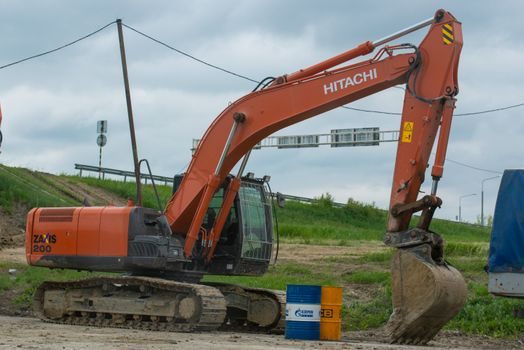
Three failure modes dominate LRE field history and should drive the spec. (a) Tip-overs at full reach with a bucket above the rated lift-mode load — the 38,000 kPa pressure is only available when the lift-mode switch is active and the load chart is read correctly; operators who leave the machine in normal-equipment mode and lift a "LRE-rated" bucket at full stick are operating outside the machine's envelope. (b) Boom-bend fatigue at the boom-foot gusset from side-load cycling — long arms magnify side loads from slewing; the OEM 12.0 mt counterweight exists specifically to suppress this, but only if the high/wide undercarriage is also extended. (c) Transport damage on the stick shipping brackets — the 8.5 m stick extends well beyond the carrier and the shipping-bracket design must support its weight during truck transport; missing or improvised brackets are a leading cause of stick-pin damage on delivery. [S2]
Cycle-time penalty is the other honest limitation: a long arm moves the same bucket through a wider arc at lower average angular velocity, so trucks per hour at the dump point are 10–20% lower than the same carrier with a standard arm. Spec the LRE when the reach premium is paid back by fewer machine repositioning moves, not by raw cycle speed. For a fleet buying decision that runs adjacent to other heavy equipment, this is the same trade-off logic used in wheeled excavator total-cost planning, where transport and repositioning costs dominate the owning calculation. Bucket-tip wear on long-stick applications is also higher than on standard arms because tip radius carries the same load over a longer arc, so plan a tip-replacement budget line that does not exist for standard-arm fleets.
Field signal worth tracking: the spread between standard-arm and LRE list prices in the 30–50 t class. When that spread compresses, it usually means the carrier OEM has integrated LRE hydraulics into the base machine and the LRE is becoming a catalogue option rather than a custom build — that is the point at which rental fleets typically convert from "build on order" to "stock the unit", and rental day-rates soften as supply normalises.
For component-level specifications, see excavator, reach truck, and linear guide.