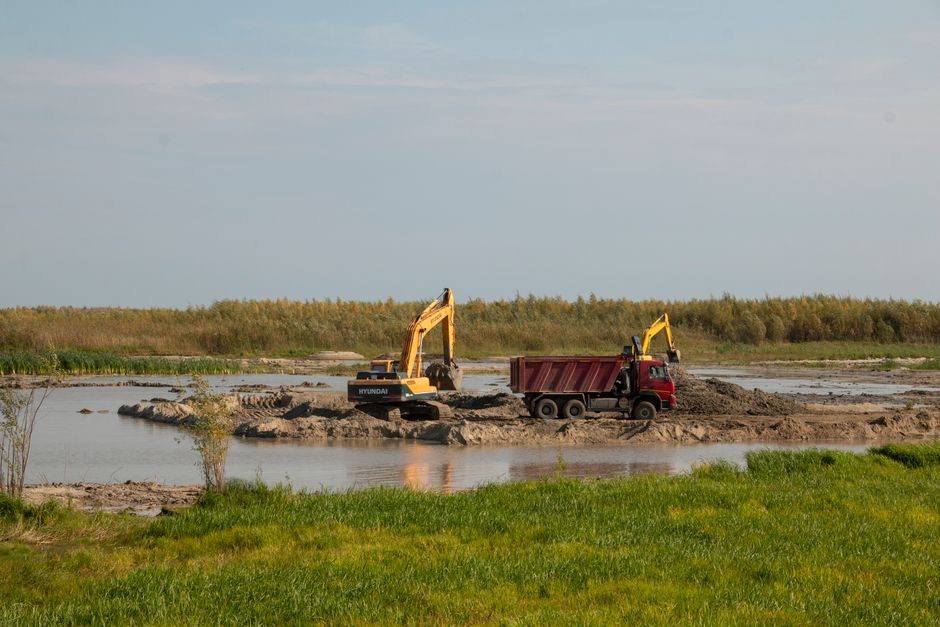
A wheeled excavator in the 12-14 tonne compact class typically pairs an 85-90 kW Stage V diesel with a sub-5,000 mm envelope circle, making it the default urban utility machine over a tracked equivalent when street-legal travel speed and low ground damage matter [S3].
Selection is not about brand loyalty — it is about four concrete numbers (operating weight, engine power, tail swing, stabilisation footprint) and one regulation (EU Stage V / US EPA Tier 4 Final). Used imported stock from Korea and China now sits in the US$ 12,000-13,200 band for 21 t class Hyundai 210W-9 units, while new Stage V European compacts command multiples of that price [S2][S3].
Define the Job Before the Brand: Operating Weight Class
Operating weight class dictates bucket capacity, lift chart and transportability more than any other spec. Liebherr's A 910 Compact runs 12,100-13,100 kg at 85 kW / 116 hp, while the A 912 Compact extends to 13,000-14,200 kg at 90 kW / 122 hp — a useful two-step bracket for the 12-14 t urban compact segment [S3]. Larger municipal machines (Cat M320, Volvo EWR150E, Hyundai R210W-9) sit in the 18-22 t range and are the typical imported used stock shown on B2B platforms [S2]. Mini wheeled units such as the Hengwang HW-10 and HW-20 fill the sub-6 t niche for landscaping and inside-building demolition [S8].
The hard rule: pick the lightest class that still meets the dig-depth and lift-chart requirement. A 22 t wheeled excavator on a confined urban site burns fuel and tears up asphalt that a 13 t compact could have handled with the right bucket.
Emissions Compliance: Stage V Is the 2026 Baseline in Europe
EU Stage V exhaust emissions compliance is now table stakes for any machine sold into the European Economic Area, implemented via Regulation (EU) 2016/1628. Liebherr achieves Stage V on the A 910 / A 912 Compact with a diesel oxidation catalyst (DOC) + diesel particulate filter (DPF) + selective catalytic reduction (SCR) aftertreatment package, paired with the Liebherr Power Efficiency engine-management system to keep specific fuel consumption low across the duty cycle [S3]. Outside Europe, US EPA Tier 4 Final and China NS-IV equivalents define the same problem with different aftertreatment thresholds.
If a quotation does not explicitly state the emissions stage with the aftertreatment architecture, treat it as suspect — used imports from non-regulated markets frequently arrive with deleted DPFs, which then fail port-of-entry inspection in the EU and increasingly in Chinese Tier-2 cities.
Steering Modes and Tail Swing: The Urban Envelope
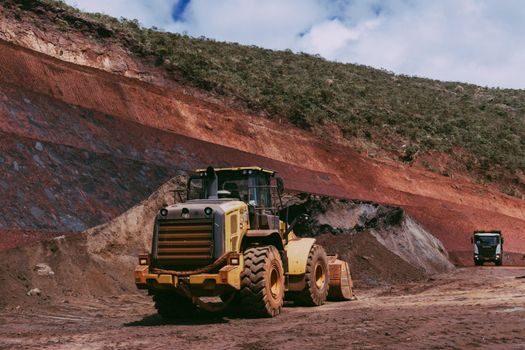
Three specs separate a workable urban wheeled excavator from a frustrating one: tail-swing radius, front swing radius, and the available steering modes. The Liebherr A 910 / A 912 Compact holds tail swing to 1,675 mm and shaved a further 70 mm off the front swing radius, keeping the full envelope circle under 5,000 mm for both models [S3].
Steering mode matters as much as swing radius on tight sites. Two-wheel steering is the road default; all-wheel steering (front and rear axles counter-phase) drops the turning radius sharply for in-yard repositioning; crab steering (front and rear axles in-phase) lets the machine slide sideways along a kerb or wall. The optional all-wheel and crab-steering package on the A 910 / A 912 Compact is the single most useful add-on for utility work in old-city centres [S3]. Volvo CE, JCB and Doosan offer functionally equivalent mode triplets across their wheeled ranges [S4][S5].
Stabilisation: Blade, Outriggers or Split Blade
Wheeled excavators need a deployed stabiliser before any heavy lift, and the geometry of that stabiliser defines the practical lift chart. The Liebherr Compact wheeled range offers three interchangeable stabiliser elements: a radially-guided dozer blade for soft or sandy ground (large contact area, lower ground pressure), outriggers for solid ground (maximum lift capacity, minimum footprint penetration), and a split-blade support with independently controllable left/right elements for uneven terrain [S3].
The trade-off, laid out against the typical job-site condition, is straightforward:
<b>Soft / sandy ground:</b> dozer blade preferred — large footprint, lower ground-bearing pressure, slightly reduced lift chart.<br><b>Paved or hard-pack ground:</b> outriggers preferred — pads concentrate load on a small area, full lift chart available.<br><b>Sloped or uneven ground:</b> split blade — each side can be raised or lowered independently, the machine can be levelled without repositioning.<br><b>Combined mixed sites:</b> specify the machine with both blade and outriggers, the most common OEM configuration on the 12-14 t compact class [S3].
Used vs New: Price Bands and Hidden Risk
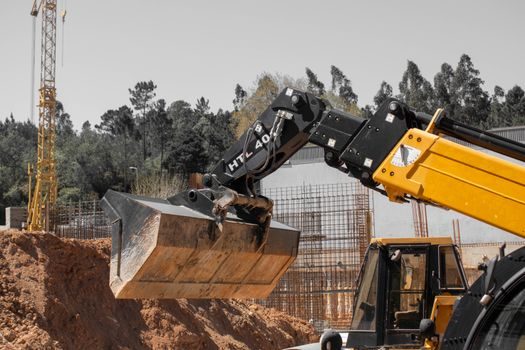
The 2026 used market is dominated by Korean and Japanese 18-22 t stock re-exported through Chinese B2B portals. A 2026-vintage listing for a Hyundai 210W-9 (21 t class, Korean brand) shipped ex-China stock shows US$ 12,000-13,200 per unit minimum-order quantity one set, with wholesale tiers dropping below that for container-load orders [S2]. New Stage V European compacts in the 12-14 t class list for several multiples of that figure once FOB, CE marking and warranty are added.
For buyers outside Europe, the used route is rational where emissions regulations are absent or loosely enforced. For any machine that will see service in the EU, Switzerland, Norway, the UK (post-Brexit alignment), or South Korea, used Tier 3 / Tier 4i stock will be refused registration or face expensive retrofits — pay the new-machine premium or pick a different market.
Attachments, Hydraulics and Serviceability
Hydraulic auxiliary circuits determine what attachments the machine can run. A standard 12-14 t compact wheeled excavator should specify one or two proportional hydraulic circuits (for tilt-rotator and breaker), a return-line connection for cases, and a drain line for high-flow attachments. OEM parts catalogues for legacy models such as the Komatsu PW30-1 remain a useful reference for circuit-count and line-size data, even on machines three decades old [S7].
For daily serviceability, check that the engine bay allows ground-level access to the aftertreatment canisters (DPF, SCR, DOC) without boom removal — the Stage V package on modern compacts is laid out for this, but some Tier 3-era Asian used imports are not [S3][S7].
Where Wheeled Excavators Win, and Where They Lose
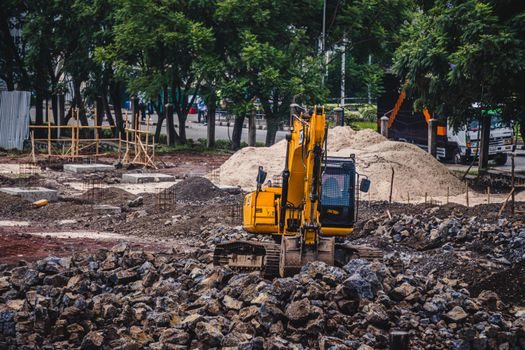
Wheeled excavators are the right call when the machine must travel on public roads between sites without a low-loader, when ground damage must be minimised (finished asphalt, paving stones, turf), and when average job duration is under two weeks. They lose on soft ground where a dozer-blade cannot stabilise the chassis, on slopes exceeding roughly 30% where tracked machines grip better, and on demolition sites with high tracked-machine traffic [S3][S4].
For a complete reference on matching machine class to job-site class, the excavator encyclopedia page consolidates the crawler vs wheeled vs mini trade-off, and the broader equipment-sourcing picture — from selection through to inbound QC and supplier audit — overlaps with the same spec-first logic used in CPU procurement strategy and in picking long-lead mechanical assets such as industrial storage racks.
Track two signals over the next quarter: (1) the rollout of electrified compact wheeled excavators — JCB, Volvo CE and Liebherr have all shown battery-electric prototypes, with production dates pending OEM confirmation; (2) tightening Chinese NS-V equivalent emissions enforcement in Tier-1 city fleets, which will redirect used stock toward Africa, the Middle East and South America and lift FOB prices for compliant 12-14 t units.
For component-level specifications, see linear guide, and crossed roller guide.