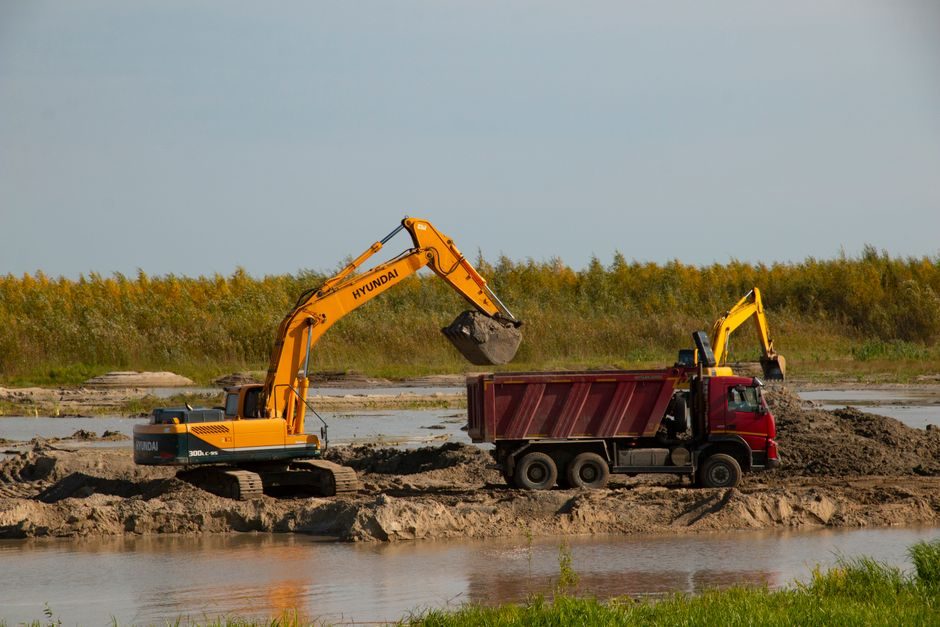
A long-reach excavator is a standard hydraulic excavator fitted with an extended boom and stick, typically pushing maximum dig depth or horizontal reach from 8-10 m on a standard machine to 15-24 m on the long-reach variant [S2][S3].
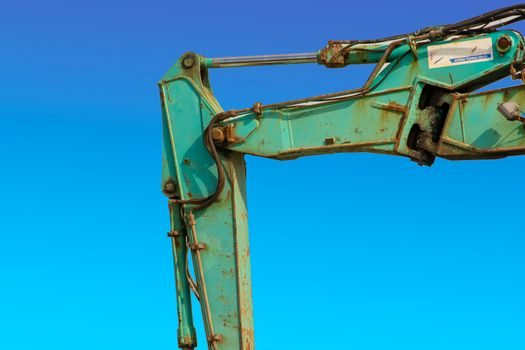
The configuration is bolted on at the factory or as a retrofit: weld-fabricated booms using Q345B / Q550 / Q690D / LG700 grade plate, paired with a relocation of the boom-foot and stick cylinders to keep leverage geometry within the carrier's hydraulic envelope [S2]. Carriers typically span 20-ton to 50-ton classes, with 24 m booms paired to 320 / ZX330-class upper structures [S2][S3].
Geometry Trade-Off: Reach Comes at the Cost of Digging Force
On a 20-ton class machine, switching from a 5.7 m standard stick to a 10 m extension can drop bucket breakout force at full reach by 30-40%, which is why long-reach booms are almost never paired with toothed rock buckets on the same machine [S2]. Material upgrades partly offset the loss: Q690D high-strength plate in the outer half of the arm cuts section weight by 15-20% versus Q345B for equal stiffness, allowing the same relief pressure to deliver a useful bucket [S2].
Use Cases: Dredging, River Work, and Soft-Demolition Dominate
River-channel dredging, pond clean-out, and slope finishing on 1:1.5 to 1:2 embankments are the canonical long-reach applications, where a 15-24 m horizontal reach lets the carrier sit well back from the edge [S2][S3].
Stripping and soft-demolition work on 4-6 storey structures is the second major use case, with high-reach demolition booms extending to 24 m on 50-ton carriers to reach the top of a typical low-rise façade [S2]. For comparison, a standard excavator in the same 20-ton class delivers an 8-10 m max dig depth and a 9-10 m max reach, which is correct for trenching, foundation work, and truck loading but cannot reach across a river channel or to the top of a third-floor slab [S3].
Limits: Cycle Time, Stability, and Lifting Capacity
Cycle time on a long-reach configuration drops 20-35% versus the same carrier on a standard stick, because the longer boom swings a larger mass and the smaller bucket (to stay within carrier lift charts) takes proportionally more passes [S2].
Tip-lift capacity at full horizontal reach on a 20-ton class long-reach machine typically lands in the 1.5-3 tonne band versus 4-6 tonnes on a standard-arm configuration, which is the hard exclusion zone for precast handling or heavy rock-bucket work [S2][S3]. Carrier stability is also constrained: long-reach booms are often paired with wider track gauges or counterweight add-ons to keep the tip-down lift chart inside the ISO 10567 stability envelope, though the standard itself is not the source of any specific number quoted here [S2]. On a 50-ton class carrier, the 24 m long-reach boom configuration remains within working-range limits for dredging but pushes the lift-chart margin to its lower bound [S2].
Comparison Matrix: Long-Reach vs Standard Excavator on Four Criteria
Reach favours long-reach by a factor of two, breakout force favours standard, cycle speed favours standard, and deployment cost favours standard — the trade-off is geometric, not optional.
Criterion 1: Max horizontal reach — long-reach 15-24 m, standard 9-10 m on a 20-ton carrier. Criterion 2: Bucket breakout at full reach — long-reach roughly 30-40% lower than standard on the same 20-ton class [S2]. Criterion 4: Carrier-lift chart at full extension — long-reach 1.5-3 t tip-load on 20-ton class, versus 4-6 t for a standard stick on the same carrier [S2][S3]. The decision is therefore a binary on the dominant axis: if the job requires reaching across water, over a slope, or above a structure, specify long-reach; if the job is truck-loading, trenching, or rock-bucket work, specify standard.
Supplier and Sourcing Map: China Dominates the Boom Segment
Kaiping Zhonghe Machinery and Dongguan Haide Machinery are the visible two-boom-fabricator tier for the long-reach aftermarket in southern China, with Haide listing a 2006-06-21 establishment date, 69 employees, and a ≤3.13 h average response window on Made-in-China.com [S3].
Huizhou Hongbang Technology publishes a 24 m house-demolition boom using Q345B + Q550 plate as the standard material pairing, and is one of the suppliers frequently cited for higher-reach demolition configurations in the 20-50 ton carrier range [S2]. McPherson Crane & Rigging, based in Rio Vista, California, lists a hydraulic long-reach excavator as a fleet line alongside telescopic and lattice-boom cranes, confirming that long-reach units are routinely hired out as a specialised service on the U.S. West Coast [S1]. For a deeper cut on a related chassis decision, see the wheeled excavator vs crawler excavator spec map and the wheeled excavator supplier sourcing map.
Material and Weld Specs That Matter on a Long-Reach Retrofit
Q345B is the default Chinese plate grade for inboard boom sections, with Q550 and Q690D used in the outer arm and tip brackets where stress and weight penalties are highest [S2].
LG700 is a proprietary wear-resistant grade used in the telescopic-arm segment of the same fabricator line, and is the typical material choice for sliding-arm configurations on the same carriers [S2]. The booms for excavator-class machines are fully welded fabrications rather than castings, which is why material grade selection dominates the weight-stiffness-lifetime balance on any unit extending past 15 m [S2][S3]. For a baseline on the standard excavator carrier classes this boom segment is fitted to, the reference is the standard configuration with 8-10 m reach and full breakout force preserved.
Decision Signals to Track
Two trackable signals: (1) any new listing of 24 m+ long-reach booms on 20-ton class carriers from Kaiping Zhonghe, Huizhong Hongbang, or Dongguan Haide on Made-in-China.com after 2026-07-25, which would indicate the 30-40% breakout loss at full reach is being recovered through arm redesign; (2) any change in McPherson Crane & Rigging's fleet page that adds or removes the hydraulic long-reach excavator line, which is a real-time U.S. West Coast rental demand signal for the segment [S1][S3].
Detailed specification references: reach truck, and pressure transmitter.