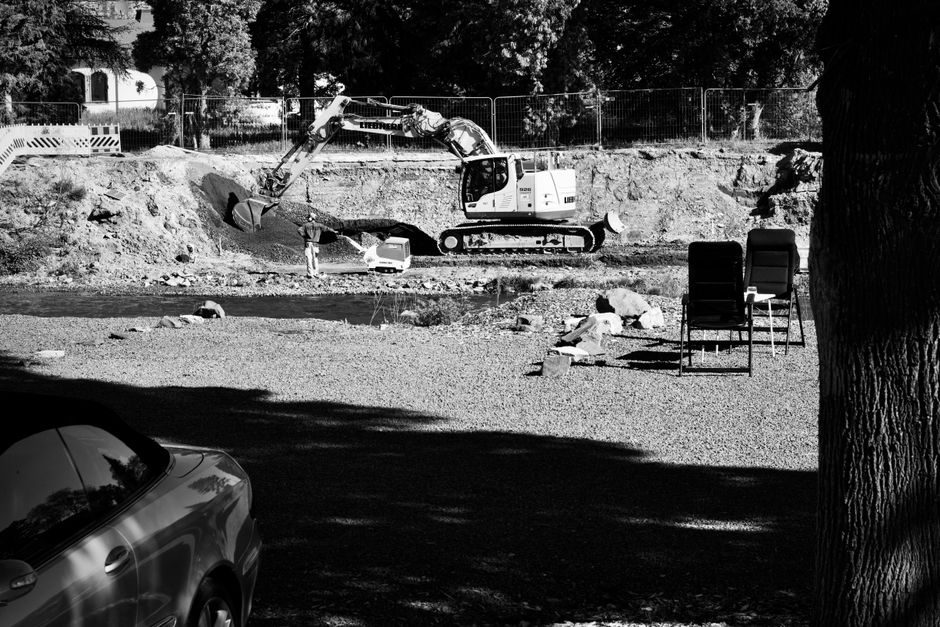
Wheeled excavators pair a hydraulic upper structure with a rubber-tyred undercarriage and stabilising outriggers, trading pure digging force for the ability to self-drive between paved jobsites at road speeds typically up to 35–40 km/h [S1][S5][S6].
Crawler excavators ride on steel or rubber tracks, deliver lower ground pressure per cm², and stay the default for bulk earthmoving, mud, and steep grades; the wheeled format is a mobility-first alternative whose market lives in municipal, road, and utility work [S2][S3][S7][S8].
Undercarriage and Ground Pressure: The Core Engineering Trade-Off
Tyre contact patches concentrate roughly 0.4–0.6 kg/cm² on a 19-tonne wheeled class machine versus 0.3–0.4 kg/cm² distributed across steel tracks on an equivalent crawler, so wheeled units need outriggers and a dozer blade for stable dig cycles [S3][S7].
On a 19-tonne comparison platform such as the Jonyang JYL619E, the manufacturer quotes 1-piece MOQ pricing, a 3000-unit annual capacity from a Guiyang facility, and FOB Shanghai shipment for a wheeled chassis positioned against the Doosan DX190W class [S3]. This is the operating-class sweet spot where road-going wheeled platforms compete head-to-head with crawlers; below 6 tonnes the comparison shifts to compact/mini segments and the undercarriage trade-off narrows [S7].
For specification engineers sourcing an excavator platform, the rule of thumb is: specify wheeled when the duty cycle involves more than 30% on-paved transit between discrete dig points; specify crawler when sustained drawbar pull, soft-soil bearing capacity, or slope work above ~30% dominates.
Mobility, Road Legal Status, and Site Logistics
Wheeled excavators can usually drive on public roads between jobs without a low-loader, and several 14–19 t European and Asian models (Doosan DX140W, DX160W, New Holland WE170) are routinely sold in configurations that meet on-road lighting, braking, and tyre regulations [S1][S5][S6].
Doosan DX140W and DX160W 1:50 scale diecast references from UH IMC list the same wheel-arch and outrigger geometry as the production machines, useful for verifying stabiliser footprint and approach-angle geometry during site planning [S5][S6]. Diecast references here are a proxy for production-machine geometry, not a substitute for OEM spec sheets.
A crawler platform must generally be trailered even short distances, adding transport cost and permitting overhead; a 3000-unit/year Shandong supplier notes FOB, EXW, LC, T/T, and 1-month peak/off-season lead times across wheeled, crawler, and backhoe lines — lead times are equivalent, so the logistics premium is purely on transport, not build [S2].
Drivetrain and Hydraulic Architecture Differences
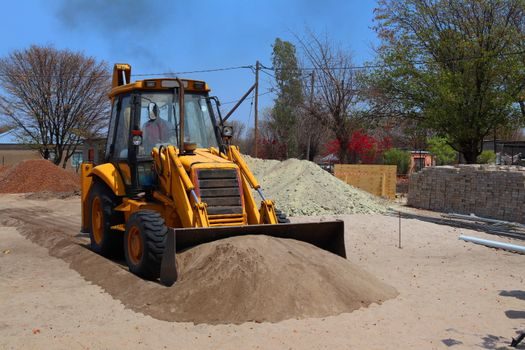
Wheeled chassis use a multi-speed powershift or hydrostatic transmission driving two or four wheels, with rear-axle steering commonly giving a 6 m-class tight turning radius; crawler machines replace this drivetrain with sprocket/hydraulic-motor final drives, no on-road transmission, and a much higher parasitic loss per metre travelled [S3][S7].
Engine power on a 19 t wheeled platform typically lands in the 110–125 kW range, and a Tier 4 Final / Stage V emissions package is standard for units sold into the EU and North America; crawler units in the same tonnage bracket run similar engines but route all power through hydrostatic travel motors instead of tyres [S3].
For buyers comparing a crawler excavator option against wheeled, the controlling spec is travel efficiency: a wheeled unit on a paved haul road moves under its own power at 30+ km/h, a crawler at 4–6 km/h.
Cost, Maintenance, and Total Ownership Stance
Wheeled undercarriages avoid track-shoe and sprocket wear but incur tyre replacement cycles every 2000–4000 hours depending on surface; outrigger seals and axle bearings are the two wear-cost centres that crawlers do not have at all [S2][S3][S7].
A Shandong manufacturer in this segment reports US$10–50 million annual output value, 5 production lines, 11–20 R&D staff, and ISO 9001 certification, with excavator output at 3000 sets/year and 51–70% export share into North America, South America, Eastern Europe, Southeast Asia, Africa, Oceania, the Middle East, Eastern Asia, and Western Europe [S2]. Hengwang Group similarly lists wheeled, mini, crawler, and modification excavators exported to 120+ countries including the EU, with Euro V-compliant compact crawlers such as the HW-10 and HW-20 in the same catalogue [S7].
For deeper crawler spec gates and selection logic, see How to Choose a Crawler Excavator: A 2026 Spec-First Selection Map; the wheeled-vs-crawler line blurs below 6 t, and the Crawler Excavator Classes, Spec Ranges, and Application Map covers where tonnage class overrides undercarriage choice.
Selection Matrix: When to Specify Each
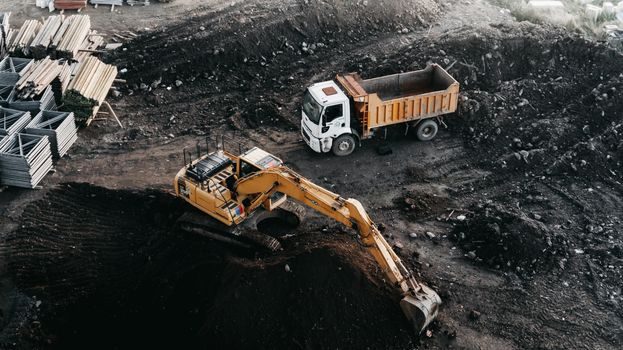
Use wheeled when: the project requires street-legal self-transit, the dig cycle includes frequent repositioning on asphalt, working radius stays under 9 m, ground bearing capacity exceeds 1 kg/cm², and slope work stays under 15% [S1][S3][S5][S6].
Use crawler when: ground bearing is below 0.8 kg/cm², drawbar pull above 80 kN is required, slope work exceeds 30%, the dig cycle is stationary for hours at a time, or the site is greenfield earthworks rather than finished-surface utility work [S7][S8].
OEM portfolios confirm this split: Volvo CE lists Large Crawler, Medium Crawler, Wheeled, and Compact Excavators as four separate product lines with distinct frame architectures, not variants of one chassis [S8]. Hengwang lists four parallel model families — wheel, mini, crawler, and modification — with Euro V compliance on the HW-10 and HW-20 crawler/mini lines [S7].
Avoid wheeled on unprepared mine haul roads, deep mud, or demolition sites with sharp debris (tyre sidewall damage dominates downtime); avoid crawler on any project with high paved-transit share unless low-loader transport is already in the site logistics budget.
Vendor Landscape and Sourcing Signals
The wheeled-excavator supply base is concentrated in Shandong, Jiangsu, and Guizhou in China, with Korean (Doosan) and European (New Holland) brands selling into North America and the EU through independent dealers [S1][S3][S5][S6][S7]. New Holland WE170 1:87 HO scale references, Doosan DX140W and DX160W 1:50 diecast models, and Jonyang JYL619E production listings all describe the same 14–19 t wheeled class that dominates the segment [S1][S3][S5][S6].
Trackable sourcing signals to watch: the 2025-04 listing of JYL619E against the Doosan DX190W positions Chinese OEM capacity at 3000 units/year targeting direct displacement of Korean wheeled platforms [S3]; Volvo CE's 2026-07 product-page split into four excavator families signals continued brand-level commitment to the wheeled category as a distinct line, not a crawler derivative [S8].
Next node: confirm on-road type-approval documentation (EU CE/2000/14/EC noise + ECE R29 cab strength, or US DOT braking for any wheeled unit destined for public-road transit), and validate the OEM's tyre/wheel-axle service-part pricing before final award — undercarriage service parts are where wheeled and crawler ownership cost diverge most.
Spec-level background on the components involved: pressure transmitter, and flow meter.