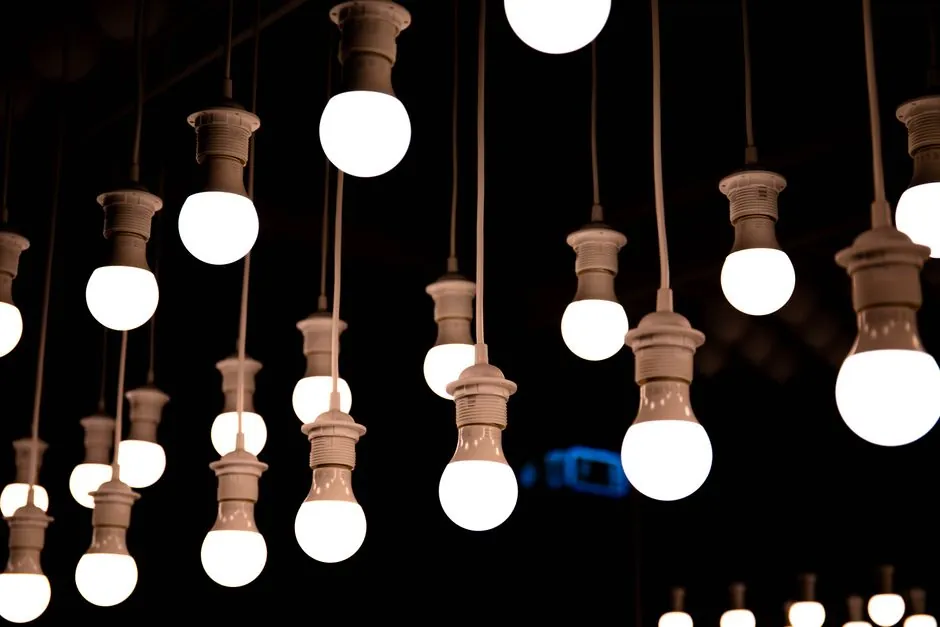
One lux equals one lumen per square meter, while a lumen measures the total visible light emitted by a source [S1][S3][S5].
Two LED headlights may both claim 8,000 lm yet deliver different road illuminance because beam distribution and cutoff affect the lux at the target [S5].
Two quantities with different measurement boundaries
Lumens, abbreviated lm, measure luminous flux, the total visible light produced by a lamp or other source [S4][S5]. Lux, abbreviated lx, measures illuminance, the amount of light falling on a surface [S1][S2]. The defining relationship is 1 lx = 1 lm/m², so lumens divided by an illuminated area provide the average lux over that area [S3][S5].
That area dependency is why 1,000 lm spread across 10 m² gives an average of 100 lx, while the same 1,000 lm spread across 2 m² gives 500 lx [S1][S3]. These are simple area conversions and assume the light is distributed evenly across the stated surface.
Criterion-based comparison of the main lighting metrics
For source selection, use lumens to compare total output or luminous efficacy; for a task surface, use lux to verify delivered illumination [S5]. For directional performance, candela, abbreviated cd, measures luminous intensity in one direction and is the relevant intermediary between source output and target illuminance [S2][S5].
Watts do not substitute for any of these metrics because they describe electrical power consumption rather than light output or illumination [S2]. A comparison should keep wattage, lumen output, beam distribution, target distance, and measured lux as separate fields.
Where each measurement belongs in procurement
Lumens suit fixture, bulb, LED-chip, and light-engine comparisons because they quantify total source output [S5]. For workplace or room design, lux is the operational metric because it evaluates illumination over the occupied area [S1][S2].
Lux is also appropriate for beam testing, but the measurement distance and target surface must be recorded. Illumination increases as the surface moves closer to the source, and the center of a directed beam generally carries the highest lux [S2]. A lux meter provides the point or surface reading needed for that verification.
Identical lumen ratings can produce unequal lux
Two LED headlights rated at 8,000 lm can provide different illuminance because one beam may be focused with a clear cutoff while the other scatters light and creates glare [S5]. Two LED headlights may both claim 8,000 lm, yet the one with a focused beam, clear cutoff, and strong center lux at distance can perform better on the road than the one that scatters light everywhere [S5].
Beam shape, distance, surface orientation, optics, and cutoff affect the lux received at the work location [S2][S5]. Luminous flux alone therefore does not reveal road coverage, glare, hotspot distribution, or usable illuminance at distance [S5].
Limitations that affect measurement reliability
Luminous flux is normally measured with a specialized integrating sphere, whereas lux at a defined location is measured with a lux meter [S3]. A lumen rating generated under laboratory conditions does not establish the lux delivered in a room, on a wall, or on a road [S3][S5].
A lux value without its measurement distance and location has limited engineering value because illuminance changes with distance and beam position [S2]. Test records should therefore identify the source, lumens, target surface, distance in metres, measurement plane, and resulting lux in lx. The same discipline applies when comparing the EV reading of a meter against a lux result, as covered in EV vs Lux Meter Reading: Conversion, Range, and Use Cases.
Worked examples for lighting decisions
If that output is distributed evenly over 10 m², average illuminance is 330 lx; spread evenly over 2 m², it is 1,650 lx [S3][S5]. Neither figure establishes local uniformity, so measurements should cover multiple points when task lighting is critical.
For a pendant, desk, workshop, or inspection station, specify the target illuminance at the workplane and then select a fixture capable of delivering it [S1][S2]. For automotive or outdoor equipment, compare lumen output, candela, beam pattern, cutoff, and lux at the stated distance [S5]. For ambient rooms, average lux helps, while fixture placement and distribution determine whether that average represents a useful lighting condition.
The first procurement step is to record the required illuminance in lx and measurement plane, then verify that the proposed source provides that value in place rather than relying on its lumen label alone.