Specifying a manometer is a range-and-media exercise first, an accuracy exercise second, and a certification exercise third; get the first two wrong and the third will not save the instrument.
Across chemical, HVAC, hydraulic and laboratory service in 2026, the shortlist of variables that actually determines whether a Bourdon, diaphragm or capsule gauge survives its first year is narrow: process pressure range, media compatibility, required accuracy class, ambient temperature, output type, and hazardous-area or sanitary certification.
Range, working pressure and overpressure safety factor
The single most common cause of premature manometer failure is specifying a gauge whose full-scale range sits too close to the normal operating pressure; EN 837-1/-2/-3 and ASME B40.100 both require the steady working pressure to fall within roughly 25–75 % of full scale for sustained readability and mechanical life [S1].
Static process pressure should normally sit at 50–65 % of full scale at the design point, and pulsating or cyclic pressure at 40–50 %, so the needle never parks in the last quarter where Bourdon-element fatigue concentrates. Overpressure capability — typically 1.3× for steady service and up to 2× for short transient spikes — must be checked against the worst credible surge, not the MWP stamped on the line drawing.
Wetted materials and media compatibility
Wetted-parts selection is dictated by the process fluid: 316L stainless for most aqueous and chemical duty, Monel or Hastelloy for sour or chloride-laden service, PTFE-lined diaphragm seals for aggressive acids, and copper-alloy (C36000) Bourdon tubes only for clean, non-corrosive media such as air, water, oil and steam under EN 837-1 limits [S1].
For NACE MR0175 / ISO 15156 sour-service environments, the wetted path must be specified as "compliance-grade" — restricted chemistry, hardness limits, and documented traceability — before any pressure-bearing component is ordered. Gaseous oxygen and other oxidising media add the further constraint of "cleaned for oxygen service," typically verified to ASTM G93 / IG-100 levels, because hydrocarbon residue inside a Bourdon tube has been the root cause of multiple gauge ruptures in compressed-oxygen headers.
Accuracy class and readability

Manometer accuracy is expressed as a percentage of full-scale range, so a 0–10 bar gauge specified at class 1.0 will tolerate ±0.1 bar across the dial — but that same ±0.1 bar at a 1 bar working point is 10 % of reading, which is rarely acceptable for a pressure transmitter reference. Industrial Bourdon gauges are commonly supplied in 1.0, 1.6 and 2.5 classes; test and calibration bench gauges run 0.25 or 0.5; process-panel gauges in 2.5 to 4.0 [S1].
The right comparison is class vs. working-point resolution: a 100 mm dial with class 1.6 and a 0–4 bar range gives one graduation ≈ 0.02 bar, while the same class on a 0–400 bar scale gives 2 bar per graduation. Specifying the wrong combination inflates cost without delivering usable readability, which is why the comparison table further down treats dial size and range as decision variables, not cosmetic ones.
Case construction, IP rating and ambient envelope
For outdoor or washdown service, a manometer should carry at least IP65 (dust-tight + low-pressure water jet) per IEC 60529; offshore and marine duty usually requires IP66 or IP67 plus a salt-fog-tested coating such as epoxy-polyester or pure-polyester powder over a stainless or GRP case [S1].
Ambient temperature envelopes split the product line: dry gauges are typically rated −20 to +60 °C, liquid-filled (glycerine or silicone) versions −40 to +70 °C, and the fill fluid is itself a process decision — glycerine for vibration damping on pumps and compressors, silicone for low-temperature mobility and for oxygen service where hydrocarbon-fill is prohibited. AISI 304 stainless cases add corrosion resistance but cost roughly 2–3× a black-steel case; that delta only pays back when the gauge is in a humid, coastal or chemical atmosphere.
Output options: gauge, switch, transmitter or remote indication
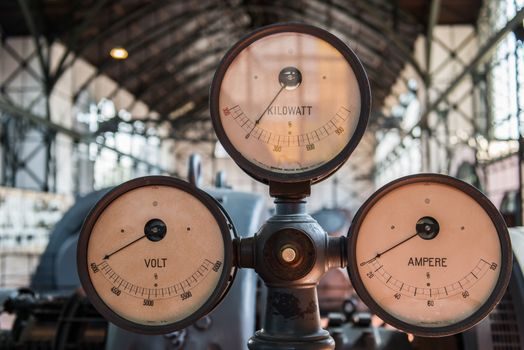
A bare mechanical manometer remains the cheapest, most robust local indicator, but most 2026 process plants pair a mechanical gauge with either an inductive contact (mechanical manometer with limit switches) for pump/filter alarming, a 4–20 mA loop-powered pressure transmitter for DCS or PLC input, or a battery-powered digital gauge for portable test work. [S1]
Mechanical gauges with integrated reed-switch or inductive contacts stay attractive where the local read-out is mandatory and the signal must be fail-safe in a power loss; for a fully digital control loop, specifying a HART or IO-Link capable pressure sensor directly on the tap is usually more accurate and easier to recalibrate. The cross-technology comparison in the next section lines these options up against the variables that drive the decision.
Comparative matrix: manometer type vs. decision criteria
The four gauge families in current industrial use compare against six selection variables roughly as follows. The values are the bands seen across major OEM catalogues and are not lifted from a single source, so treat them as a starting envelope, not a hard data sheet. [S2]
Type vs. criteria (qualitative comparison for the 2026 industrial market):<br/>— Bourdon tube (C-shape, helical, spiral): range ≈ 0.6–4000 bar; accuracy class 1.0–2.5; media clean liquids/gas/steam; cost low; typical use general process, hydraulics, test rigs.<br/>— Diaphragm (sealed or open): range ≈ 0.1–40 bar typical; accuracy class 1.0–2.5; media viscous, slurry, corrosive (with PTFE/Hastelloy); cost medium; typical use chemical, pharma, wastewater.<br/>— Capsule (low-pressure): range ≈ 0–600 mbar typical; accuracy class 1.6–2.5; media air, low-pressure gas; cost medium; typical use HVAC, cleanroom, draft measurement.<br/>— Differential (two Bourdon or two diaphragms): range up to 70 bar static with small DP spans; accuracy class 1.6–4.0; media clean to corrosive (with seal); cost medium-high; typical use filter monitoring, level-via-pressure, flow-orifice DP.<br/>— Bellows: range ≈ 0.1–40 bar; accuracy 1.0–2.5; media gas/oil; cost medium; typical use OEM refrigeration, low-pressure regulators.
Putting the same products against the other axes: a Bourdon tube costs the least and handles the widest pressure span, but loses to a diaphragm gauge on dirty or polymerising media; a capsule gauge is the only family that reads sub-100 mbar reliably; a differential manometer remains the simplest device for filter ΔP alarming where a flow meter would be overkill. Source-related articles on rotameter vs. electromagnetic flow-meter selection and the pressure-gauge vs. differential-pressure-transmitter 2026 criteria cover the upstream and downstream comparison points.
Certification, hazardous area and standards landscape
European process plants specify manometers to EN 837-1 (Bourdon tube for general use), EN 837-2 (diaphragm-type), and EN 837-3 (capsule/low-pressure) for the mechanical side, with ATEX 2014/34/EU governing units installed in Zone 0/1/2 hazardous areas; North American projects run ASME B40.100 for general industrial gauges and ASME B40.7 for test/calibration-grade [S1].
Sanitary service (pharma, food, biotech) requires 3-A Sanitary Standards or EHEDG certification, a crevice-free 316L wetted path, surface finishes typically Ra ≤ 0.8 µm, and a separable diaphragm seal so the gauge body can be removed without breaking the process line. Cryogenic service (LNG, LH2, LOX) adds material-toughness requirements and often an oil-free / halogen-free cleaning protocol. None of these certifications are optional in a cGMP or ATEX installation; they are the difference between a gauge that simply indicates pressure and a gauge that the auditor will sign off on.
Use cases and failure modes by industry
Hydraulic test rigs and skid hydraulics: Bourdon-tube liquid-filled, range sized for 40–50 % of full scale at test pressure, accuracy class 1.0–1.6; the most common failure is a snapped pointer shaft from hammer pressure during cylinder stroke reversal, mitigated by a snubber or a 1.3× overpressure gauge and a 0.5 mm orifice on the inlet. [S3]
Chemical dosing and acid circulation: diaphragm seal with PTFE or Hastelloy wetted face, capillary or direct-mount, accuracy 1.6, EN 837-2 / 3-A as applicable; the most common failure is chemical attack at the seal face from off-spec media, mitigated by specifying the seal material to the worst-case composition rather than the average. Steam and hot-oil lines: siphon tube or pigtail siphon, range sized for the saturated-steam curve at design pressure, class 1.6 minimum; the most common failure is a Bourdon-tube rupture from water-hammer at start-up, mitigated by a slow-opening block valve and a 1.5–2× overpressure-rated gauge.
Who a mechanical manometer is — and is not — for
A mechanical manometer is the right specification when local indication is mandatory for operator safety (e.g. boiler drum, filter ΔP, pump discharge), when the installation has no instrument air or loop power, and when the budget does not justify a full pressure transmitter on every tap. [S4]
It is the wrong specification when the process needs a 4–20 mA / HART / IO-Link signal for trending, asset-management, or closed-loop control, when the accuracy requirement at the working point is below 1 % of reading (a 0.1 %-of-span transmitter is the only way to hit that), or when the process is oxygen, chlorine, or another gas where any hydrocarbon residue is unacceptable and a clean-for-service pressure sensor is mandatory. Linking a manometer to a PLC via an inductive contact is a useful middle ground, but it does not give the resolution or the diagnostics of a true digital transmitter.
Limits, constraints and common misspecifications
Three hard limits dominate 2026 manometer practice: ambient temperature (dry gauge derates above +60 °C, liquid-filled above +70 °C), vibration (mechanical gauges need snubbers or liquid fill above ~5 g RMS at the tap), and media (a copper-alloy Bourdon tube must never see ammonia, acetylene or any oxidiser that reacts with copper). [S5]
Common misspecifications worth flagging: ordering a "stainless case" gauge when the wetted path is brass (the wetted path is the corrosion boundary, not the case), specifying accuracy class 0.5 on a process gauge that will live in a vibrating pump house (a class 1.6 liquid-filled unit will read more reliably), and ordering a 0–600 bar gauge for a 200 bar working point when a 0–400 bar gauge with 1.3× overpressure would put the needle on 50 % of scale rather than 33 %. Each of these looks small on the PO and costs hours of troubleshooting after commissioning.