
A 5,500 lb / 2,500 kg class manual pallet jack is the workhorse SKU of floor-level material handling, and as of 2026-06-26 the new-unit price band on Alibaba spans roughly $200 to $900 depending on frame, forks, wheels and pump seal spec [S1]. The same 5,500 lb class on US retail channels (Dayton 493X19) is listed at US $739.99 new, while used 5,500 lb / 48×27" hand pallet trucks clear around US $1,399 on secondary channels [S3][S6].
The hidden cost is not the truck itself but the wheels, seals and steer linkages, where aftermarket wheel kits for a Big Joe P33 or Lift-Rite LR2055 sell in the $70–$150 per-axle range, with bulk discounts dropping the per-unit figure toward $74 when buying 2+ [S2][S8]. In other words, the spec you order and the channel you buy through set first cost, and the wear parts you stock set lifetime cost.
What actually moves the price: capacity, fork length, pump and wheels
Four specifications account for the bulk of the $200–$900 spread on a 5,500 lb manual pallet jack: rated load, fork length/width, hydraulic pump class, and the polyurethane vs nylon wheel choice [S1][S9]. A standard 48×27" fork set is the most common SKU; extended forks (60" or 72") for longer pallets or two-pallet handling add roughly 15–25% to the truck cost, with the Lift Rite LR2055 and Crown PTH series commonly cited as the durability reference points [S2][S5].
Wheel spec drives both ride quality and recurring cost: Durarun 95A polyurethane load wheels for a Big Joe P33 platform sell in the $74–$83 per-axle range, while full replacement seal kits for a Lift-Rite LR2055 sit around $145 plus freight [S2][S8]. For a buyer comparing two otherwise identical 5,500 lb trucks, the 95A polyurethane vs harder nylon wheel is typically a $20–$40 per truck upcharge but doubles the floor-marking noise life in high-cycle warehouses [S1][S8].
2026 price band by channel and condition
The current channel map, drawn from listings dated April–June 2026, breaks into four tiers. Tier 1 is Alibaba/Made-in-China factory-direct new units at $200–$500 for 5,000–5,500 lb standard frame, with bulk pricing on 2500 PCS/month supply capability lines like the Okorder hand pallet jack listing [S1][S7]. Tier 2 is US industrial retail (Dayton, Big Joe, Lift-Rite) new at $700–$900 per truck, with the Dayton 493X19 5,500 lb manual at US $739.99 listed new with free shipping [S6]. Tier 3 is OEM-aftermarket parts at $70–$150 per wheel/seal kit, the line item that controls lifetime cost on any fleet of 20+ trucks [S2][S8].
Tier 4 is the used 5,500 lb / 48×27" hand pallet truck segment, where 2025-vintage listings cleared around US $1,399 on secondary marketplaces — counterintuitive until you factor in that used units often carry the heavier steel-reinforced frames that the current new-Tier-1 SKUs have lightened [S3]. For a fleet of 1–5 trucks, Tier 1 or Tier 2 is the rational pick; for fleets above 20, Tier 1 with a Tier 3 parts kit stockpile is the cost-minimising configuration.
Standard vs heavy-duty: where the Crown PTH and Lift-Rite LR2055 sit
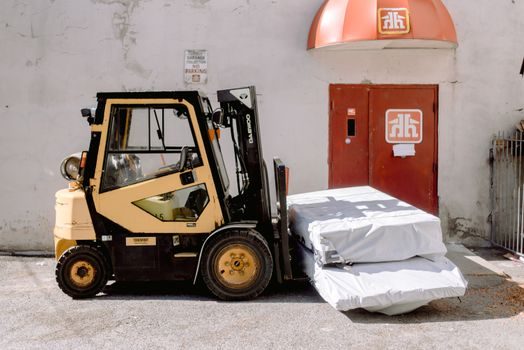
Standard 5,500 lb manual pallet jacks are built for occasional-shift duty on smooth concrete, while heavy-duty 6,000–8,000 lb SKUs add thicker fork plate, larger steer wheels and a chrome-plated piston for higher-cycle use [S1][S5]. The Crown PTH series is positioned by its OEM as the "serviceable, not disposable" class — meaning individual pump seals, load wheels and handle springs are stocked as service parts rather than throwing the whole truck away at end of life [S5]. The Lift-Rite LR2055 follows the same logic, with a full seal kit available aftermarket at $145 plus $33.64 freight [S2].
By comparison, a Tier 1 Alibaba 5,500 lb truck at the $200 end of the band typically ships with single-piece cast pump blocks, 80A polyurethane wheels and a one-year chassis warranty, with no separately stocked seal kit — a fine starter truck but a finite-life design [S1][S7]. For a buyer cross-shopping a pallet stacker at the same budget point, the manual jack is almost always the lower-cost, lower-throughput option; the stacker earns its premium when ground-to-second-tier pallet moves exceed ~30 per shift.
Total cost of ownership: a 5-year worked example
For a 5,500 lb manual jack running one 8-hour shift, six days a week, realistic lifetime is 5–7 years before chassis fatigue, with two wheel changes and one pump seal change in that window [S2][S5][S8]. At Tier 1 new pricing of $300 per truck + two wheel kits at $80 + one seal kit at $145, the 5-year landed cost lands near $605 per truck; at Tier 2 new pricing of $740 + $80 + $80 + $145, the 5-year landed cost lands near $1,045 per truck [S1][S2][S6][S8]. The Tier 1 truck is therefore roughly 42% cheaper over a 5-year window, even after paying for parts that the Tier 1 OEM does not stock as standard.
Used Tier 4 inventory at $1,399 with zero included warranty looks expensive on paper, but the heavy-gauge fork plate on a 2018–2022 vintage unit typically outlasts two Tier 1 chassis cycles, which closes the gap to roughly $700 per 5-year cycle once amortised [S3]. For a single-truck buyer, the worked example is simple: new Tier 1 ($605) beats new Tier 2 ($1,045) beats used Tier 4 ($700 nominal, $700 amortised), but the ordering pivot is the parts supply chain you can reach in 48 hours.
Who should buy what: selection rules for 2026
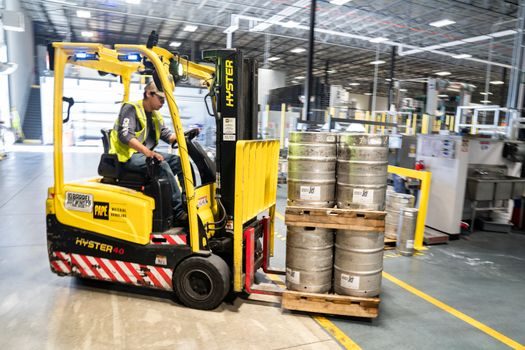
For under 10 trucks, light duty, and budget-driven purchasing, the Tier 1 Alibaba or Made-in-China 5,500 lb truck at $200–$400 is the rational pick, with the explicit understanding that you are buying chassis, not service parts [S1][S7]. For 10–50 trucks on multi-shift operation, the Crown PTH or Lift-Rite LR2055 class at $700–$900 is the correct call because the OEM service-parts network collapses your downtime risk on a fleet that is now a production-critical asset [S2][S5]. For one-off specialty needs — odd fork lengths, galvanised frames for washdown, stainless for food grade — used Tier 4 is often the only source, with $1,200–$1,500 the realistic landed range [S3].
Across all three tiers, the buyer is NOT a fit for a manual pallet jack if the workflow needs more than ~75 pallet moves per hour, repeated travel over 30 m, or any second-tier drop-off — at that point the right tool is an electric pallet truck, not a heavier manual jack [S9]. For a structured comparison of manual vs electric at the same capacity, the 2026 spec cut on manual vs electric pallet trucks is the natural next read, and the electric pallet truck buying guide covers the upgrade path.
Sourcing signals worth tracking into H2 2026
Two trackable signals will tell you whether the $200–$900 spread compresses or widens through the second half of 2026. Signal one is Alibaba Tier 1 bulk pricing on 2,500 PCS/month supply lines: the Okorder hand pallet jack listing posted 2026-06-09 quotes a "Ref Price" with a 1 PCS minimum and 2,500 PCS/month capability, so any published per-100 or per-500 price band is the most current floor on new chassis cost [S7]. Signal two is the US retail Tier 2 price for a 5,500 lb Dayton 493X19, which printed at US $739.99 on 2025-04-10 and is the cleanest retail benchmark to re-check against on a quarterly cadence [S6].
A third, weaker signal is the used Tier 4 clearing price, which moved from $1,399 on a 2025-03-17 listing to whatever the next batch clears at — useful only as a vintage-fleet price ceiling [S3]. A buyer who needs to lock cost before Q3 should pull a Tier 1 Alibaba quote at a named fork length, a Tier 2 retail line-item from a US distributor, and a current Tier 3 wheel/seal kit price, then write the order against the median.
For component-level specifications, see linear guide.