
Manual pallet jacks ship in 1,000–5,000 kg load ratings, with 2,500 kg as the dominant retail stockroom spec, and the 2,000–2,500 kg band covering roughly 80% of store-level receiving and shelf replenishment duty in North American grocery and big-box chains [S2][S4].
For retail distribution specifically, the manual pallet jack category is split between standard 2,500 kg hand-pump units for backroom work, narrow-aisle 540 mm fork-width variants for dense shelving, and galvanised or stainless units for cold-chain and wet-grocery environments; electric models show up only at the high-volume DC end of the retail supply chain [S1][S3][S7].
Load Capacity Bands and Fork Geometry
Standard manual pallet jacks are rated 1,000–5,000 kg, with the 2,500 kg unit accounting for the majority of retail purchases because it handles full pallets of bagged grocery, case-pack beverage, and general merchandise without forcing operators into the next weight class [S2].
Fork length clusters around 1,150 mm for EUR-pallet compatibility and 1,220 mm for the standard 1,219 × 1,016 mm CHEP pallet; fork width sits at 520 mm standard or 540 mm wide, and overall lowered height is typically 75–85 mm to clear the bottom board of standard stringer and block pallets [S2][S5]. Lift height tops out at 150–200 mm on a standard hand pump, which is enough to clear the floor but not enough to load a truck bed or stack onto pallet racking, a hard mechanical limit that distinguishes a pallet jack from a pallet stacker [S2].
Retail Backroom vs Distribution Centre: Same Tool, Different Spec
In store backrooms, the typical duty cycle is 10–40 pallet moves per shift over distances under 30 m, with load weights capped at roughly 1,500 kg after de-layering; in this band a standard 2,500 kg manual jack is the correct spec, and an electric unit would add cost without throughput gain [S1][S4].
At the regional distribution centre, shift volume climbs to 80–150+ pallet moves over 50–150 m hauls with full 2,000–2,300 kg loads, which is where electric pallet movers begin to justify their higher purchase price through reduced operator strain and faster cycle times; manual jacks remain in service for backup, dock spotting, and low-traffic aisles [S1][S4][S7]. A separate spec map covering that warehouse-automation crossover is in Manual Pallet Jack Selection for Warehouse Automation: Spec Bands, Throughput Limits.
Comparison: Manual vs Electric Pallet Jack for Retail Duty
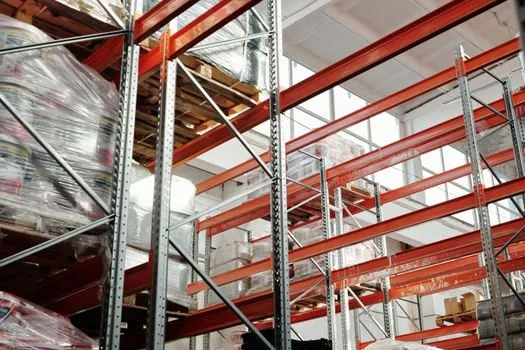
The four criteria that actually drive the buy decision in retail are upfront cost, training burden, throughput at peak, and aisle manoeuvrability, and the manual jack wins three of four against its electric sibling [S1][S4][S7].
On upfront cost, manual units list at roughly $300–$700 new versus a meaningful step-up for an electric model with battery and charger, and they require no charging infrastructure or battery rotation [S4]. On training, manual jacks need only a short on-floor familiarisation while electric units require OSHA operator certification in the US and equivalent instruction under provincial OHS rules in Canada [S4]. On peak throughput in a small backroom, the electric advantage is invisible because the bottleneck is the aisle, not the operator; in a 50,000+ sq ft DC running multi-shift, electric units move more pallets per hour because the operator is no longer the prime mover [S1][S4][S7]. On aisle manoeuvrability, the manual jack's compact frame and lack of powered components give it a 200–400 mm tighter turning footprint than a typical electric pallet mover, which matters in 2.4–2.7 m retail aisles [S7].
Spec Criteria That Drive the Model Number
Beyond capacity and fork size, four build options swing the model number in retail: wheel material, pump construction, frame finish, and handle ergonomics, and each is tied to a specific store environment [S2][S5].
Nylon wheels suit smooth concrete and protect floor coatings, polyurethane is the retail default for noise and roll resistance on sealed warehouse floors, and rubber or steel-loaded phenolic is reserved for wet, oily, or outdoor dock conditions [S5]. The hydraulic pump is either a one-piece cast unit, typical on entry-level retail jacks, or a welded steel pump with a chromed piston for higher-cycle DC duty; the chromed pump typically doubles service life under multi-shift loads but adds weight and cost [S5]. Frame finish is standard powder-coat for dry backrooms, galvanised for cold-storage and produce areas where condensation is constant, and full stainless (304 grade) for meat, seafood, and pharmaceutical retail where wash-down is daily [S2][S5]. Handle options include the standard loop handle for occasional use, an ergonomic three-position lever with polymer grip for full-shift operators, and a foot-lift variant for sites where the operator cannot comfortably pump a handle repeatedly [S5].
Ergonomics, Safety, and the NIOSH Overexertion Signal

Manual material handling is named in NIOSH data as a leading contributor to reported musculoskeletal disorders in the US workforce, and retail is exposed because the operator population is often non-specialist store staff rather than trained warehouse workers [S4].
The practical mitigation is not to abandon manual jacks, it is to cap the application: a 2,500 kg manual jack is appropriate for occasional moves of sub-1,500 kg loads by a fit operator on a flat sealed floor, and it is the wrong tool for sustained full-pallet shuttle duty at a DC [S1][S4]. For sites where pallet loads consistently exceed 1,800 kg or moves exceed 60 per shift, the spec should escalate to an electric pallet mover, not a heavier manual jack; for a parallel view on apparel-warehouse duty cycles, see Manual Pallet Jack Selection for Apparel Distribution: 2026 Spec Map.
When a Manual Jack Is the Wrong Spec
Manual pallet jacks are the wrong tool when any one of four conditions is met: pallet loads consistently above 2,300 kg, sustained shift volume above roughly 60 moves, travel distance over 75 m on a single move, or repeated loading into trailers where the lift height must clear a 600+ mm dock plate [S1][S2][S4].
Outside those limits, the operator is either the throughput bottleneck (volume case), the injury-risk bottleneck (load case), or both. The standard countermeasure is an electric pallet mover with a 1,500–2,500 kg load rating and a 100–150 mm powered lift, not a high-capacity manual jack; the manual unit at 3,000–5,000 kg ratings exists for heavy industry and is generally over-spec and harder to steer for retail staff [S1][S2][S4][S7].
Selection Checklist and Sourcing
The minimum spec sheet a retail buyer should lock before requesting quotes: capacity 2,500 kg, fork length matched to the dominant pallet (1,150 mm for EUR, 1,220 mm for CHEP), lowered height ≤85 mm, polyurethane tandem load wheels, three-position control valve, and frame finish matched to the wettest environment the unit will see [S2][S5].
For retail procurement, the two trackable signals in the next quarter are (a) whether OSHA or provincial OHS bodies tighten manual-handling guidance for retail backrooms, which would push fleets toward electric at the store level, and (b) any sustained upward move in the 2,500 kg retail-spec price band, which would compress the manual-vs-electric payback calculation in favour of a faster electric transition [S3][S4][S8].