
Apparel distribution runs on light, bulky pallets: case-packed shirts at 25 to 40 lb per case, poly-wrapped footwear at 30 to 50 lb, and folded denim or sweaters bundled onto standard 48" x 40" GMA pallets that rarely tip the scale past 2,000 lb loaded. The manual pallet jack class at 4,400 to 5,500 lb capacity therefore gives a 2x to 2.5x safety margin on the heaviest realistic load, which is why floor-level put-away and loading-dock work in apparel DCs is almost always specc'd for manual rather than powered units [S1][S3].
Three numbers decide the model: fork footprint, lowered fork height, and wheel material. For a GMA pallet you want forks at 27" wide x 48" long (the industry default), with a 21" narrow-fork variant reserved for the half-pallet and Euro-pallet footprints that show up in fashion retail backstock [S1]. Lowered height of 3.0 to 3.5 inches clears standard bottom-board decks without scrubbing, and the VEVOR-class manual truck published at a 3.35 to 7.1 inch fork lift range fits that envelope for under $500 street [S4].
Load Rating: Why 5,500 lb Beats 4,400 lb for Apparel Floors
Standard manual pallet jacks cover 4,400 to 5,500 lb, and heavy-duty manual models like the Xilin WB line stretch to 11,000 lb without adding a motor [S1]. For apparel the upper end of the standard band, 5,500 lb, is the pragmatic pick because case cartons compress and shift under fork pressure, and a fully loaded double-stacked GMA pallet of folded apparel can briefly spike above its rated static weight during a turn.
Spec'ing 5,500 lb over 4,400 lb costs roughly 10 to 20% more at the unit level and buys a thicker hydraulic cylinder, a reinforced handle linkage, and a heavier pump casting that all extend service life in a 2-shift DC. The 11,000 lb class is overkill for apparel unless the same jack is shared with a hardware or accessories dock, in which case one heavy-duty unit on the floor is cheaper than two [S1][S4].
Fork Geometry: 27" x 48" vs 21" Narrow Forks
The 27" x 48" fork is the GMA standard, and it is what every apparel DC receiving door should default to [S1]. Narrow 21" forks only earn their keep where you handle Euro-pallets (1200 x 800 mm), display pallets from retail stores, or half-pallet totes that show up in e-commerce returns; mixing fork widths across one floor creates operator confusion and scratched bottom decks.
For apparel specifically, the lower-profile cartons and high cube utilization on GMA pallets mean fork tip damage is rare, so a standard 0.2 to 0.25 inch steel thickness is sufficient. A tapered fork tip is worth the small upcharge when operators are sliding forks into gaylords of loose-packed hosiery or accessories, where a blunt tip tears corrugated.
Wheels, Floor Interface, and Pump Action

Polyurethane wheels are the right default over nylon or steel on apparel DCs because polyurethane is quieter on polished concrete, gentler on sealed or painted floors, and rolls more easily under a 1,500 to 2,000 lb loaded pallet [S1]. Nylon is harder and rolls easier on rough concrete but transmits more vibration into the load, which matters less for apparel than for pharmaceuticals or electronics but still shows up as operator fatigue after a shift.
Single-piece cast pump units with a 5 to 10 stroke lift cycle to clear the floor by about 1 inch are the operating standard; operators pump until the pallet just clears the deck, then shift the three-position lever (lower / neutral / raise) to neutral for travel [S2]. A leaking seal or a handle that requires more than 12 pumps to lift is the field test for end-of-life; if either shows up, the jack gets tagged out, not repurposed [S2].
Pre-Use Inspection: The Five-Point Daily Check
Every apparel DC should run a 60-second pre-shift check: forks for cracks or bends, wheels for flat spots or debris, handle for loose bolts, hydraulic pump for smooth raise/lower under no load, and the three-position control lever for clean detents [S2]. The capacity plate, usually stamped on the handle yoke, must be legible and match or exceed the heaviest pallet the operator will move that day [S2].
Two apparel-specific additions belong on the checklist. First, a quick scan of the load for loose poly wrap strapping, which can catch in the steer wheels and yank the operator forward. Second, a floor check for the plastic strapping and broken case-pack debris that are routine fallout on an apparel dock; both foul the steer wheels and make a manual jack feel heavier than its rating implies [S2].
Operating Cadence: Pull vs Push, Speed, and Foot Position
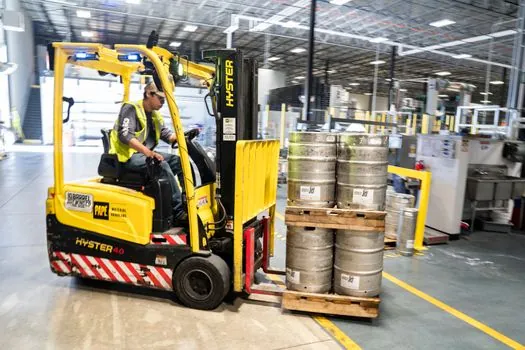
Pulling a loaded manual jack toward you gives better control and visibility; pushing is reserved for forward sightlines and short repositioning moves [S2]. Operators are taught to keep feet clear of the forks and wheels at all times because manual pallet jacks have no brakes, and a 1,500 lb pallet on a polished concrete floor will not stop when the operator stops [S2].
For apparel work, a slow walking pace, roughly 2 to 3 mph, is the right ceiling. Faster than that and the poly wrap on the load aero-shifts; slower and the DC's cycle time target slips. Wide turns, not pivot turns, are the rule in any aisle narrower than the truck's turning radius plus two feet of pallet overhang [S2].
Where Manual Wins, and Where It Loses, in an Apparel DC
Manual wins in receiving (single-pallet drops from a truck), in the staging lane between sortation and the pallet rack face, and in will-call / store-replenishment aisles where pallets move 20 to 50 ft at a time [S1][S3]. It loses in cross-dock operations longer than about 200 ft, in e-commerce fulfillment where a single operator can hit 80 to 120 pallet touches per shift, and in any cold-chain apparel add-on (refrigerated pharmaceuticals co-located in a retail DC) where operator fatigue compounds.
Manual pallet handling equipment accounted for 52.7% of the global pallet handling market in the past years, while electric pallet trucks represent approximately 42% of pallet jack demand globally, with rapid growth in warehousing and e-commerce [S3]. The apparel sector sits firmly in the manual majority, but the boundary is moving: a DC moving more than 150 pallets per operator per shift on long hauls should be re-speccing at least part of the fleet to powered units, and running the rest as manual backup [S1][S3].
Comparison: Manual vs Electric Pallet Jack for Apparel Use Cases

On purchase price, manual is 4x to 8x cheaper upfront than an electric pallet jack, with no battery, charger, or motor service over the life of the unit [S1][S3]. On throughput, an electric unit can move 2x to 3x the pallets per hour of a manual one in high-volume pick operations, but in an apparel DC the average pick path is short enough that the manual figure, 30 to 50 pallets per operator per shift, is rarely the binding constraint [S1].
On operator fatigue, electric wins decisively above 8 hours of continuous manual pumping per shift, but most apparel DC operators do not hit that volume on a manual jack because the case weights are low. On maintenance, manual needs only annual seal and wheel inspection, while electric adds battery watering or lithium monitoring, charger checks, and controller diagnostics [S1][S3]. For the standard apparel DC, a fleet of manual jacks backed by one or two electric units for the longest cross-dock hauls is the right balance; for a 100,000-plus sq ft automated apparel fulfillment site, the ratio flips.
Standards, Floor Conditions, and Sourcing Notes
Apparel DCs operate on sealed, often polished concrete with a flatness tolerance that lets a manual jack roll smoothly when the floor is clean. The pre-use inspection must explicitly include floor condition, because a wet or debris-littered floor turns a manual jack into a safety hazard; tag the area and reroute, do not push through [S2]. Fork tip taper, polyurethane vs nylon wheel selection, and the three-position lever detent are the three spec-line items most often negotiated at order time, and the manual pallet jack spec sheet should be reviewed against the heaviest realistic load and the longest realistic hauls, not the catalog maximums.
For apparel operations that also handle hanging-garment carts, boxed footwear, or retail display fixtures, a related spec map on automotive-parts logistics covers heavier load classes, and the pharmaceutical distribution spec map covers the clean-room and stainless variants that occasionally show up in retail-DC cold-chain add-ons. Operators moving more than 150 pallets per shift on long cross-dock runs should be piloting at least one electric pallet jack on a 90-day trial before re-fleeting, with throughput and injury-rate data collected weekly.
The underlying component specifications are covered under distribution cabinet.
Background reading: Slewing Ring Bearing Selection for Packaging Lines: Diameter, Load and Lubrication Spec.