
Angular contact bearings specified for marine propulsion gear, azimuth thrusters, and deck machinery must handle combined radial and axial loads, salt-spray corrosion, and continuous misalignment cycles; matched-pair mounting in DB or DF arrangement is the default rule for any angular contact bearing carrying bidirectional propeller thrust [S3][S8].
Contact angles of 25, 30, 35, and 40 degrees govern load-share between radial and axial capacity: a 40-degree unit carries more thrust at the cost of lower limiting speed, while a 25-degree unit runs faster but accepts less axial load [S8]. Marine propulsion engineers typically pick 30-40 degrees for propeller-shaft support and 25-30 degrees for marine gearbox pinion shafts where speed and rigidity both matter.
Bearing Family and Series Codes Relevant to Marine Duty
Single-row angular contact ball bearings in 7200, 7300, and 7400 series (ISO 15) cover the bulk of marine main-shaft and gearbox applications, with 7200 B series (40-degree contact) the most common for combined loads per industry catalogue listings [S2][S7]. Bore ranges in the 7234 B/DF and 7244 B/DT cross-sections run 170 mm to 220 mm, width 104 mm to 130 mm, mapping to propeller-shaft diameters on mid-size vessels [S7].
Double-row angular contact types (e.g. ZKLF series, two-row ball-screw support) cover bores 6-90 mm, outer diameters 19-190 mm, and are used where axial stiffness matters more than speed; flanged outer rings simplify marine gearbox housing machining [S4]. Four-point contact ball bearings (QJF series, e.g. QJF1064M at 320x480x74 mm) handle pure axial load in both directions and are common on marine rudder and stern-tube carrier positions [S7][S8].
Matched-Pair Mounting, Preload, and Internal Clearance Classes
Single-row angular contact units can only support axial load in one direction, so matched bearing mounting in DB (face-to-face), DF (back-to-back), or DT (tandem) is the standard fitment practice for marine propulsion shafts and marine gearboxes [S3]. Preload is set by grinding a controlled offset on the inner or outer race; matched pairs arrive pre-ground to a target axial clearance class (C2, CN, C3, C4 per ISO 5753) so the engineer does not hand-shim on the dock.
DB mounting (face-to-face) gives a shorter effective span and tolerates misalignment better, which is why it appears in marine gear pinion supports; DF (back-to-back) gives a wider effective span and higher moment stiffness, preferred for propeller-shaft struts where deflection under reversing thrust must stay tight [S8]. DT (tandem) shares load along one axis only and is paired with a third bearing in the opposite direction for full bidirectional thrust. Cage material selection follows service temperature: brass or phenolic for marine gearbox steady-state 80-150°C, while PEEK or bronze-back PTFE appears on higher-temperature zones near marine engine take-off casings [S3].
Corrosion, Sealing, and Lubrication Constraints
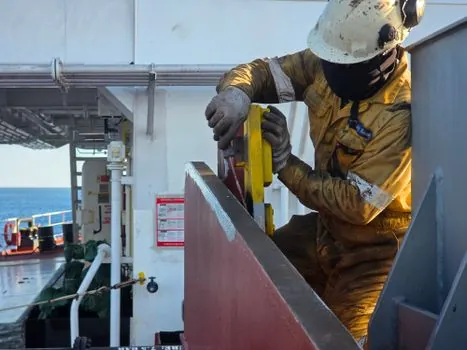
The 7234 B/DF and 7244 B/DT cross-sections ship in standard steel for enclosed marine gear service [S7]; deck-exposed duty asks for 440C or marine-grade ring material plus contact seals (2RS, 2RZ) or matched metallic shields.
Grease retention on marine bearings is critical because salt ingress and water washout are real failure modes; classifiable marine greases with EP additives, water resistance, and salt-spray resistance (per the bearing-maker's published grease compatibility chart) are specified at the bearing-swap interval rather than at installation [S5]. Operating temperature ceilings for marine greases on exposed deck machinery typically cap at 120-150°C; above that, oil-mist or forced-oil lubrication of the bearing housing is the standard engineering answer for stern-tube and thrust-block service.
Selection Criteria Comparison: ACBB vs Four-Point vs Double-Row vs Cylindrical
For marine applications, the choice between the main angular contact variants lines up against four decision axes: axial capacity, limiting speed, bidirectional load support, and corrosion-package availability. The table below maps typical spec data from the cited catalogues onto marine propulsion use cases. [S3]
Single-row ACBB (7200-7400 series, 40°): axial capacity high in one direction, bidirectional only when matched-paired, limiting speed moderate, standard steel or 440C available. Used for marine gearbox pinion and propeller-shaft lines [S2][S7]. Double-row ACBB (ZKLF series, 60° effective): high axial stiffness, low-speed favor, flanged or unflanged, used for ballscrew-feed deck machinery and rudder actuators [S4]. Four-point contact (QJF series): handles pure axial load in both directions as a single unit, lower radial capacity, used for marine rudder carrier and stern-tube positions [S7][S8]. Cylindrical roller (roller bearing family): high radial capacity, zero axial capacity on standard NU/N types, used for marine shaft line-up but never in pure thrust duty. The right answer is: matched 7200-series ACBB for combined-load main shafts, QJF for pure bidirectional axial duty, cylindrical only when the axial load is fully reacted elsewhere.
Quality Control Signals from Production Lines

Modern angular contact bearing production lines run inner/outer diameter height detection, channel sorting, retainer steel-ball loading, cleaning, bulge detection, runout detection, vibration measurement, atomization cleaning, and SPC quality monitoring as a single integrated sequence; that is the public manufacturing spec for new single-row ACBB assembly [S1]. Buyers evaluating a marine bearing source should ask for documented SPC output on the matched-pair runout (typical spec under 2-3 µm for precision classes P4/P2) rather than relying on catalogue rating alone.
Chinese export-catalog data through 2026-07-29 still shows US$0.12-0.50 per piece at 1,000-piece MOQ for general-purpose ACBB pillow-block units, with stainless-steel 440C variants at a higher price band, useful for budgetary framing but not for marine propulsion main-shaft service [S6]. Ceramic bearing hybrid variants (Si3N4 balls, steel rings) appear in marine bearing-maker catalogues for high-speed or salt-exposed duty where electrical-isolation of the bearing from shaft current is also a concern, though hybrid marine propulsion is still a specialty application rather than the default [S5].
Where Angular Contact Is the Wrong Choice in Marine Service
Angular contact bearings are not the right call for very large-bore slow-rotating propeller-shaft lines where plain white-metal bearings or tilting-pad thrust bearings dominate; the practical ACBB bore ceiling for standard catalogue units sits around 200-250 mm in production volume, beyond that custom lead times extend sharply [S7]. They are also not the right call for marine slewing-ring duty (e.g. offshore crane pedestal, deck crane slew drive) where slewing bearing four-point or crossed-roller types in the 500-4000 mm diameter range take over.
For low-speed high-radial applications such as marine shaft-line support, roller bearing cylindrical (NU, N, NNU) types are usually cheaper and easier to mount. The matched-pair ACBB cost premium, plus the preload procedure, is only justified when combined load or pure axial thrust actually exists; mis-applying ACBB on a pure radial duty burns budget for no performance gain.
Trackable Signals for Q4 2026 Spec Updates
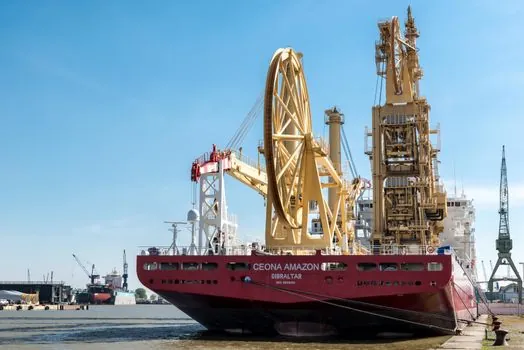
Two near-term signals worth watching: published updates to ISO 15 (rolling bearings, radial bearings, single-row angular contact, boundary dimensions) for any contact-angle or tolerance revision, and class society rule changes (DNV, Lloyd's Register, ABS) for marine azimuth-thruster and pod-propulsion bearing monitoring requirements. updated price lists on made-in-china.com under the 7200/7300/7400 search) for any meaningful marine-grade price movement, as the 2026-07-29 export price band sits at US$0.12-0.50 per piece for general-purpose units and is the current benchmark to beat [S6].
For deeper cross-application context, the angular contact bearing selection map for steel mills covers high-temperature continuous-duty gates, while the angular contact bearing selection for wind power piece covers variable-load pitch and yaw systems; both share the matched-pair, 30-40° contact-angle, and P4/P2 runout logic that governs marine main-shaft and gearbox service.