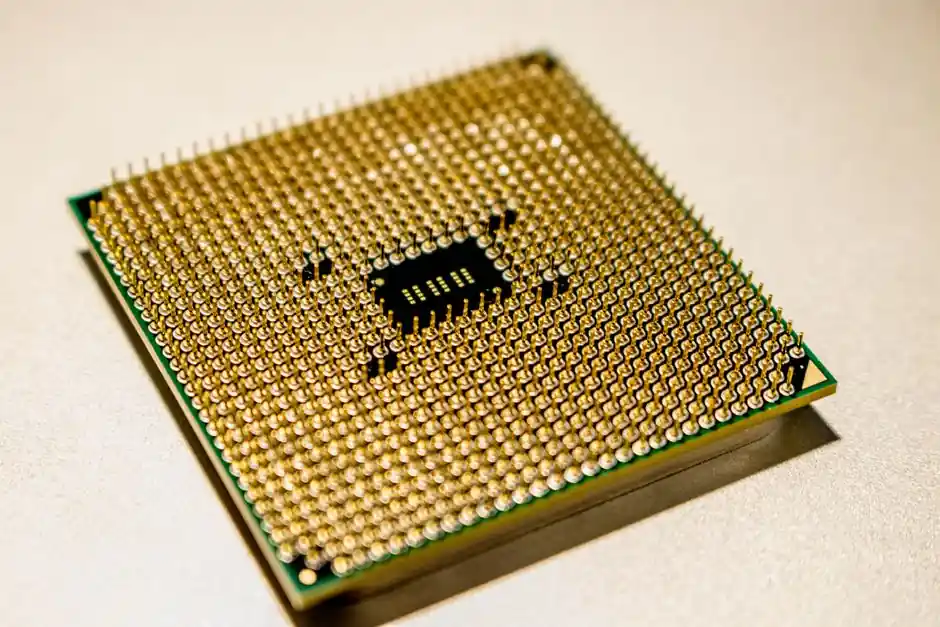
The 2026 MCU recovery is selective: STMicroelectronics reported Q2 revenue of $3.49 billion and inventory days down to 126 from 166 a year earlier [S5].
Demand is broadening across automotive, industrial, communications and general-purpose products, while some power and discrete-device businesses remain weak, making lead times and availability product-specific rather than market-wide [S5].
What Changed After the 2023–2024 Inventory Correction
The correction began with excess inventories at manufacturers and distributors after the 2021–2023 shortage, followed by order cancellations, write-downs and reduced wafer starts at mature 40 nm, 55 nm and 90 nm process nodes [S1]. China research describes the 2023–2024 phase as a deep inventory correction that worked down excess capacity and inventory [S7].
The correction had consumed much of the excess inventory, while AI-edge processing, automotive ADAS, and industrial IoT emerged as new demand vectors pressuring supply in certain segments [S1]. This is not a uniform return to the 52-week lead-time environment.
STMicroelectronics reported Q2 2026 net revenue of $3.49 billion, up 26% year over year and 12.7% sequentially, while gross margin reached 34.8% and operating margin improved to 5.4% [S5]. Its Q2 net income was $222 million, compared with a loss in the same quarter of 2025 [S5]. Those results connect the inventory correction with better factory loading and an improving product mix, rather than with a simple surge in unit availability.
Inventory Signals Point to a Two-Speed Recovery
STMicroelectronics inventory stood at $3.19 billion in Q2 2026, but the more revealing metric was inventory days: 126 days, down from 140 days in Q1 and 166 days in Q2 2025 [S5]. Distribution inventory was also below the company’s standard target, while bookings were strong across all end markets [S5].
STMicroelectronics reported distribution inventory below its standard target level [S5].
The recovery remains two-speed. General-purpose MCUs, optical-connectivity controllers and selected industrial products warrant closer supply monitoring, whereas ST’s power and discrete businesses continued to show weak utilization and significant operating losses [S5]. Spot-market activity moved in the same direction before STMicroelectronics' earnings release, with increased search interest and inquiries for several STM32 families [S5].
Demand Drivers by MCU Type

General-purpose MCU demand is supported by automotive electrification, industrial automation and battery-powered consumer devices, with the low-power general-purpose segment forecast to rise from $5.13 billion in 2025 to $5.479 billion in 2026 [S2].
AI-edge devices form a distinct demand pool because smart sensors, industrial cameras, predictive-maintenance nodes, wearables and embedded controls can execute small inference models locally.
Automotive architectures add a different constraint.
Architecture Selection Criteria
Low-power general-purpose MCU revenue is concentrated in 32-bit devices, which hold a 58% share [S2].
The 8-bit and 16-bit microcontroller markets serve legacy and cost-sensitive designs [S2].
Regional Mix and Americas Capacity
Asia-Pacific is the largest regional market for low-power general-purpose MCUs [S2].
The Americas MCU market was estimated at $739.52 million in 2026, up from $725.23 million in 2025, with a forecast to reach $815.33 million by 2031 at a 1.97% CAGR [S4].
Near-shoring support includes the $52 billion US CHIPS and Science Act and Brazil’s $186.6 billion Nova Indústria Brasil program, both linked to new fabrication and design capacity intended to reduce exposure to Asian supply risk [S4]. Regional diversification does not eliminate mature-node bottlenecks, especially where automotive qualification, package requirements or software ecosystems restrict interchangeability.
Procurement Limits and Failure Modes
Long lead times are most credible where several constraints overlap: scarce 40 nm or 55 nm wafers, complex package demand, customer-specific qualification and limited approved suppliers. Automotive MCUs are especially sensitive because safety qualification restricts source changes, while AI-edge products can face allocation pressure from higher die complexity and newer production ramps [S1].
Inventory digestion remains a downside risk in automotive, and prolonged wafer-price inflation could interrupt the recovery [S2]. The forecast for low-power general-purpose MCUs also assumes no severe foundry disruption through 2034 [S2]. That assumption matters because mature-node price increases and production interruptions can undermine otherwise visible order books.
Spot purchasing also carries a second-order risk. Higher prices can attract dealer-to-dealer trading and precautionary buying, creating temporary price strength that does not necessarily represent end demand [S5]. Procurement teams should distinguish manufacturer lead time, authorized-distributor stock, broker inventory and customer consumption before treating a price move as a durable shortage signal.
How Buyers Should Track the Recovery

Inventory days, distribution stock and order visibility provide the clearest early signals. ST’s reduction from 166 inventory days to 126, combined with distribution inventory below target and bookings across every end market, demonstrates why channel inventory matters as much as revenue growth [S5].
For industrial buyers, the useful comparison is between mature 8-bit or 16-bit control devices and more capable 32-bit or 64-bit controllers. The decision should balance price and power consumption against flash size, real-time performance, connectivity, software migration effort and qualification constraints. In the Americas, 64-bit and higher devices are forecast at a 5.54% CAGR through 2031, while wireless-enabled MCUs are forecast at 6.44% [S4].
Two measurable signals can confirm whether selective tightness is becoming a broader constraint: further reductions in manufacturer and distributor inventory days alongside lengthening quoted lead times, or rising allocation pressure in automotive and AI-edge families without improvement in end-equipment shipments. Until both appear, the evidence supports a market in recovery, not a return to the 52-week shortage episode [S1][S5].