
Truck megawatt charging systems can deliver up to 3.75 MW at 1,250 V and 3,000 A, enabling heavy electric trucks to recharge during 30–45-minute driver breaks.
The global market supports depot, port, industrial-terminal and long-haul corridor deployments, with 2026 forecasts ranging from $279.2 million for manufacturer-level MCS hardware to $944.3 million for the broader truck megawatt charging market.
Megawatt charging removes the dwell-time penalty
The Megawatt Charging System is designed for heavy battery-electric trucks and buses with large packs that require power above 1 MW. MCS delivers up to 3.75 MW at 1,250 V direct current and 3,000 A [S5].
Field demonstrations have charged battery-electric commercial vehicles from the demonstration state to 80% state of charge or full charge within the 30–45-minute rest periods scheduled for long-haul operations [S4]. A demonstration showed battery-electric commercial vehicles charged to 80% or fully charged during legally mandated driver rest breaks of 30 to 45 minutes [S4].
That timing matters because a typical heavy truck carries a battery of several hundred kilowatt-hours. The MCS objective is not simply higher peak power; it is to restore enough range during the legally scheduled pause without adding four to five hours to a route [S3][S5].
Market forecasts show a fast but non-uniform ramp
Published 2026 market estimates differ sharply because their scope definitions differ. One forecast values the truck MCS system segment at $279.2 million in 2026 and $2.88 billion in 2035, a 29.6% compound annual growth rate from 2026 through 2035 [S1].
The truck megawatt charging market is projected to grow from $0.94 billion in 2026 to $9.65 billion by 2034, at a CAGR of 33.8% [S2]. A separate 2026 MCS report estimates $0.99 billion in 2026 and $2.20 billion in 2030, representing a 22.2% CAGR [S6][S7].
The numbers should not be blended. The global truck megawatt charging system market was valued at $175.1 million in 2025 and is projected to reach $279.2 million in 2026 [S1]. The wider truck-market studies can encompass associated infrastructure and service categories [S1].
Selection depends on power, site and control strategy
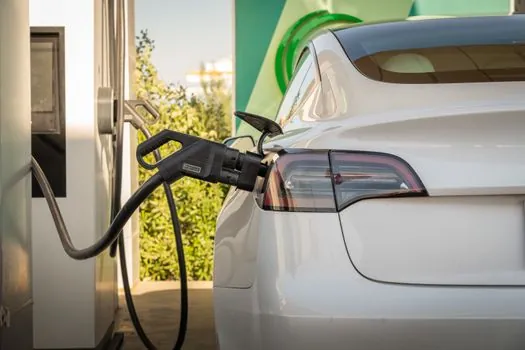
MCS is a charging standard for heavy electric trucks and buses, with demand concentrated at freight depots, long-haul corridors, industrial terminals and ports where charging speed directly determines vehicle utilization [S1][S5].
The comparison criterion is not peak power alone. Grid availability, dwell time, truck compatibility, redundancy and software control determine whether a megawatt rating produces useful fleet capacity. MCS hardware also needs a suitable power cabinet, liquid-cooled connector, communications path and protection arrangement, not just a high-power outlet.
Interoperability now has a published technical specification
IEC TS 63379 was published on 9 February 2026 under the CharIN industry alliance effort, providing the basis for interoperability between vehicles and charge points from different manufacturers [S5]. The international specification IEC TS 63379 creates a basis for interoperability between vehicles and charge points from different manufacturers [S5].
MCS has charging power of up to 3.75 MW at 1,250 V and 3,000 A of direct current [S5]. MCS is designed to deliver rapid charging for trucks and other large electric vehicles such as buses [S3].
Interoperability remains more than connector geometry. A fleet operator must verify that the truck’s battery voltage window, maximum current, thermal limits, charge curve and communication implementation match the installed dispenser. A physically compatible plug does not prove that a vehicle will accept the station’s full power profile [S3][S5].
Grid access is the principal deployment bottleneck

With MCS, the central question shifts from vehicle technology to the grid connection and the digital control behind it [S5]. This constraint shifts site selection from a simple charger-footprint decision to an electrical infrastructure and permitting exercise.
At IAA TRANSPORTATION on 14 September 2026, Milence was joined by Daimler Truck, MAN Truck & Bus and Scania for a demonstration of the Megawatt Charging System [S4]. The live demonstration provided an opportunity to advance interoperability and prepare MCS for widespread commercial deployment [S4].
Buffer storage is not a substitute for adequate interconnection, but it can decouple part of the instantaneous charging load from the site peak.
Europe is turning mandates and corridors into demand
Europe needs up to 5,300 public megawatt chargers for electric trucks by 2030, creating a quantified infrastructure pipeline [S1][S5]. Germany’s charging master plan targets approximately 4,200 MCS and CCS charge points by 2030, while European AFIR requirements are intended to establish truck-charging pools along TEN-T corridors [S5].
Milence reported more than 2,000 publicly accessible heavy-duty charging points across Europe and almost 40 operational hubs in nine markets. The operator plans 70 hubs by the end of 2027, with more than half supporting MCS, and a separate MILES project covers 284 MCS charge points at 71 sites across ten EU countries [S4][S5].
The first German public MCS point opened at the A2 Lipperland Sued service area on 29 September 2025, delivering up to 1.2 MW [S5]. North America was identified as the largest regional MCS system market, while Asia Pacific was projected as the fastest-growing region in the manufacturer-hardware forecast [S1].
Market expansion still has measurable execution risks

Grid connection queues, equipment standardization and truck availability determine when fleet plans convert into installed hardware [S1]. The commercial risk is therefore split between stranded infrastructure and delayed vehicles. A site built without confirmed vehicle pipelines can wait years before utilization develops, while a truck ordered without compatible charging cannot gain operational value from an early corridor installation.
Three signals provide a practical market test: the number of truck models configured for MCS, the number of public hubs reaching operational status, and the share of sites with confirmed medium-voltage capacity or an engineered storage solution. Europe already has more than 2,000 public heavy-duty charging points and a planned pipeline of 284 MCS points at 71 sites, but deployment dates remain tied to grid and construction schedules [S4][S5].
The 2026 evidence supports genuine infrastructure growth, not a completed transition. MCS has a published interoperability specification, a maximum rating of 3.75 MW, demonstrations that reached 80% charge within driver rest breaks, and multibillion-dollar forecast ranges through 2030–2035 [S1][S2][S3][S4][S5][S6][S7][S9].