Medium-level order picker platform heights span roughly 2.8 m to 12.1 m across current OEM lines, with the 6 m to 7.5 m band the most common for 1.0 to 1.25 t class trucks aimed at second- and third-level rack picking [S2][S5][S7]. The "medium-level" label is applied loosely, so the practical cutoff between low/medium and medium/high is closer to a 4 m platform floor and a 7.5 m platform ceiling, not a single fixed number [S4][S7].
Engineers specifying a truck for a 6 m rack should compare platform height (where the operator stands) against picking height (top of the second-level reach), since the two differ by 1.0 m to 1.6 m on every spec sheet reviewed [S3][S5]. A useful rule of thumb from the data: picking height is platform height plus 1.0 m to 1.6 m of fork or operator reach, with the exact delta published per model in the OEM datasheet.
What "medium-level" actually covers in 2025/2026 OEM catalogs
CAT Lift Truck splits its order picker line into "Second and Low Level" (1.2 m or 1.8 m rising platform, picks up to 2.8 m or 3.4 m) and a separate "Medium and High Level" line at 1.0 to 1.2 t capacity [S4]. That vendor-side split is the cleanest public definition of the medium band: anything above the 1.8 m / 3.4 m low-level ceiling and below dedicated high-level VNA turret trucks.
TCM's EO series publishes platform heights up to 10,500 mm and a maximum picking height of 12,100 mm, with load capacity 1,000 to 1,250 kg, truck width 810 to 1,350 mm, and travel speed 9 to 12 km/h [S5]. That 10.5 m platform / 12.1 m pick ceiling sets a hard upper edge on what gets called "medium-level" in 2025/2026 EU catalogs, with anything above that crossing into VNA turret territory [S4].
Toyota's Optio medium-to-high-level line tops out at a 12.1 m picking height, available in rail- or wire-guided configurations, mirroring TCM's ceiling within the same market segment [S2][S7]. The fact that two independent EU majors publish the same 12.1 m max suggests that number is a structural limit (mast column stability, operator fall-arrest reach, and EN ISO 3691-1 sightline geometry) rather than a coincidence.
Spec ranges side-by-side: low, medium, and high-level cutoffs
The clearest public comparison uses CAT's own two-tier split plus the Crown and Big Joe US-side numbers. CAT low/second-level: 1.2 m or 1.8 m platform, picks to 2.8 m or 3.4 m [S4]. CAT medium/high-level NOM10P / NOH12PH: 1.0 to 1.2 t, no platform height on the page but capacity-bracketed for higher lifts [S4]. TCM EO: 1.0 to 1.25 t, platform to 10.5 m, picking to 12.1 m [S5]. Toyota Optio: medium to high level, picking to 12.1 m, rail or wire guidance [S2][S7].
On the US side, Crown's mid- and high-level man-up line publishes up to 118 in (about 3.0 m) for the WAV 60 work-assist vehicle and 3,000 lb (1,360 kg) capacity on the SP 3500/4000 stockpicker series [S1]. Big Joe lists six lift heights from 177 in to 354 in (4.5 m to 9.0 m platform), with platform raise points at 126 in, 162 in, and 192 in (3.2 m, 4.1 m, 4.9 m) [S3]. Conger publishes a high-level man-up figure of 371 in platform, forks to 366 in, 3,000 lb capacity [S6]. The pattern: the same truck is sold in three or four platform height options, so "medium-level" is a range, not a single SKU.
Selection criteria: capacity, platform height, and aisle width
The first citable selection criterion is load capacity, which sets the structural limit on platform height. The 1.0 to 1.25 t medium-level band (TCM EO 1,000 to 1,250 kg, CAT NOM10P / NOH12PH 1.0 to 1.2 t) corresponds to platform heights up to roughly 10.5 m before mast and counterweight sizing force a step up to a heavier high-level chassis [S4][S5]. Pushing above 1.25 t on a 10 m+ lift typically forces a wider truck, which then forces a wider aisle.
The second criterion is aisle class, which interacts with truck width. TCM's EO widths run 810 to 1,350 mm; Toyota Optio's rail/wire guidance versions are intended for very narrow aisle (VNA) operation [S2][S5]. Crown's mid-/high-level man-up line is described as "especially within narrow and very narrow aisle warehouses" with operator raised alongside the load [S1]. A 1,000 mm-wide medium-level picker on wire guidance is a different machine from a 1,350 mm-wide medium-level picker on free-path guidance, even at the same 8 m platform height.
The third criterion is platform raise mechanism. A rising-operator platform (man-up) gives direct eye-level picking but adds fall-arrest requirements; a man-down design keeps the operator on the ground and lifts only the forks, capping practical picking height around 3 m. The medium-level band in current OEM catalogs is dominated by man-up, since man-down designs fade out above roughly 3 m of useful picking height [S1][S3][S5].
Who medium-level order pickers are for, and who they are not for
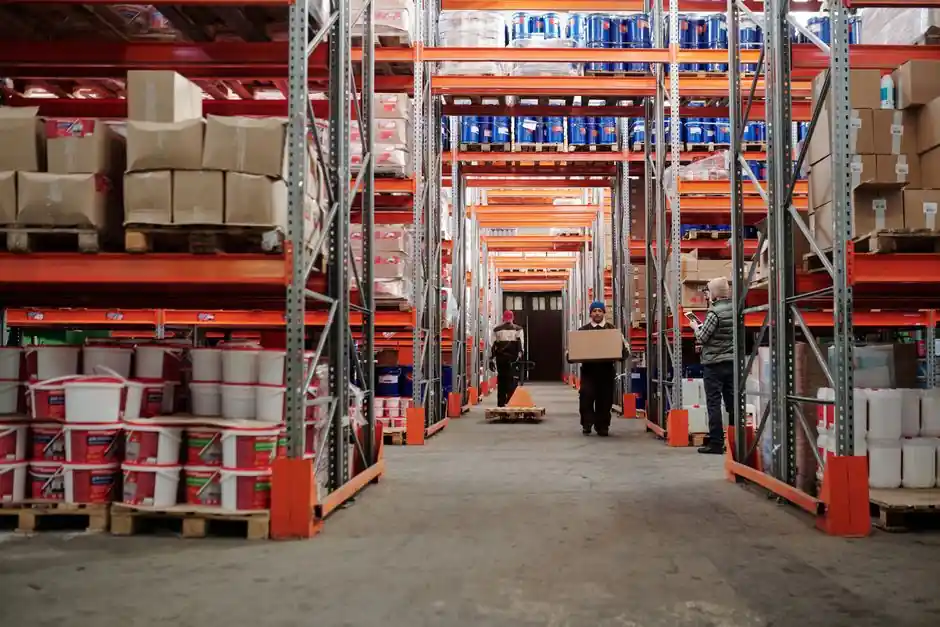
Medium-level order pickers fit warehouses with rack top-heights between roughly 4 m and 11 m, where picking is still order-by-order (not full-pallet) and where aisle widths can accommodate trucks in the 810 to 1,350 mm width range [S1][S2][S5]. That covers most general-merchandise DCs, parts warehouses, and e-commerce fulfillment operations that have moved beyond ground-level picking but do not run true VNA turret trucks.
They are not the right tool for ground-only picking under 2.5 m, where a low-level picker (CAT NO12-25N2F or the 1.0 t NOL10P) is cheaper and faster [S4]. They are also not the right tool for true high-bay VNA operation above 12 m of picking height, where a man-down VNA truck (CAT NTD13-15N3, 1.3 to 1.5 t) or a man-up turret truck (CAT NVT11-20XL, 1.1 to 2.0 t) is the engineered choice [S4]. For work zone safety context on adjacent equipment, the order picker encyclopedia entry covers the broader machine class and how platform height fits into the overall spec.
One trap to avoid: the 12.1 m picking-height number quoted by both Toyota and TCM applies to the truck standing on the floor, not to the operator's reach from a raised platform with a fall-arrest rail extended. Specifiers should confirm in the OEM datasheet whether the published picking height is the top of the mast fork or the top of the second-level operator reach, since the two values can differ by 1 m to 1.5 m [S2][S5][S7].
Failure modes and constraints at the platform-height envelope
Mast stability is the dominant mechanical constraint as platform height climbs. The 10.5 m platform / 12.1 m pick ceiling shared by TCM and Toyota corresponds to a 24/48 V electric chassis in the 1.0 to 1.25 t class; pushing higher requires moving up to higher-capacity mast sections, which adds truck mass and forces a wider wheelbase [S2][S5]. Above roughly 12 m of picking height, the platform-height-to-base-width ratio crosses a stability threshold that the EU EN ISO 3691-1 standard family addresses through mandated tilt and wind-load checks.
Operator fall protection is the second constraint. Crown's mid- and high-level man-up line raises the operator alongside the load, which requires integrated harness anchor points and, in many jurisdictions, a secondary guarding system on the platform edge [S1]. Big Joe's order picker line lists collapsed height at 62.6 in (1.59 m) for the lowest platform option, which is the dimension that matters when the truck has to clear doorways and dock-level approaches between shifts [S3].
Floor loading and battery swap are the third constraint. TCM's EO series advertises an "efficient battery exchange" to keep multi-shift operations running, and ECO mode saving around 6% on running costs is presented as a meaningful TCO lever [S5]. For a 10 m+ platform picker, the battery mass is a large fraction of total truck mass, so the battery-swap architecture is part of the platform-height decision, not a separate one.
Comparison table: 5 OEM medium-level data points
Pulling the headline numbers from each source into a single matrix makes the platform-height range concrete. Toyota Optio: 12.1 m max picking height, rail or wire guidance, medium to high level [S2][S7]. TCM EO series: 10,500 mm platform, 12,100 mm picking height, 1,000 to 1,250 kg, 810 to 1,350 mm wide, 9 to 12 km/h [S5]. CAT medium/high-level NOM10P / NOH12PH: 1.0 to 1.2 t capacity, model-bracketed for higher lifts [S4]. Crown mid-/high-level man-up: 118 in (3.0 m) on the WAV 60 work-assist, 3,000 lb (1,360 kg) on the SP 3500/4000 series [S1]. Big Joe: six platform heights from 177 in to 354 in (4.5 m to 9.0 m), with 126/162/192 in raise options and 62.6 in collapsed height [S3].
The takeaway from that matrix: the medium-level band is a 4 m to 12 m platform-height corridor populated by multiple SKU options per vendor, not a single number. Specifiers should pin the platform height and picking height separately, then verify the truck width and guidance type against the target aisle class before locking the model.
Standards, sourcing, and the data points worth tracking
No single harmonized standard defines "medium-level" as a discrete truck class. The boundary is set implicitly by the EN ISO 3691-1 industrial truck safety family, by OEM product-line segmentation (CAT, Crown, Toyota, TCM, Big Joe), and by warehouse racking practice where 4 m to 11 m rack top-heights dominate general-merchandise DCs. The US-side OSHA 1910.178 forklift standard and the EU Machinery Directive 2006/42/EC both apply at the platform-height envelope, but neither carves out a "medium" sub-band [S1][S2][S4][S5].
Two trackable signals for the next spec cycle. First, watch whether any major OEM publishes a 1.25 t class truck at a platform height above 10.5 m; both Toyota and TCM currently top out at 12.1 m picking height in this capacity band, and a published breach of that ceiling would signal a new structural or stability limit being crossed [S2][S5][S7]. Second, watch the 6% ECO-mode running-cost claim on TCM's EO series; if it holds across the next data refresh, it is a usable TCO benchmark for medium-level 1.0 to 1.25 t electric pickers in 2026 procurement [S5]. For adjacent equipment context, the platform trolley entry covers non-powered variants that share the same platform-geometry vocabulary at ground level.
Three signals to pin in a spec sheet today: platform height (not picking height) in mm, picking height in mm with the OEM's definition noted, and truck width in mm against the target aisle class. If those three numbers align with the 4 m to 10.5 m platform / 12.1 m pick / 810 to 1,350 mm width corridor above, the truck sits inside the current medium-level band as published by the major EU and US OEMs in 2025/2026 [S1][S2][S3][S4][S5][S7].
For component-level specifications, see height gauge.
Background reading: Automated overhead cranes: steel coil yards and paper roll handling compared.