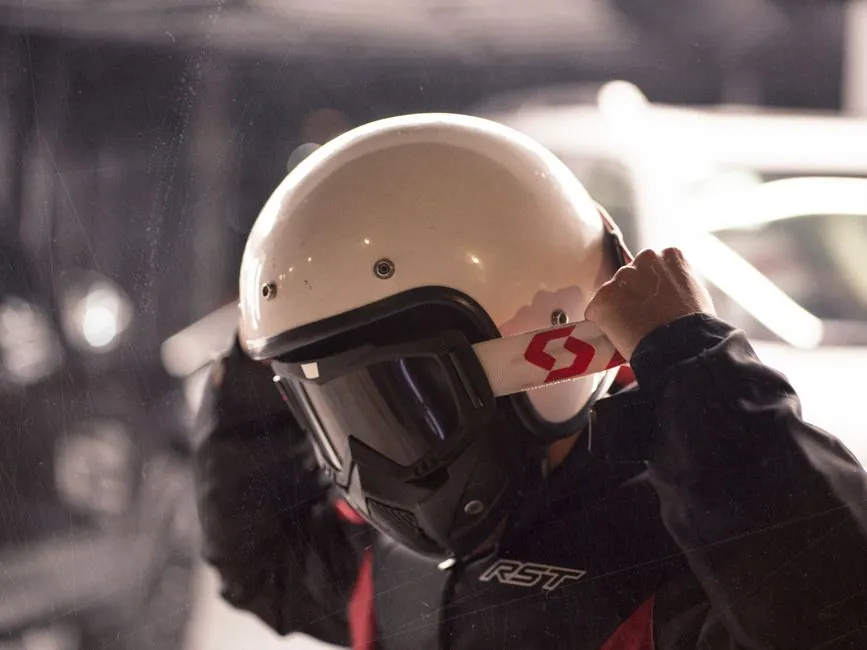
Choose a mesh visor when the hazard consists mainly of coarse particles, such as wood chips or vegetation, and select a solid polycarbonate visor when impact, liquid splash, welding radiation, or heat is present.
Mesh is an airflow-oriented screen, not a general-purpose impact barrier; solid polycarbonate provides a continuous optical surface but must still be paired with safety glasses or goggles where the risk assessment requires eye protection.
Mesh and solid visors protect against different hazards
A mesh facial visor is intended for work environments containing projected particles that are not micro-sized, with forestry and gardening identified as representative applications [S4]. Its openings allow air and large debris to pass or limit contact, which supports heat dissipation during physically demanding work.
A solid visor forms a continuous barrier across the face. Polycarbonate is suitable for impact protection, while acrylic is identified as more vulnerable to impact [S3]. For high-speed chips from grinding, cutting, drilling, or riveting, that material difference is a primary selection point.
Solid coverage must extend from the forehead to the chin and from side to side to the front of the ears; an undersized shield leaves the cheeks, lower face, or neck exposed [S3]. The lower edge also matters because liquid can enter beneath a short visor.
Decision criteria compare the two visor formats
The decisive distinction is not appearance but whether the visor must stop an airborne or moving hazard. Use the following comparison when preparing a face shield specification. [S4]
Mesh should not be selected merely because the wearer finds it cooler. If the task includes grinding, chemical splash, molten metal, furnace radiation, or an arc-light exposure, the solid-visor column addresses the actual hazard. Conversely, a solid visor does not create a breathable substitute for respiratory protection.
Who should use each format

A mesh visor fits work involving coarse material that can strike the face, particularly forestry and gardening, where airflow matters and the hazard is not fine particles [S4]. It is not the preferred format for chemical splash, welding, hot work, or environments containing airborne contaminants that must be filtered.
A solid visor fits impact and exposure tasks where the face needs a continuous barrier. The face shield should cover the forehead, chin, and lateral face, and it should be selected for the dominant hazard rather than marketed simply as a general visor.
Several worker groups should not rely on either visor as the sole protective layer. Respiratory protection requires an approved respirator, while welding requires a welding protector with the correct filter shade. A general face shield does not substitute for a welding shield, and GB 14866-2023 expressly excludes welding protectors from its scope [S3].
Impact, heat, and splash hazards drive material choice
Impact-resistant solid visors are commonly made from polycarbonate, while acrylic (PMMA) offers transparency but has lower impact performance [S3]. S1 identifies the Blue Eagle B1BL Full Face Shield with Replacement Visor as a top pick for protection and comfort in facial safety gear [S1].
Heat introduces a separate qualification. Furnace work, casting, forging, glass processing, and metal heat treatment can involve radiant heat, molten-metal splash, and flying chips [S3]. Selection must account for the site temperature, distance from the heat source, and continuous working time, because no single generic “solid visor” rating covers all three conditions.
Welding face shields and helmets must guard against arc light, molten-metal splash and dust, and their filters carry shade numbers matched to the welding process [S3]. A product expressly rated for molten-metal splash is therefore the defensible choice for that exposure, with flame-retardant clothing and gloves added as required by the task assessment.
Coverage and under-PPE combinations limit performance

A face shield does not replace safety glasses. Splash can enter from below or from the sides, so international practice treats the shield as a second layer over safety glasses or goggles [S3]. For grinding and cutting, the stronger configuration is safety glasses worn under the shield, because the visor alone may not stop an impact approaching from an oblique or lower angle.
Headgear compatibility is another physical limit. A headband shield may be worn independently or with a safety helmet, but a shield used with a helmet needs a matching interface; forcing an incompatible carrier into service can leave the shield unstable or misaligned [S3].
Chemical and respiratory decisions require similar separation of functions. A solid shield may reduce facial splash exposure, but it is not a sealed respirator and does not remove airborne gases or particles. Where such hazards exist, the dust mask or respirator must be selected from the contaminant-specific protection requirement rather than from the visor format.
Standards and supplier evidence control procurement
For general eye and face protection in China, GB 14866-2023, General Technical Specification for Eye and Face Protection, applies from 1 January 2025 and classifies face shields separately from safety glasses and goggles [S3]. Welding protection is governed by the separate GB/T 3609.1-2008 framework for welding protectors, while auto-darkening filters are covered by GB/T 3609.2-2009 [S3].
For industrial procurement outside China, verify the exact shield designation and test evidence rather than accepting a generic CE mark. The cited extrusion-grade polycarbonate example lists ANSI Z87.1, CE EN166, CSA Z94.3, and UKCA certification [S1]. EN 166 identifies the European eye-and-face protection framework, but the applicable part and test marking must match the product and hazard.
Ask suppliers for material, coverage, temperature range, and intended-hazard data. A heat-resistant product should state its operating temperature range, and a molten-metal application should have a specific rating [S3]. Keep the visor marking, task-specific risk assessment, and replacement inspection together as procurement records.
Track two signals before standardizing a visor: whether the task has changed from coarse-debris handling to grinding, welding, or chemical splash, and whether operators report reduced visibility from pitting, coating damage, or mesh obstruction. Either change can invalidate an otherwise suitable earlier selection.