
Select a positioning harness for controlled hands-free work at height, but specify a full-body harness when the system must arrest a free fall, distribute forces across the torso and legs, or support post-fall rescue [S1][S2].
The decision depends on the highest foreseeable consequence, available fall clearance, connection points, user fit, and the intended function of the complete fall-protection system, not on the number of D-rings alone [S3][S5].
Define the Protection Function First
A fall-arrest harness connects the worker to an anchored system and uses straps around the shoulders, chest, back, hips, and thighs to distribute arrest forces and keep the wearer upright for rescue [S1]. Its dorsal D-ring is the primary connection for fall arrest, while positioning side D-rings support controlled leaning and hands-free work [S4][S5].
A positioning harness adds front or side attachment capability, commonly through a double D-ring or waist-belt arrangement, so the worker can lean back without losing the back connection used for fall arrest [S2]. This makes it a task tool for supported work, not a substitute for a full-body arrest configuration.
A waist body belt is a different category from either option. A full-body harness distributes force across the body rather than concentrating it at the waist [S1]. The related comparison of full-body harnesses and positioning belts further separates body support from arrest capacity.
Compare the Two Harness Types
Positioning and full-body harnesses differ across four practical criteria: fall-arrest capability, force distribution, working position, and system complexity. A positioning harness may include a dorsal arrest connection, but its added attachment points are intended for positioning [S2]. A full-body harness is built around shoulder, chest, back, hip, and thigh support to manage arrest and post-fall suspension [S1].
Do not select from D-ring count alone. A 1-point harness is described as basic fall arrest, while 2-point or multipoint designs add options for positioning, climbing, or rescue; the attachment’s location and rated task remain decisive [S4].
Identify Who Each Option Is For
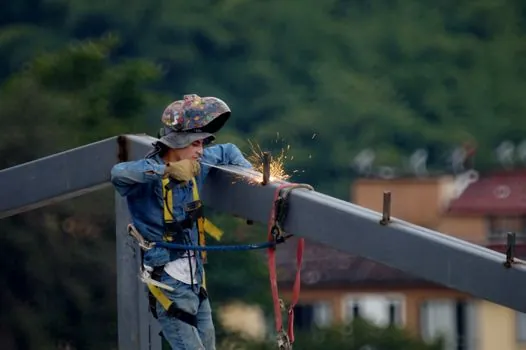
A positioning harness is for workers who need to remain connected while leaning against a structure, working on a ladder, or performing hands-free tasks with a controlled connection [S2][S5]. Tower and utility work may require positioning features, while confined-space work may require retrieval arrangements [S5].
A full fall-arrest harness is for workers exposed to a free fall or needing distributed body support after arrest. It applies to general construction, roofing, and maintenance work, where the system must connect to a lanyard or self-retracting lifeline and distribute loads over the upper and lower body [S4].
Neither harness should be selected solely because the worker occasionally reaches height. A lower trigger does not remove the need to assess landing hazards, suspension exposure, and rescue consequences.
Match the Task to the Fall Scenario
Use a positioning harness when the connection prevents entry into a fall-hazard zone or maintains a supported working position. Use a full-body harness when the assessment identifies a credible free-fall hazard, insufficient restraint capacity, or a need for rescue after suspension [S3][S5].
Full-body construction includes shoulder straps to distribute force, leg straps for lower-body stability, a chest strap to prevent shoulder separation, and a sub-pelvic support that helps prevent the wearer from slipping through the harness [S4]. Full-body coverage also helps keep the worker upright after a fall, supporting rescue and reducing suspension-related risk [S1].
Specialized needs change the selection: confined-space entry may require retrieval systems, while rope-access work may require multiple attachment points [S4][S5]. In these cases, a generic positioning harness or generic full-body harness may be technically inadequate even if each has the expected number of connectors.
Check Fit, Clearance and Connection Compatibility

Confirm that the harness fits the wearer before judging it by its category. Inspect webbing, stitching, buckles, D-rings, labels, and certification markings before each use; deployed impact indicators require removal from service [S4][S5]. Adjustable leg, torso, and shoulder straps must sit correctly, because a loose or twisted harness can undermine the intended load path [S3].
Match every harness attachment to a compatible lanyard or lifeline connector and verify that the connection supports the intended function, fall-arrest or fall restraint [S2]. A dorsal D-ring’s location behind the shoulder blades is intended to orient the wearer during arrest [S7]. For positioning, side D-rings permit connection to a positioning lanyard while the worker leans against a vertical surface [S4].
Fall clearance is equally critical. A positioning setup can introduce geometry different from a free-fall arrest setup, while a full-body harness does not create usable clearance by itself. Anchorage height, connector length, lanyard stretch, worker height, and the space below the body must be evaluated as one system before specifying either harness.
Apply Standards and Sourcing Controls
For European sourcing, XSPlatforms identifies EN 361 for its fall-arrest and fall-restraint harness range [S2]. For United States procurement, the cited harness category is associated with ANSI Z359.11-2021 and OSHA 1910.140 [S4]. These references must remain tied to the product and jurisdiction being purchased, rather than treated as interchangeable labels across markets [S4][S5].
Record the manufacturer’s model designation, harness classification, attachment-point locations, user-weight range, material, certification markings, and intended applications. The fall arrest harness encyclopedia entry can support broader system selection, but the product label and manufacturer documentation control the final suitability decision.
For a positionable system, also document the positioning lanyard, anchor, clearance calculation, rescue plan, and user training. OSHA 1910.140 applies to full-body fall-protection work in the cited guidance, while side D-rings and front attachment points define the separate positioning function [S4][S5].
Track Selection and Inspection Controls

Record each task as one of four outcomes: fall arrest, fall restraint, positioning, or a combined system. Then retain the selected harness model, attachment map, certification, user-weight limit, inspection status, and named approval in the site-specific fall-protection plan [S2][S5].
Two signals should trigger reselection: the task gains a new free-fall exposure, or attachment and clearance requirements change after installation. Another control is impact-indicator deployment, because an activated indicator requires removal from service rather than continued use [S4]. A focused review of dorsal D-ring impact indicators can support that inspection decision.
For pricing or replacement planning, the fall arrest harness price comparison is useful only after the required category, attachments, certification, and complete connected system have been defined.