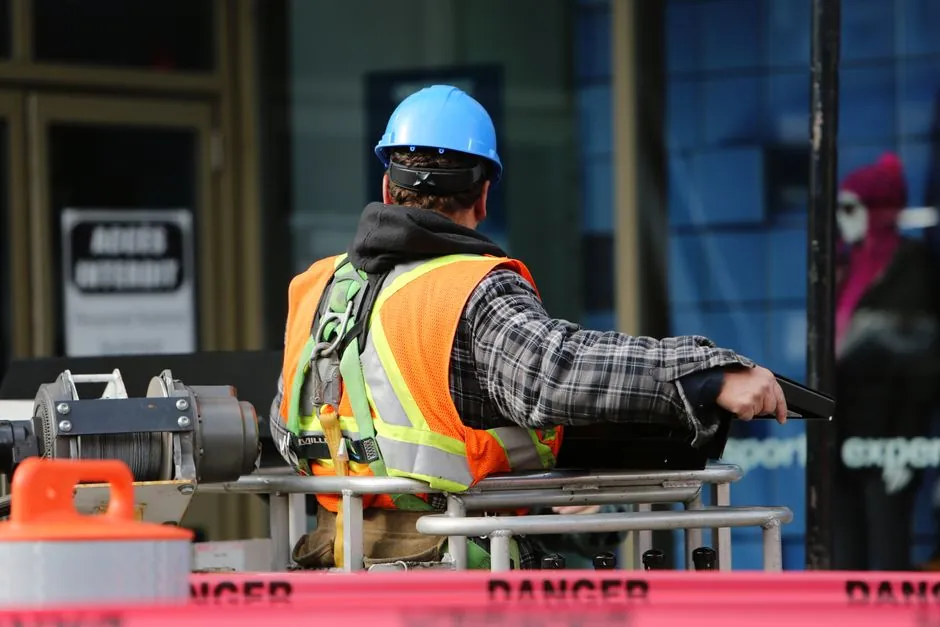
A mid-level order picker operating with the platform above 4 ft must be tied off with a full-body harness whose back D-ring sits at the center of the wearer's back near shoulder level, the geometry explicitly required by 29 CFR 1910.140 [S1].
The harness is part of a wider personal fall arrest system (PFAS) that includes a synthetic-webbing full-body harness, a lanyard or self-retracting lifeline (SRL), and an engineered overhead anchor on the truck rated to hold 5,000 lb per attached worker, or engineered to twice the maximum arrest force from a 6 ft free fall [S3]. Mid-level order pickers without that anchor-lanyard-harness chain are out of compliance and a citation risk, because 29 CFR 1910.178 (powered industrial trucks) does not itself mandate a harness but defers to 29 CFR 1910.28 once the operator's feet are above the trigger height [S7].
When a harness becomes mandatory on a mid-level order picker
OSHA's general-industry fall protection trigger height is 4 ft, and 29 CFR 1910.28(c) requires protection for any worker on an unprotected side or edge above that height, which captures most order picker platforms whose floor typically sits 6-12 ft above the aisle [S4].
The November 2017 final rule on Walking-Working Surfaces (effective January 17, 2017 for new equipment, phased through 2018 for existing fleets) removed body belts from the list of acceptable fall protection for high-lift trucks designed to lift personnel, including order pickers and swing-reach trucks; today's spec has to be a full-body harness plus either an energy absorber or a self-retracting lanyard [S3]. Operators on units that are fully enclosed to the top rail with a guardrail system meeting the 1910.29 criteria (42 in. top rail, mid-rail, toeboard) are exempt from PFAS use, which is why some fleets pair a harness with the truck anyway as belt-and-braces insurance [S2][S4].
Anatomy of a compliant order picker PFAS
OSHA's ABCDE inspection method lays out the three load-bearing elements that have to be verified before each shift, and each one has a numeric pass criterion, not a vibe check [S3].
A, anchor and anchorage connector: the order picker's overhead eye must be engineered, approved, and rated to 5,000 lb per worker, with welds and bends inspected for cracks and corrosion. B, body wear: a full-body harness of synthetic webbing (nylon or polyester webbing is the typical construction), with a certification label attached, the dorsal D-ring at center back near shoulder level, and no paint, marker, or chemical exposure that would degrade the fibers [S1][S3]. C, connecting device: a lanyard or SRL that limits free fall to 6 ft (lanyard) or 2 ft (SRL), with snap hooks and deceleration stitching inspected for cuts and pulled threads, and a 3,000 lb static load rating on SRLs; any lanyard that has seen a shock load is removed from service immediately [S3]. The fall arrest harness must be inspected before each use, and the operator's rescue plan has to assume a suspension-trauma scenario, not just the arrest event itself [S4].
Selection criteria: which harness and lanyard fit a mid-level unit
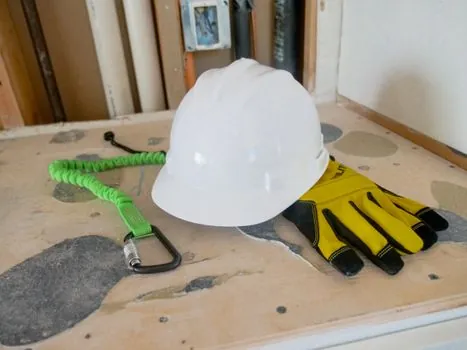
Three spec decisions drive compliance and operator comfort on a mid-level picker, and they line up against the OSHA numeric limits rather than brand preference. [S2]
Lanyard type, restricted-length vs SRL: a fixed-length lanyard can be sized to keep the operator on the platform (restraint, not arrest), which Worksafe Victoria recommends as a pendulum-fall mitigation; an SRL with a 2 ft arrest distance is the better choice when the operator has to lean into the rack to pick, because the shorter arrest distance reduces the calculated fall clearance, and the block keeps tension automatically [S3][S5]. Connector: a double-locking snap hook on the lanyard end and a matching connector on the harness D-ring, all meeting ANSI Z359, which is the consensus standard OSHA enforcement relies on for PFAS components [S4]. Harness fit: a vest-style or cross-chest style with a back D-ring positioned at the operator's shoulder-blade level is the only geometry OSHA accepts, and the D-ring is what the arrest load pulls on, so a chest-only D-ring is wrong equipment for vertical fall arrest on a picker [S1].
Common failure modes flagged by enforcement
Enforcement actions and Worksafe Victoria hazard bulletins cluster around four recurring failure modes that show up in incident reports and citations, and each one has a numeric fix [S2][S5].
Lanyard too long: an untrimmed 6 ft lanyard on a narrow platform lets the operator drop off the edge before the line goes taut, producing a pendulum swing into racking; the fix is a lanyard or SRL sized so the line cannot extend past the platform perimeter [S5]. Anchor on the wrong structure: tying off to a pallet, rack beam, or mast instead of the truck's engineered overhead point is a recurring violation, and the 5,000 lb per-worker rating only applies to the manufacturer's designated anchor [S3]. Damaged webbing: chemical attack from facility cleaners, cuts from rack edges, or pulled stitching from a previous shock load; the harness is removed, not repaired [S3]. No rescue plan: a suspended operator in harness suspension for more than about 5-10 minutes can develop suspension trauma, so a written prompt-rescue procedure is part of the written fall protection plan that OSHA expects under 1910.28(c) and Subpart D generally [S4].
Comparison: harness-only, harness + guardrail, fully enclosed platform

Three configurations are common on mid-level picker fleets, and the spec trade-off across four criteria is sharp enough to drive a purchasing decision without further information [S3][S4][S5].
OSHA compliance: harness + lanyard + anchor passes when working above 4 ft, while a compliant guardrail (42 in. top rail plus mid-rail and toeboard) removes the PFAS requirement, and a fully enclosed platform with proper gates effectively eliminates the fall hazard to the platform edge. Cost: harness + SRL is the lowest capex (about 150-400 USD per operator) but the highest ongoing inspection burden; guardrails are mid-capex and low-maintenance; a fully enclosed platform retrofit is the highest capex (commonly four to five figures per truck) and the lowest ongoing compliance cost. Operator pick-rate: harness + SRL keeps the operator's reach wide because no rail blocks the pick face, guardrails cut reach by the rail footprint, and enclosed platforms can cut reach further unless the design uses a swing gate. Pendulum / suspension risk: highest on a long-lanyard open platform, intermediate on a short-lanyard open platform, lowest on a fully enclosed platform, and Worksafe Victoria explicitly recommends the enclosed-platform route as the best-practice endpoint of the hierarchy of controls [S5].
Standards and sourcing for the spec
The governing US regulation is 29 CFR 1910.140 (personal fall protection systems) for harness and connector geometry, 29 CFR 1910.28 (Duty to have fall protection) for the trigger height and the written-plan requirement, and 29 CFR 1910.29 (fall protection systems criteria) for guardrails; the underlying consensus standard referenced in OSHA compliance directives is ANSI Z359, which is the family that covers harnesses, lanyards, SRLs, and anchors [S1][S4]. Australia's equivalent hazard guidance from Worksafe Victoria, "Fall restraints on order picking forklifts" (2011), is the source of the lanyard-length, pendulum, and inertia-reel guidance above and is widely cited in North American safety bulletins as well [S5].
For spec writing, anchor the harness callout to "full-body harness, dorsal D-ring, synthetic webbing, ANSI Z359.11 compliant, 5,000 lb anchor rating, SRL with 2 ft maximum arrest distance" rather than to a brand, and pair that with a written rescue plan and a pre-shift ABC inspection log on the truck, so the specification is auditable rather than aspirational [S3][S4]. A practical companion read for fleet planners sizing the truck around door and rack geometry is the Order Picker Collapsed Mast Height: Passing 2.5 m Doors spec guide, since the harness + lanyard + mast envelope has to clear the same door.
Component reference pages worth checking: microcomputer protection.