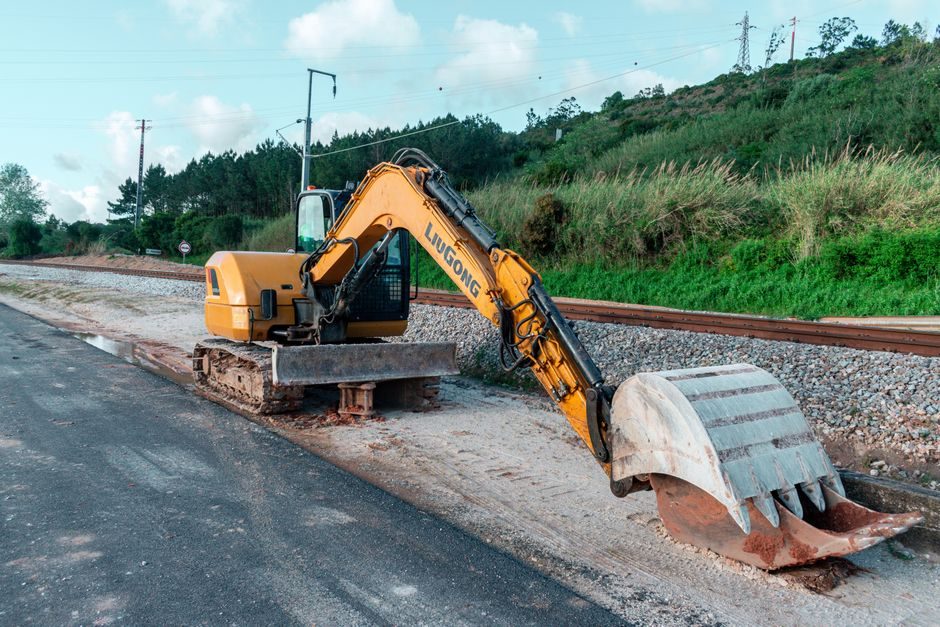
A mini excavator is typically defined as a hydraulic digger under 6 metric tons operating weight with engine power under 30 hp, while a conventional (full-size) excavator starts around 10 tons and scales past 100 tons [S2][S8].
Across 2026 supplier catalogs, mini classes cover 0.8 t, 1.2 t, 1.8 t, 2.5 t, 3.5 t and 4 t operating weights with bucket volumes from 0.02 m³ to ~0.1 m³; full-size machines begin at the 20-ton class with 1 m³ buckets and 145 kW engine output [S3][S4][S7].
Operating Weight and Power Bands by Class
The Bobcat E26 sits at 2,570-2,763 kg with a 24.8 hp Tier 4-final diesel and minimal tail-swing geometry for confined urban digs [S1]. The Caterpillar 300.9D drops to 2,061 lb (935 kg) with 13 hp net power for landscaping and utility trench work [S8]. The VOTE VTW-08 micro-class unit runs 800 kg operating weight, 0.02 m³ bucket, 1,200 mm dig depth and 0-4 km/h travel on crawlers with a 12-month warranty [S5].
Full-size 21-ton used units from manufacturers such as Doosan (DH210W-9) ship with 1 m³ standard buckets and 145 kW engines, priced between $24,000 and $32,000 per piece on 2026 wholesale listings [S7]. Used Kubota KX155 (15.5-ton class) units show a 2026 floor of roughly $8,000 per piece in the same channel [S7].
Mobility: Crawler vs Wheeled Mini Chassis
Wheeled mini excavators such as the Minitrucks Robotics 2E64 run 4-8 km/h road travel at 490-640 kg operating weight and 13 hp diesel output, optimized for cemetery and marble-yard access where ground disturbance must stay low [S2]. Crawler mini excavators — Bobcat E26, Caterpillar 300.9D, VOTE VTW-08, Toros TE-12S, TE-16 — use rubber or steel tracks for traction on soft soil and slopes, with 2-Speed Auto-Shift on the E26 to handle 0-4 km/h work cycles and faster repositioning [S1][S5][S8].
Buyer specification requests in 2026 list extendable chassis, 360° cab rotation on the crawler frame, swing boom, dual hydraulic pumps, and joystick servo control as standard requirements for 2.5-3 ton closed-cab mini units [S6]. Engine brand preference concentrates on Yanmar, Kubota, or Perkins for Tier 4-final emissions compliance in the 2-4 ton segment [S6].
Bucket, Dig Depth and Attachment Envelope
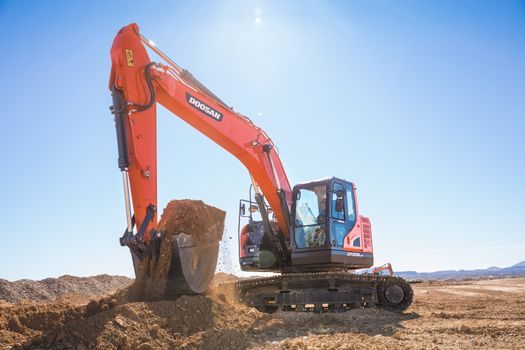
Dig depth for the mini class runs 1.2 m (0.8 t VOTE) to 2 m (2E64) and 2.3 m maximum dig height on the VOTE VTW-08 [S2][S5]. Bucket capacity scales from 0.02 m³ at 800 kg up to 0.1 m³+ on 3.5-4 ton Toros and Rippa models, with 220 mm, 400 mm, and 600 mm spoon widths commonly specified for trench work [S4][S5][S6].
Attachment range includes scraper buckets, hammers (breakers), log grapples, and auger drills, with 20 cm / 40 cm / 60 cm spoons and auger drill interfaces frequently bundled in buyer RFQs against Kubota, Yanmar, or Perkins power units [S5][S6]. Full-size 21-ton excavators use 1 m³ standard buckets, with hammer and grapple options scaled to hydraulic flow that mini auxiliary circuits cannot match [S7].
Selection Matrix: Cost, Transport, Productivity, Site Access
On cost, 0.8-4 ton new mini units from Chinese OEMs cluster at $3,000-$8,000 wholesale in 2026 listings, against $24,000-$32,000 for used 21-ton full-size machines [S3][S4][S5][S7]. On transport, mini units under 4 t fit on standard 3.5-ton trailers without permits, while 20+ ton excavators require lowboys and escort vehicles per typical regional road rules [S3][S4].
On productivity per shift, a 1 m³ bucket on a 21-ton Doosan or Kubota moves roughly 8-10× the volume per cycle of a 0.1 m³ mini bucket, but cannot enter a 1 m alley or work inside a finished building. On site access, the Minitrucks 2E64 at 640 kg is built specifically for cemetery alleys where a 20-ton machine cannot pass [S2].
2026 Supplier Landscape: Where the Units Are Built
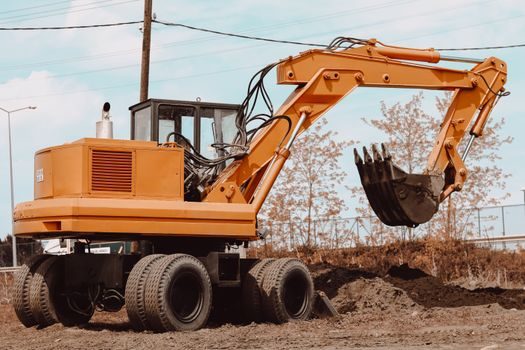
Shandong Rippa Machinery Group operates a 100,000 m² plant in Jining high-tech zone with 209 employees and 50 engineering staff, listing mini excavators from 1 ton through 4 ton plus 3.5 ton and 4 ton classes alongside skid-steers and electric forklifts [S3]. Toros positions the TE-12S at 1,200 kg and TE-16 at 1,600 kg operating weight in its 2026 catalog with 0.022 m³ bucket capacity on the TE-12S [S4].
DirectIndustry-hosted OEM data on the Bobcat E26 carries a €41,000 ex-VAT starting price, with the smaller E10 at €28,900 and E20 at €33,300 in the same catalog set [S1]. Caterpillar's 300.9D is listed on cat.com US as a "checking price" configuration, indicating build-to-order rather than stocked inventory [S8].
Limits, Failure Modes, and What Each Class Cannot Do
Mini excavators lose productivity on mass excavation because cycle time scales with bucket size; a 0.1 m³ mini at 4-second cycle needs ~10× the cycles of a 1 m³ 21-ton unit to move the same volume [S7]. Track-driven minis also tear soft turf and finished pavement, which is why the 640 kg wheeled 2E64 exists for cemetery and marble-sector sites [S2].
Full-size excavators fail in confined access, indoor demolition, and landscaping where ground pressure from a 20-ton machine exceeds soil bearing capacity. The decision rule is straightforward: under 6 tons operating weight stays in the mini class with sub-30 hp diesels; above 10 tons, plan for lowboy transport and dedicated operator certification [S1][S8]. For a 2026 supplier-by-supplier view of mini-excavator factories, the Rippa and Toros sourcing map breaks down plant size, tonnage range, and engine brand options in this segment.
The next trackable signal is Tier 5 emissions rollout on 19-25 hp mini diesel platforms — Yanmar and Kubota have published Tier 5 reference designs that Chinese OEMs including Rippa have not yet integrated in their 2026 catalogs. Watch for OEM announcements on battery-electric mini units at the 1-2 ton class, where the Toros TE-12S and VOTE VTW-08 currently dominate the entry-level diesel segment [S1][S3][S4][S5].
Spec-level background on the components involved: excavator, pressure transmitter, and flow meter.