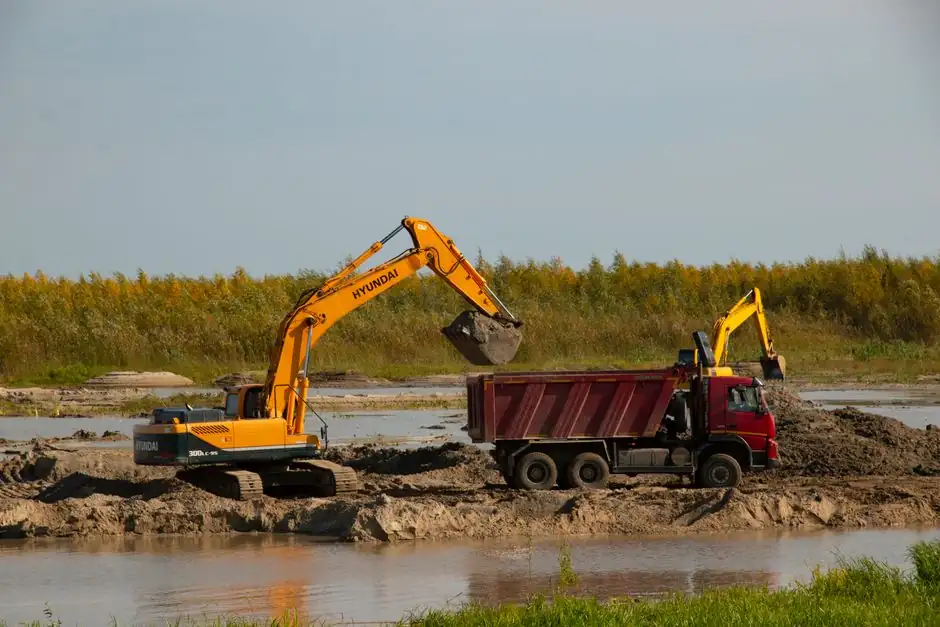
Rigid mining dump trucks carrying 90 to 400 tons per load with engines above 2,000 hp are engineered for open-pit haul roads, not city streets, and the cost of mis-applying them on urban infrastructure is wasted fuel, oversized turning radii, and broken pavement [S3].
For road, utility, residential, and municipal projects, the practical fleet sits in the 10 to 16 ton standard class and the 25 to 60 ton articulated class, with ultra-class rigid haulers reserved only for short quarry-to-site rock haul legs that never touch public right-of-way [S1][S3].
Where a True Mining Dump Truck Fits, and Where It Does Not
Rigid off-highway mining dump trucks are defined by a single non-articulated frame, a heavy-duty rear tipping body, massive off-road tires, and a reinforced chassis built for continuous high-load cycles on controlled mine haul roads; ultra-class configurations exceed 300 tonnes of payload and are explicitly not designed for public road circulation [S1]. For urban infrastructure, that means a rigid mining dump truck is the right call only when a quarry or borrow pit feeds a sub-base or fill operation through a private haul road, never for last-mile delivery on city streets. By contrast, the standard dump truck class of 10 to 16 tons dominates residential, road, landscaping, municipal, and agricultural transport, and is available in 4x2, 6x4, and 8x4 chassis configurations to match local axle-weight rules [S3][S5].
Payload Bands and What Each One Actually Hauls
Selection starts with payload because the truck class, the chassis, and the operating cost all flow from it. Standard dump trucks cover 10 to 16 tons and are the everyday workhorse for paving, residential building, and road repair; articulated dump trucks cover 25 to 60 tons and dominate dam construction, large earthworks, and rough access roads where traction matters more than top speed; rigid mining trucks span 90 to 400 tons and move blasted rock in quarries and open-pit mines [S3]. A high-capacity mining truck may require over 2,000 horsepower to function at peak efficiency, which is roughly 3x what a heavy-duty on-road tipper uses, so the fuel and tire budget alone disqualifies it for short urban cycles [S3][S5]. A parallel read on mining dump truck selection for quarrying confirms that rigid haulers earn their keep on long, steep, high-tonnage loops where shovel pass matching drives cycle time, not on fragmented city work.
Selection Criteria: Engine, Hydraulics, Axles, and Tires
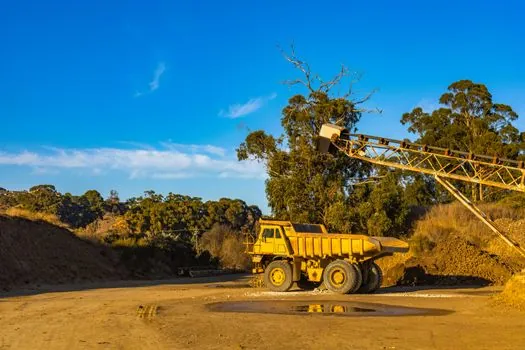
Engine power determines gradeability under full load; heavy-duty on-road and articulated units typically run 300 to over 600 hp with torque output often above 2,000 Nm, which is the band urban and peri-urban fleets should target for fully loaded starts on ramp grades [S5]. Hydraulic system speed sets the dump cycle: faster high-pressure pumps shorten unload time and raise daily productivity, which matters more on a 20-cycle urban day than on a 6-cycle mine shift [S3]. Tire selection and axle configuration control both flotation and legal compliance, since wider tires float better on soft surfaces but burn more fuel, and multiple rear axles are what keep a standard truck inside public-highway weight limits [S3][S5]. The chassis conversation also extends to driveline layout, a topic covered in detail for pipeline work in mining dump truck specs for pipeline construction, where liner wear and access-road grade drive the same engine and tire trade-offs seen on urban sub-base haul legs.
ADT vs Standard On-Road: A Decision Comparison
For urban infrastructure, the real choice is between articulated and standard on-road units, not between either and a rigid hauler. On four decision criteria, the comparison reads as follows. First, payload: ADTs deliver 25 to 60 tons per pass while standard trucks deliver 10 to 16 tons, so an ADT replaces roughly 3 to 4 standard units on a heavy fill job but cannot legally or physically do it on a city street [S3]. Second, terrain: the ADT's central pivot joint and 6x6 driveline maintain traction on muddy, uneven, or steep ground, which is exactly the condition of an unimproved site access road; the standard on-road truck needs finished or compacted surfaces and suffers on soft subgrade [S1][S2]. Third, maneuverability: ADTs pivot through a tight center hinge and work confined cuts, but their top speed sits well below highway limits, so they lose time on long transits between site and crusher [S2]. Fourth, regulation and cost: standard trucks share parts with the on-road fleet, carry lower acquisition cost, and register for public-road use, which is why municipal and residential work defaults to them [S5].
Urban Use Cases and the Right Truck for Each
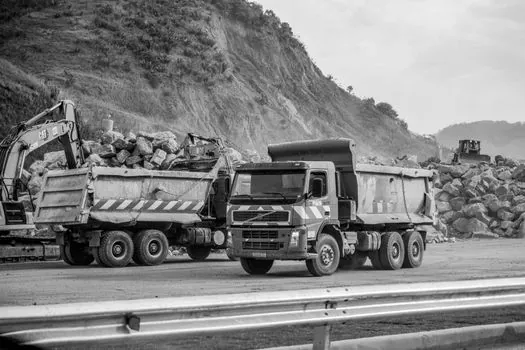
Road construction, asphalt delivery, curb and gutter work, residential subdivision grading, and landscaping all sit inside the standard dump truck's envelope of 10 to 16 tons and 4x2/6x4/8x4 configurations, where maneuverability, parts commonality, and street-legal registration decide the bid [S2][S5]. Quarrying, dam construction, large earthmoving, and subdivision mass-grading on rough terrain sit inside the ADT envelope of 25 to 60 tons, where off-road traction, high flotation, and gradeability pay back the higher unit cost [S1][S3]. Demolition haul cycles, where mixed debris and short hauls punish brakes and tires, call for a purpose-selected chassis, as mapped in mining dump truck specs for demolition haul cycles. Open-pit mining, large quarry output, and bulk overburden moves sit inside the rigid mining dump truck envelope of 90 to 400 tons and over 2,000 hp, which is correct only when the haul road is private and the shovel can load it in 3 to 5 passes [S3].
Failure Modes and Constraints to Engineer Around
The most common mistake is sending a rigid mining truck onto a public road, which is illegal in most jurisdictions because the vehicle exceeds axle and gross weight limits and lacks the lighting, brakes, and steering geometry for mixed traffic [S1][S3]. The second is under-spec'ing hydraulic cycle time on a high-frequency urban job, where a slow hoist burns productive minutes on every load and compounds across a 20-cycle day [S3]. The third is ignoring tire selection: over-sized off-road tires on a standard chassis raise rolling resistance, lift fuel burn, and may not fit standard road-width lanes, while under-sized tires on an ADT sink in soft subgrade and stall the truck [S3]. The fourth is treating engine power as the only performance number; without matching torque above 2,000 Nm for heavy-duty on-road work, a fully loaded truck cannot start on a 10% grade and the schedule slips [S5].
Market Context and Sourcing Signals
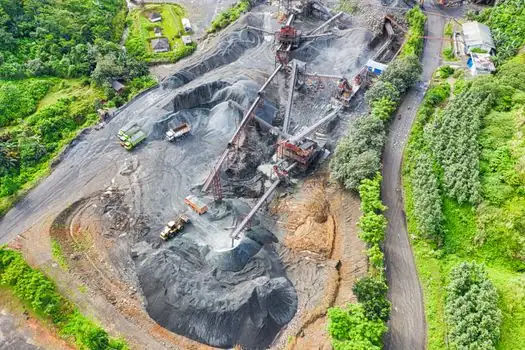
The global dump hauler market is projected to grow from USD 4.1 billion in 2025 to USD 8.5 billion by 2035, a 7.56% CAGR, with construction, mining, oil and gas, and agriculture as the main application split and products segmented into less than 30 ton, 30 to 40 ton, and more than 40 ton classes [S4]. That segmentation is useful for spec writers: the sub-30 ton and 30 to 40 ton bands are where most urban infrastructure spend lives, since standard and light articulated units dominate those classes, while the over-40 ton band is where ADTs and entry rigid haulers compete for quarry and mine work. On the supply side, US dump-truck services revenue tracks construction and mining demand for sand, gravel, and dirt, which is the same material flow an urban infrastructure fleet moves, so fleet sizing should follow local services capacity rather than peak-project need [S7].
Trackable signals for the next planning cycle: local adoption of 6x4 and 8x4 standard chassis for higher payload within axle limits, and the share of 25 to 40 ton ADTs replacing rigid haulers on short quarry-to-site rock haul legs where public-road access is not required [S3][S5].
Detailed specification references: reach truck.