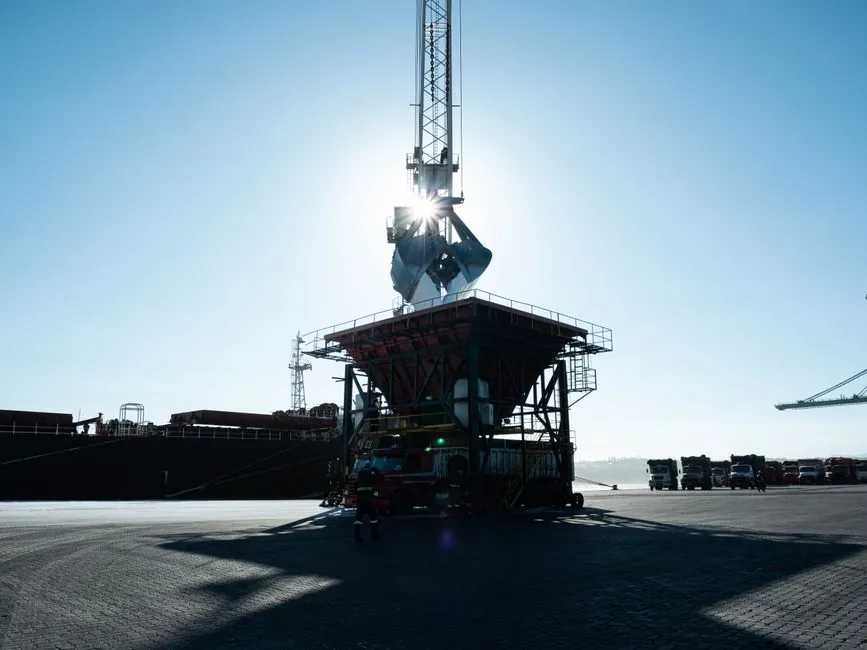
Sany's SKT130 PRO mechanical truck posts a 90 t nominal payload at 144 t GVW with 925 kW gross power and 50 km/h top speed, the high end of the 50-90 t envelope common to bulk-terminal and open-pit fleet duty [S1]. The same SKT platform covers the lower band: SKT105S delivers 70 t rated capacity on a 390 kW Weichai WP13G530E310 at 2100 rpm, and SKT105 Black Diamond mirrors it at 35,000 kg operating weight with 2,300 Nm peak torque [S1].
Port and wharf operations are a documented target duty cycle, not an afterthought. Sinotruk's HOWO "Mine Overlord" (model ZZ5607S3640AJ, 6x4, 371 hp) is explicitly designed for short-distance transport in wharves, steel mills, open pits, and hydropower sites under harsh environment duty [S4]. Tare sits at 12,000 kg, rated payload at 58,000 kg, and the cast-steel AC26 twin rear axle with 10.47 ratio and cross-axle + inter-axle diff locks is sized for the soft, graded wharf apron common to terminal approaches [S4]. A baseline spec like the HOWO frame illustrates what a mining dump truck suited to port-side loading must deliver, not what a road tipper can.
Payload, GVW and Powertrain Envelope
Nominal payload spans 58-90 t across the current Sany and Sinotruk port/mining lines, and powertrain choice is where the spec diverges sharply. The SKT110E BEV variant lists 466 kWh battery capacity with 1-hour charging from 25% to 95% state of charge and a 70 t nominal payload, with peak power stated at 570 kW / 820 kW across operating modes [S1]. The SKT130 PRO, by contrast, is a 925 kW diesel mechanical with no electrification stage yet announced for the port-tug envelope [S1].
Selection math for terminals is not torque-per-tonne alone. The chntruck buying guide partitions the engine map by duty: 300-380 hp covers urban short-haul tippers, while mining and long-haul heavy-duty starts at 400-550 hp and is paired with 8x4 or 6x6 drive layouts when daily loads clear 50 t [S3]. Sany's SKT130 PRO exceeds that band by design, but the 6x4 HOWO at 309 kW (420 hp) covers the 50-60 t port-side envelope within a smaller footprint and lower fuel burn [S4][S3].
Drive Configuration: 4x2, 6x4, 8x4 and What Each Actually Buys You
Drive layout is a cost-vs-traction trade, not a marketing label. The chntruck guide positions 6x4 as the best-value, most common configuration for construction and road haulage, 8x4 as the upgrade path for higher payloads in heavy mining and earthmoving, and 4x2 as the light-duty, short-distance choice for small-scale projects [S3]. Each step adds traction, axle load capacity, and tyre count, and each step adds tare weight that erodes payload margin.
For port duty, two factors override textbook drive selection. First, terminal apron surfaces are often concrete pavers with localised soft spots at drainage channels, so 6x4 with a heavy-duty rear axle and a locking diff is the default Chinese-spec recommendation [S3][S4]. Second, haul distance dictates whether a tractor-trailer combo (430-460 hp tractor + 3-axle dump semi-trailer) can out-haul a rigid 6x4. TRUCKMAN's Liberia case study reports a payload jump from 30 t to 55 t per trip and a 15-20% fuel-consumption reduction with that swap [S5]. The same report cites a current 62% transport-efficiency figure against design for Liberian iron-ore logistics, a gap that drive-config mis-specification is a documented contributor to [S5].
Structural and Body Specs That Matter at the Wharf
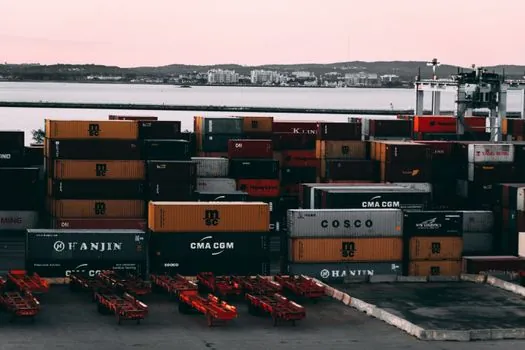
Body steel and hoist geometry separate a port-class truck from a road tipper. Wear-resistant high-strength steel is the baseline recommendation for any dump body expected to see mining-fleet impact loading, with capacities of 15-25 m³ for general engineering and larger volumes for bulk material transport [S3]. The HOWO Mine Overlord specifies a 5,900 x 3,100 x 1,800 mm dump body and a front-lifting style hoist, paired with a 500 L fuel tank and 14.00-25 NHS radial tyres inflated to 1,000 ± 10 kPa, an unusually prescriptive cold-tyre pressure for a port-tug spec [S4].
Ground clearance, track width, and wheelbase determine whether a given truck can stage under a ship loader or reach-stacker spout. Sany's SKT 115E (BEV chassis) lists a 4,075 + 1,750 mm wheelbase, 2,835 mm front track, 2,859 mm rear track, and 350 mm ground clearance, numbers that read like a wheel-loader chassis rather than a tipper and matter when the apron is shared with construction machinery and equipment such as container handlers [S1]. Hydraulic cycle times, raise and lower, are not published for the SKT port-tug SKUs, but a benchmark is the Cat R1700G LHD: 6.8 s raise, 2.9 s dump, 2.4 s lower, 12.1 s total cycle at 4.6-8.8 m³ bucket, the kind of timing that decides cycle-time at a stacker-reclaim feed point [S6].
Comparison: 6x4 Diesel Rigid vs BEV Rigid vs Tractor + Dump Semi
Three configurations cover roughly 90% of port and terminal mining-truck bids. The Sinotruk HOWO 6x4 371 hp 60 t rigid is the low-capex, short-baseline option, well suited to wharf apron work within 15-30 km, with 50 km/h top speed and a cast-steel twin-reduction rear axle [S4]. The Sany SKT110E BEV is the zero-exhaust option at the same 70 t nominal payload, with the operational trade being a 1-hour 25-95% SOC charge window and a yet-unknown continuous-power rating [S1]. The TRUCKMAN 6x4 tractor + 3-axle dump semi-trailer is the long-haul option, taking payload from 30 t to 55 t per trip at a 15-20% fuel-economy gain, but it loses the manoeuvrability of a rigid around tight stacker-reclaim loops [S5].
For projects where the haul leg is under 15 km on a graded wharf road, the HOWO-class 6x4 diesel is hard to beat on parts availability, given Sinotruk's stated after-sales network and one-year warranty coverage across Asia, Africa, Eastern Europe and the Americas [S4]. For enclosed or zero-emission terminals, the SKT110E is the only Sany SKU with published battery and charge-window data, and the 466 kWh pack is the spec to compare against when other BEV brands bid [S1]. The tractor-trailer combination is the correct call when the mine-to-port leg exceeds 45 km and road access is consistent, conditions common in the Liberia and West African iron-ore corridors [S5].
Emissions, Compliance and the Hidden Spec Sheet
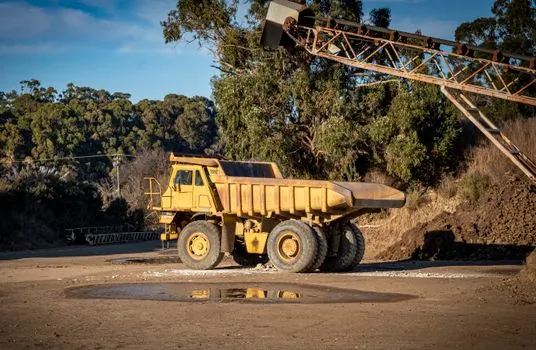
Euro class and brake-system certification are the spec lines that lock a truck in or out of a tender. The HOWO ZZ5607S3640AJ ships to Euro 2 baseline in the published spec, a cost-driven choice for export markets with lax enforcement but a hard fail for European Union and select Middle East tenders [S4]. The chntruck guide flags local-emission compliance as a precondition and recommends a vendor with complete export certification and global spare-parts supply, an issue that becomes acute when a dump truck fleet runs 50 t-plus per unit in remote ports [S3].
Brake architecture on a 58 t-rated rigid is non-trivial. The HOWO spec lists a dual-circuit compressed-air service brake, spring-applied/air-released parking brake on the rear wheels, and an engine exhaust valve brake as auxiliary, with a ZF8098 hydraulic power-steering gear and 24 V negative-earth electrics [S4]. Reverse ratios of 13.91 and 3.18 on the gearbox give the low-speed manoeuvrability needed for stacker-reclaim positioning, and the HW7D 53 tiltable cab with A/C and sleeper addresses driver-fatigue compliance on multi-shift wharf operations [S4].
Failure Modes and Sourcing Constraints
Most port-class mining-truck failures are not powertrain failures. TRUCKMAN's Liberia analysis points to improper vehicle configuration, high failure rates, and unreasonable route planning as the principal causes of the 62% realised-vs-designed transport efficiency figure, with the rainy-season standing-water depth of 30 cm and 12% maximum gradient on the Yekepa-Buchanan corridor being the operating envelope that purges under-spec'd filters and tyres [S5]. The chntruck guide similarly notes shortened air-filter replacement intervals, down to 80 hours, on the 15-45 km dust-heavy leg of a mine-to-port route [S3][S5].
Sourcing risk sits in the spare-parts tail, not the purchase order. Chinese-brand tipper trucks are documented to offer a clear advantage on parts availability and total cost of ownership in the chntruck guide, while Sinotruk's stated after-sales network covers in-house training, on-site service, technical support, and international logistics for the HOWO line [S3][S4]. For buyers running a 6x4 fleet at 50 t GVW, that tail decides lifetime cost, and a maintenance-program clause in the supply contract is worth more than a 5% purchase-discount.
Selection Criteria Mapped to Terminal Duty

A pragmatic decision tree starts with four questions: payload target (under 60 t or 70-90 t), haul distance (under 30 km rigid, over 45 km tractor-trailer), emissions class of the destination port, and whether a zero-exhaust zone applies [S3][S5]. If payload is 58-70 t and haul is short, the HOWO-class 6x4 diesel covers it with the widest parts tail [S4]. If the port enforces zero on-site exhaust, the SKT110E BEV is the only Sany SKU with public battery and charge data, and any comparison bid must be normalised to the 466 kWh pack and 1-hour 25-95% SOC charge [S1]. If haul is 45-270 km with consistent road, the tractor + 3-axle dump semi-trailer spec at 430-460 hp wins on payload per trip and fuel economy, both 15-20% better than a comparable rigid in the TRUCKMAN data [S5].
For very high tonnage, 90 t nominal and 144 t GVW, the SKT130 PRO is currently the largest Sany SKU published, and buyers should confirm driveline availability for their duty cycle before standardising fleet specs [S1]. Across all three branches, the underwriting spec lines are GVW, drive layout, axle rating, brake architecture, and emission class; everything else is option pricing.
The next signal to track is BEV port-truck field data: Sany's SKT110E and SKT 115E are the only published battery-electric port-tug SKUs, and 12-month operating data on the 466 kWh pack's cycle life and charge-curve degradation will decide whether the next tender round tips toward BEV or stays on mechanical 6x4 diesel. A second signal is the Euro 3/4/5 compliance re-spec of the HOWO line, which is the gating item for any European wharf operator currently locked out by the published Euro 2 baseline [S4].
This topic is covered further in FRP Composite Selection for Construction: Resin, Fibre, Process and Spec Gates.