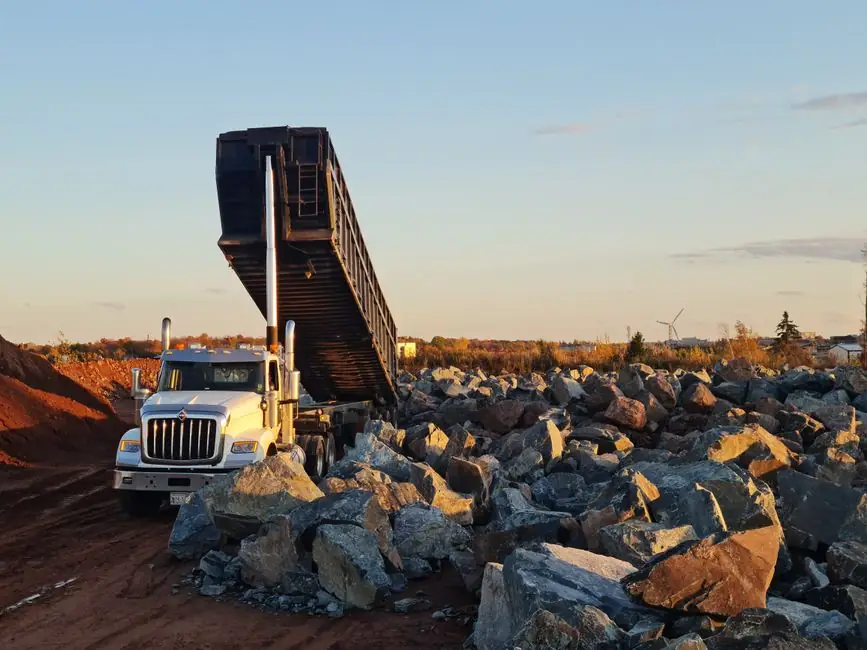
Pipeline construction right-of-way (ROW) spreads sit between quarry haul and full open-pit mining: 30-50 t rigid-frame 6x4 trucks with 14-18 m³ bodies cover the typical trench and backfill haul, while 70 t plus mechanical-drive units belong on mainline borrow pits feeding the spread [S3][S4].
On 2026-07-09 the DirectIndustry industrial index listed 20 manufacturers with 68 mining-and-quarrying dump-truck models, with Bell, Caterpillar Global Mining, Hitachi, Hyundai, Komatsu, and XCMG dominating the OEM shortlist, and payload bands running from 30 t utility class up to 363 t ultra-class mechanical-drive trucks [S3]. Choosing between those classes for a pipeline job is driven by mine tonnage and haul-road profile, not engine horsepower or tyre size [S3].
Payload Class: Where a Pipeline Truck Fits
The 2026 spec map groups mining dump trucks into four payload bands: 30-50 t for construction-quarry and small open-pit work, 70-100 t for mid-range rigid-frame mechanical-drive trucks, 150-240 t for the Cat 793/797 class, and 290-363 t for the 980E/MT5500 ultra-class [S3]. A 6x4 HOWO 70-ton mining dumper (ZZ5707S3840AJ family) sits at the lower edge of the off-road mining class with manual transmission and Euro 2 emission rating, which matters on any ROW where the contract requires Tier 4 Final or Stage V [S3].
For ROW trench support and bedding-stone haul, the 30-50 t rigid-frame 6x4 with 14-18 m³ U-shape or square body, paired with a 5-6 m³ shovel pass for 3-pass loading, is the practical floor [S3][S4]. Above 50 t, the truck crosses from construction tipper into a true off-road mining dump truck, and the chassis, retarder, and tyre rating change accordingly [S3].
Drive Layout and Powertrain Match for ROW Haul
Common drive configurations on the 2026 OEM shortlist are 4x2, 6x4, 8x4, and 6x6, with 6x4 dominating the 30-50 t class and 6x6 standard on articulated dump trucks (ADTs) [S3][S5]. For pipeline ROW work, the choice between 6x4, 8x4, and 6x6 is set by daily tonnage: daily loads at or above 50 t push the spec toward 8x4 or 6x6 heavy-duty, while general short-haul stays on 6x4 [S5].
Engine horsepower bands split cleanly by duty: 300-380 hp covers urban short-haul, while mining and long-haul heavy duty requires 400-550 hp from Weichai or Cummins engines with reinforced gearboxes [S5]. Western OEM mechanical-drive rigid haulers scale gross engine power at roughly 1,500 kW in the 100 t class, 2,000-2,500 kW at 240 t, and 2,600-3,000 kW at 363 t, paired with AC-drive or DC-drive electric-wheel traction and megawatt-class retarder braking [S3]. Picking diesel-mechanical on a long down-gradient pipeline haul wastes fuel and overheats service brakes; electric-drive with retarder is the standard answer for sustained down-haul cycles [S3]. Reference the broader dump truck category for highway tipper comparisons against off-road rigid-frame haulers.
Articulated vs Rigid-Frame on Soft ROW
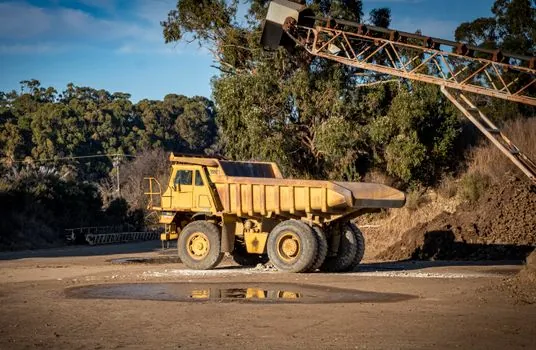
ADTs in the 25-45 t payload range with 6x6 drive and oscillating articulation suit soft-ground, muddy, or steep-gradient haul roads below roughly 2 km one-way, where a rigid-frame mechanical-drive truck would bottom-frame or lose traction [S3]. On a pipeline spread that crosses a wet river crossing or muskeg section, the ADT keeps cycle time intact where a 6x4 rigid truck bogs down.
Rigid mechanical-drive haulers belong on hard-rock, long-cycle, high-tonnage borrow pits with crushed-stone or blasted bench roads [S3]. Mixing the two on the same haul road is a common mistake: the maintenance bay, tyre inventory, and operator-licence class differ, so fleet planners should segregate the ADT and rigid pools to different sections of the ROW [S3].
Body, Liner, and Loading-Tool Match
Body volume (heaped m³) and payload must reconcile to within roughly 10% of the loading tool's pass count, or the truck either short-loads and wastes cycle cost, or spillage-loads and damages the struck pan [S3]. A 16 m³ body suits 5-6 m³ shovel passes for 3-pass loading; a 25 m³ body suits larger mining-class shovels [S3].
Liner selection follows material behaviour: a rubber mat suits coal where impact is light and hang-up is the failure mode, while high-strength wear-resistant steel plates are the default for blasted rock and overburden [S3][S5]. For pipeline ROW overburden, which is typically ripped shale or clay-sand mix, the steel liner out-lives rubber by a wide margin on impact and lasts longer against gouging from blasted rock at the borrow pit [S3].
Braking, Grade Performance, and Tyre Selection
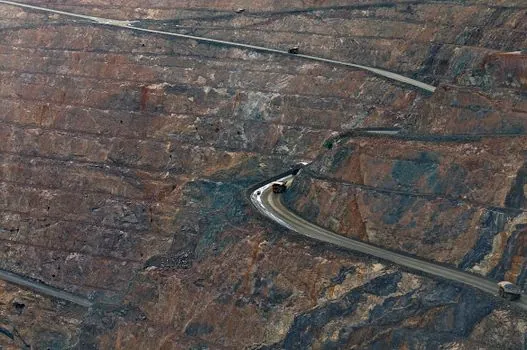
For pit ramps at 8-12% sustained grade, the retarder and service-brake balance decides whether a truck can run a continuous down-haul cycle without overheating [S3]. Aerodynamic studies on mining dump trucks, including head-shape rounding and splitter-plane additions, show measurable drag reduction at sustained haul speeds, but for typical 30-40 km/h cycle speeds the fuel saving is marginal against liner and tyre cost [S3].
Standard 12.00R20 XL tyres with weekly pressure checks are the maintenance baseline on 6x4 construction-quarry trucks; mine-spec tyres step up to larger sizes with reinforced sidewalls for the 70 t plus class [S4]. The HOWO ZZ3257N3647W demonstrates typical high-performance numbers: 35% gradeability at GVW, 9.5 m turning radius, 28° approach, 45° departure, and 45° cab tilt for engine access [S4]. A properly configured 6x4 dump truck can reach 95% availability in quarry operations when maintained to manufacturer schedules [S4].
Emission Tier, Sourcing, and Total Cost of Ownership
Euro 2 through Euro V engine ratings cover most 2026 export-supply mining dumpers, with Euro III/V-compliant WD615 and WP10 engines delivering 266-371 kW and 9/10-speed manual transmissions rated at 2,000-2,400 Nm of torque [S3][S4]. For buyers running ROW work in regulated markets, the spec sheet must confirm Tier 4 Final, Stage V, or equivalent before the chassis hits the contract clause; Euro 2 builds remain common in export supply but disqualify on many North American and EU pipeline tenders [S3].
Export pricing on the Chinese side clusters around the HOWO Tx 380/400/430 hp 8x4 25 m³ tipper at US$19,800-26,900 FOB and the 6x4 ZZ5707S3840AJ 41-50 t class dumper on OKorder at FOB Shanghai with roughly 1,500 pcs/month supply [S3]. Operators in Africa and Southeast Asia show 18% annual growth in mining-spec configuration orders, with 25-30 t models with 14-18 m³ dump bodies and 30-35 L/100km consumption as the preferred band [S4]. Chinese-brand tipper trucks hold a clear value-for-money and global parts-availability advantage on ROW work, while Western OEM mechanical-drive rigid haulers carry the long-life advantage on multi-year pit duty [S3][S5].
Selection Criteria for Pipeline Construction Spreads
For a pipeline construction fleet, the spec gates run in this order: daily tonnage per truck, haul distance and grade, loading-tool pass match, emission tier required by contract, then drive layout and brand [S2][S7]. A typical ROW spread with 50 t per day per truck at under 1 km one-way on a packed-earth or gravel right-of-way runs cleanly on a 6x4 30-40 t rigid-frame truck with a 16 m³ U-body and Euro III/V engine, serviced at 250-300 engine hours with 15,000 km oil-change intervals and 40,000-60,000 km brake-lining life [S3][S4].
For mainline borrow-pit support feeding the spread, the spec steps up to a 70 t plus mechanical-drive rigid hauler with electric-wheel drive, retarder braking, and a matched loading tool that fills the body in 3-4 passes [S3]. For soft-ground or short wet-section hauls under 2 km, an ADT in the 25-45 t 6x6 class keeps cycle time intact where a rigid truck would bog down [S3]. Buyers comparing mining haulers against construction machinery and equipment for trench support should match the mining dump truck class to the 40 t plus payload tier and reserve lighter tippers for ancillary haul [S3]. On any ROW where methane or low-ventilation work is possible, fixed gaseous-suppression hardware on the truck is a separate spec, addressed in the mining gas-suppression guide. For trench support pairing with a hydraulic excavator fleet, see the related construction tools reference.
Track on the next 90 days: confirm the 2026 export emission-tier lineup from HOWO, XCMG, and Shacman for Tier 4 Final and Stage V compatibility on the 30-50 t and 70 t classes, and watch for any DirectIndustry index updates adding electric-drive rigid haulers below 100 t for trench-side charging economics.