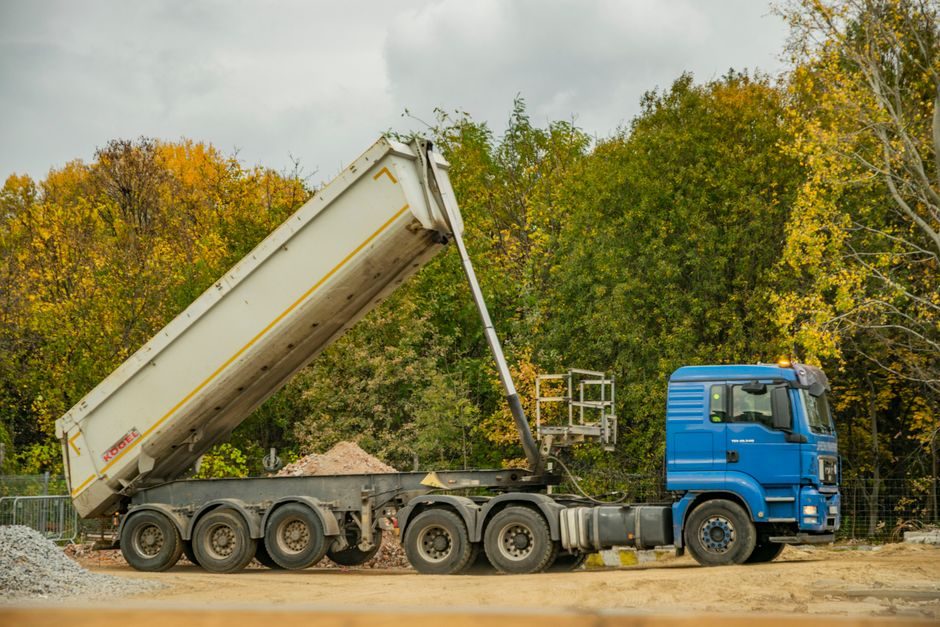
A mining dump truck is sized by payload first, frame architecture second, and powertrain third — choosing 363-tonne ultra-class machines for a 40 t shift is a 7-figure mistake that buyers can avoid by mapping payload to the truck's GVW, body capacity and the mine's ramp grade [S3].
Modern lineups in 2026 cover a 60-360 t payload envelope, with the dominant operating point sitting between 90 t and 150 t for hard-rock metal mines and 40-60 t for quarrying and construction-mineral haul [S1][S2]. Manufacturers actively offering rigid mining and quarrying dump trucks include Caterpillar Global Mining, SANY, Bell Equipment, ASTRA VEICOLI INDUSTRIALI, Deere-Hitachi and the new-energy entrant YIMU [S3][S4][S5].
Payload Class Bands and the Axle-Load Check
Payload is set by the truck's GVW minus its empty operating weight, and the practical selection check is tonnes-per-axle on the loaded drive axle — a 100 t rigid on six loaded axles runs about 16.7 t per axle, the upper limit for many pit-floor pavements [S2]. Caterpillar's 777-class rigid in current 2026 product literature is positioned as a 100 t-class all-terrain mining truck, marketed at construction and quarrying customers who also need bare-chassis WTR variants for water/fuel/lube service [S2].
Below the 100 t line sit SANY's SRT55D-class mechanical-drive rigid trucks, where vendor literature claims a 2-metre shorter blind spot than comparable models and an oil-temperature delta of 5°C versus peers thanks to revised hydraulic matching [S1]. At the 60 t entry point, the FT8060 specification in current manufacturer listings shows 60,000 kg payload paired to a 313.19 kW engine, the typical power density for that class at roughly 5.2 kW per tonne of payload [S3].
Rigid-Frame vs Articulated: When Each Topology Fits
Rigid-frame dump trucks carry a larger payload per cycle and are more efficient on well-maintained haul roads, while articulated dump trucks keep traction on soft, muddy or steeply-graded pit floors because the oscillating hitch keeps all wheels loaded through a turn.
Frame stiffness is the hidden selection variable. SANY's SRT55D platform uses a reinforced articulated bearing at the hitch to keep steering predictable over rough ground, an engineering point that matters because a 5° frame twist at the hitch is enough to misalign a hoist cylinder and crack a body [S1]. For ultra-class rigs above 240 t, frames are typically box-section welded high-strength quenched-and-tempered steel plate, 25-40 mm thick at the rail, and buyers should ask for the steel grade (commonly ASTM A514 / A517) and the rail weld procedure spec at the RFQ stage [S3].
Powertrain, Driveline and the AC vs DC Choice
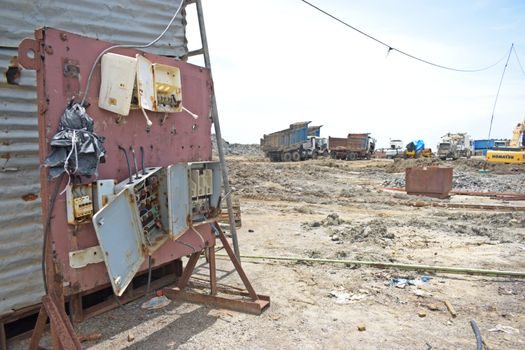
Most 60-100 t mining dump trucks in 2026 are mechanical-drive with a torque-converter lockup and 6-7 speed planetary powershift, while 150-360 t ultra-class units are almost universally AC-drive with four-wheel or six-wheel electric traction motors and retard AC dynamic braking. Caterpillar's 777-class documentation in 2026 confirms the truck ships as both a dump-truck model and a bare-chassis WTR (water truck / tow / fuel & lube) variant, both using the higher Tractor ROPS certification rating required for specialty service bodies [S2].
Fuel density at 100 t is around 5 kW per tonne; for a Cat 777-class engine in that envelope buyers should expect roughly 1,000-1,200 hp gross. Below 60 t the engine often doubles as the retarder; above 100 t a separate oil-cooled or AC retarder is the norm, sized to absorb 60-70% of rated flywheel power continuously without fading on a 10 km continuous downhill [S2][S3]. New-energy entrants such as YIMU position battery-electric and hybrid large mining dump trucks (HiMADS architecture) for sites that can absorb charging infrastructure and require lower diesel-particulate exposure on the bench [S5].
Body, Tonnage and Loading-Tool Match
Body struck capacity is set by 1.5-2.0 passes of the loading shovel, and 4-6 passes is a flag that the body is undersized or the loading tool is wrong. For a 100 t rigid the 6×6 m heaped body typically holds 40-60 m³ struck, matched to a 30-50 t hydraulic excavator (a mining dump truck of that class should not be matched to a 15-tonne backhoe). [S1]
Body liner choices are: 400-500 Brinell quenched-and-tempered plate for limestone and clean overburden; 500 HB plus chromium-carbide overlay for granite and iron-ore with impact loading; and hard-facing only on the floor plus AR400 on the walls for abrasive copper tailings. Hoist cylinders are single-stage on smaller rigs and twin-stage telescopic on ultra-class — buyers should confirm the body raise angle (commonly 65-70° for spillage control) and the dump-cycle time, which at 100 t runs 28-35 seconds loaded [S2][S3].
Selection Criteria: A Side-by-Side
When lining the three main options — small (40-60 t) mechanical rigid, mid-class (90-150 t) rigid, ultra-class (200-360 t) AC-drive rigid — against four decision variables, the table reads: 40-60 t on total cost of ownership (lowest acquisition, but highest fuel-per-tonne); 90-150 t on TCO/cycle (best breakeven for most hard-rock pits); 200-360 t on throughput (lowest cost per tonne-km but only on a 10+ km bench); and 40-60 t on capital risk (smallest exposure to commodity-price swings). The same 90-150 t class is mid-range on capital risk and lowest on operating complexity per engineer-shift [S1][S2][S3].
For a deeper dive on the same envelope, the spec-band companion piece on pharmaceutical bulk-material handling is a useful cross-reference where the loading tool and clean-zone constraints differ but the payload-tonnage math is identical.
Standards, Compliance and Sourcing Levers
Haul-truck safety cases run against ISO 3471 (ROPS) and ISO 5700 (FOPS) for the operator cab, ISO 5010 for steering, and ISO 6015 for the hoist system. ROPS on Caterpillar's WTR variants is specified at the higher Tractor rating — a deliberate OEM choice for service bodies that travel loaded at higher speeds than a rigid dump truck in a V-cycle [S2].
For a structured read on the same payload/drive-layout tradeoff framed as a buying decision, the Choosing a Mining Dump Truck: Payload, Drive Layout and Sourcing Specs companion walks the same envelope from a sourcing-bench angle. Cross-link to linear guide or truck scale if a weighbridge or a weigh-in-motion scale is being added to the bench — the payload-class discussion there follows the same 60-360 t envelope and the same GVW logic as the haul truck itself.
Limitations, Failure Modes and Sourcing Risk
Common selection mistakes in 2026 are: under-spec'ing the retarder for a hot, high-altitude mine where the air-density correction drops cooling-fan effectiveness by ~15%; ordering 6×4 drive when the pit floor is wet (the third axle should be driven); and accepting an unspecified body liner — buyers should pin the Brinell hardness and overlay chemistry in the PO. Lead time for an ultra-class rigid runs 12-18 months from a Tier-1 OEM, which is why 40-60 t and 90-150 t classes now see 4-6 regional assemblers entering the field [S3].
After-sales risk is concentrated in the drivetrain: AC-drive traction motors and inverters on ultra-class units have a 30,000-40,000 hour rebuild interval and a single motor replacement can take the truck off-hire for 4-6 weeks if spares are not held in-country. Mechanical-drive units below 100 t use 1-2 common OEM axle and transmission platforms, so spares are typically stocked in 7-14 days [S2][S3][S4].
Final signals to track: (1) YIMU and other new-energy OEMs moving pilot battery-electric and hybrid large mining dump trucks (HiMADS) from demo to commercial fleet by end-2026 [S5]; (2) continued WTR bare-chassis variants at the 100 t class, useful for water/fuel/lube conversion at mine-build phase [S2]; (3) the steady migration of 313 kW-class 60 t trucks into mid-size hard-rock pits — the spec band documented in current manufacturer listings as the entry point for new mine-builds [S3].