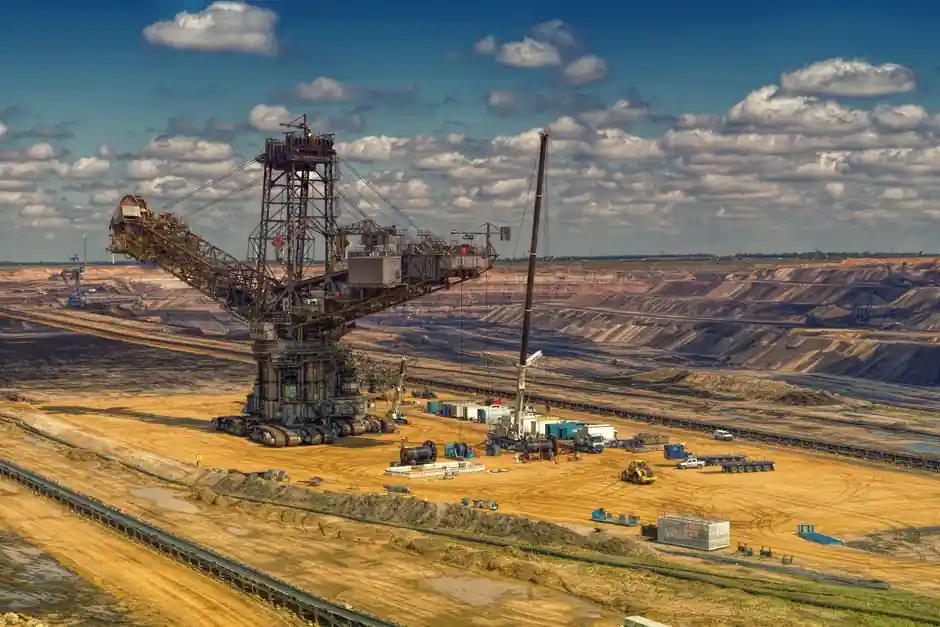
Rough terrain forklifts dominate mining materials handling, with North American OEM lineups covering 4,000-30,000 lb capacities on full-time 4WD/4WS chassis purpose-built for haul-road and pit-floor duty [S1].
Mining duty cycles differ from warehouse or yard logistics: surfaces are unpaved, grades exceed 15%, dust load on air intakes is high, and shift lengths stretch past 10 hours. The selection problem is therefore closer to off-highway equipment sizing than to standard forklift selection for palletised indoor work.
Capacity classes and chassis architecture
Rough terrain forklifts for mining are typically split into two load windows. The lighter class covers 4,000-12,000 lb units used for pipe, conveyor spares, and small consumable moves, while the heavy class covers 6,000-30,000 lb units used for drill steel, tyre handling, and containerised stock [S1]. A full-time 4WD driveline with 4-wheel steering is the defining chassis feature, because a 2WD machine loses traction on wet haul-road clay and a 2WS machine cannot reposition inside a typical pit-floor pad.
Within the rough terrain forklift category, two body types compete. Truck-mounted units (e.g. the Sellick STM55 Series II) deliver forklift capability off the back of a road-going truck or trailer, suiting road-to-pit transfer duty. Dedicated rough terrain forklifts, by contrast, are self-contained and sized for continuous off-road work, which is the configuration most mines standardise on for pit-floor rehandling.
Engine and emissions gates (Tier 4)
Diesel remains the default prime mover for mining rough terrain forklifts, and Tier 4 Final emissions compliance is now the baseline for any new North American unit, driving the need for diesel particulate filter (DPF) regen cycles and diesel exhaust fluid (DEF) infrastructure on-site [S1]. Engine power is typically in the 60-110 hp band for the 4,000-12,000 lb class and 120-200 hp for the 30,000 lb class, paired with torque converters sized for low-speed tractive effort rather than transport speed.
On a site running mixed vintage equipment, a Tier 4 forklift will need scheduled regen windows (typically 20-40 minutes every 8-12 hours under load). Mines that cannot guarantee a 600-700 deg C DPF temperature for passive regen must plan a forced regen bay, and that bay sizing is often the hidden civil-works cost of buying Tier 4 over Tier 3.
Mast, attachment, and load geometry
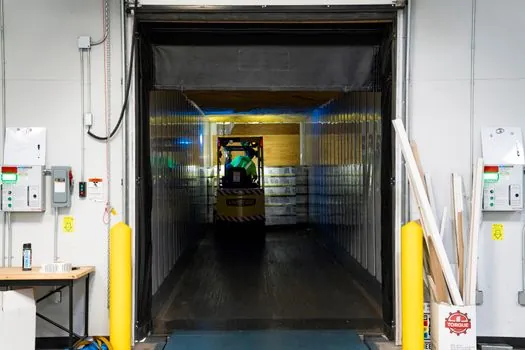
Mast selection is driven by container and pallet geometry, not by reach alone. Two-stage masts suit 48 in pallets and standard intermodal handling, while three-stage full-free-lift masts are specified where the lift truck works inside 20 ft containers with low ceiling clearance. Side-shift carriages are near-universal on mining units because lateral adjustment compensates for uneven load positioning on rough ground. [S1]
Attachments that recur in mining spec sheets include coil booms (for wire-rope reels), drum clamps, rotating carriages for cylinder handling, and jib booms rated 2,000-4,000 lb at 4-6 ft for odd-shaped consumables. For mine workshops adjacent to the pit, the same machine often doubles as a light crane, which is why OEM attachment quick-disconnect plates are increasingly standard rather than optional.
Site conditions: dust, heat, and grade
Mining sites impose three environmental loads that warehouse spec sheets do not address. Airborne dust mandates pre-cleaners with cyclonic separation ahead of the main air filter, and most OEMs quote a 500-1,000 hour primary filter life in pit conditions versus 2,000+ hours in a clean yard. High-ambient sites (open-pit in arid regions) push hydraulic oil cooling into the 50 deg C continuous bracket, and a heavy-duty oil-to-air cooler is non-negotiable above 40 deg C ambient. [S1]
Gradient capability is the second most mis-specified parameter. A rough terrain forklift rated for a 30% loaded grade on a prepared surface typically delivers 15-20% sustained grade on wet clay, because loaded tractive effort drops as tyre slip rises. Buyers should request sustained-grade performance curves from the OEM, not the marketing-grade maximum.
Decision criteria: matching machine class to mining duty
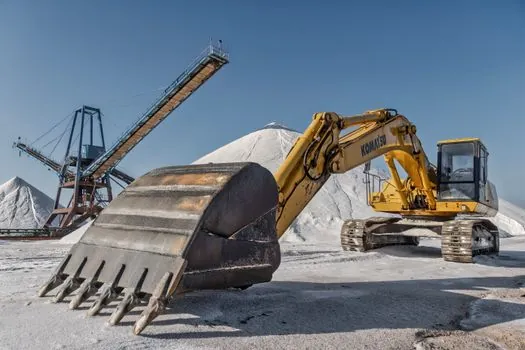
Three machine archetypes cover most mining duty cycles, and the right choice depends on three engineering criteria: payload band, mobility requirement, and infrastructure dependency. [S1]
For pit-floor rehandling under 12,000 lb on unpaved haul roads, a dedicated rough terrain forklift with 4WD/4WS and Tier 4 diesel in the 60-110 hp band is the workhorse. For road-to-pit transfer and occasional pit work, a truck-mounted unit (e.g. STM55 Series II) reduces capital outlay and frees the prime-mover truck for haulage. For low-clearance underground or tunnel work, a compact rough terrain unit with reduced mast height and stage 4 engine is the only compliant option, with size, not capacity, as the binding constraint.
Capital cost per pound of capacity, infrastructure dependency (DEF, regen bay, spare parts stocking), and OEM dealer support radius are the three commercial gates. Sites beyond a 4-hour dealer radius should weigh a dedicated rough terrain unit over a truck-mounted one, because downtime cost on a remote pit typically dwarfs the capital premium of a self-contained machine.
Standards, sourcing, and service
OEM ISO 9001 certification and a published Tier 4 engine regen procedure are baseline procurement gates; the 24-hour parts delivery commitment advertised by established North American OEMs (e.g. Sellick, 55+ years in business, 100+ dealer locations) is the operational benchmark mines benchmark against [S2]. Fleet operators running more than 4-6 units commonly negotiate dedicated parts stocking at the mine warehouse to compress mean time to repair below 8 hours.
Two trackable signals to watch through 2026 are: Stage V emissions transition for European-sourced rough terrain units entering African and Australian mines, and the spread of telematics (load weight, hour meter, fuel burn, regen cycles) from Tier 4 engine ECMs into standard mine-fleet management dashboards. Either shift will change the spec checklist on the next tender round.
For component-level specifications, see mining dump truck.
For related coverage, see Asphalt Paver Selection for Urban Infrastructure: Width, Mobility, and Emission Gates.