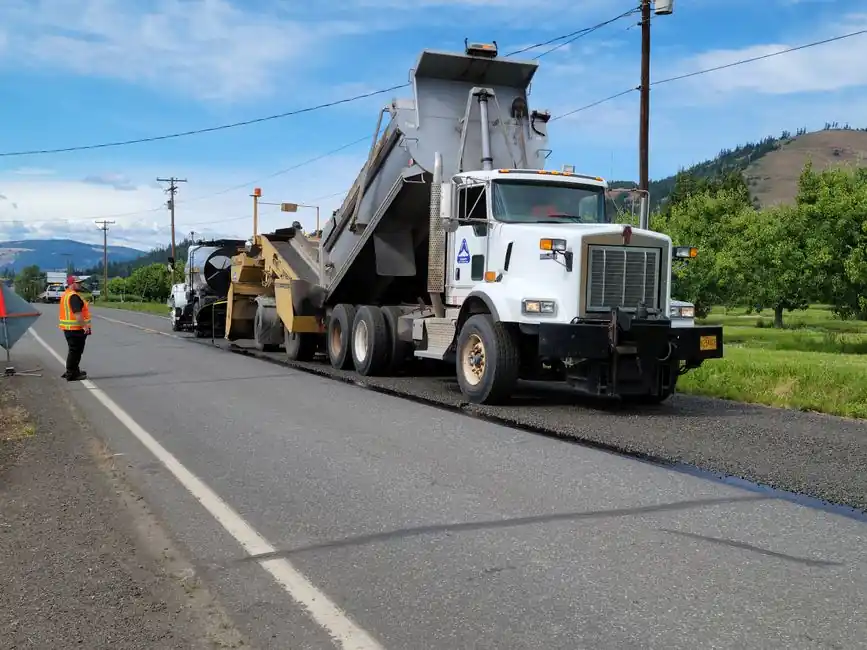
Urban road rebuilds and resurfacing jobs in 2026 are spec'd to a tight envelope: typical single-lane widths run 3.0–3.6 m, intersection kerb radii sit at 6–9 m, and most municipal contracts require Tier 4 Final diesel on machines above 56 kW, with EU Stage V as the parallel gate in EEA jurisdictions [S1].
City paving is not a quarry job, so the dominant decision drivers are NOT raw throughput, but manoeuvrability on tight kerbs, low ground pressure on restored subgrade, and a screed that can pave-asphalt or tack-coat widths down to 1.8 m without handwork. Selecting the wrong size class on any one of those three creates the rework cost that erodes the contractor's margin on the job.
Urban Paving Width Bands and Lane Geometry
Standard urban paver width bands cluster at 2.5–5.0 m hydraulically extendable screed, with bolt-on extensions adding another 0.75 m per side on the most common mid-size classes used by city contractors [S1]. A single residential lane at 3.0–3.5 m is comfortably paved in one pass; a 7.2 m arterial needs the extended screed or a two-pass setup, with a centre-line joint risk that contractors typically avoid by sizing up.
For alleys, utility cuts and manhole reinstatement (catch-basin and manhole work is a recurring city line item [S1]), contractors often drop to a 1.7–2.5 m tracked mini-paver, which is small enough to fit through a 3 m gate yet still delivers a vibratory screed for compaction to 92–96% Marshall density on 50–75 mm lift thicknesses. Overspec'ing the machine to a 9 m highway-class paver for a 4 m street is the single most common urban-paving mistake.
Tracked vs Wheeled Undercarriage on City Streets
Tracked pavers dominate the urban segment because they deliver lower ground pressure (typically 35–55 kPa on a 8–14 t tracked machine) and better traction over milled surfaces, manhole frames and patch repairs. Wheeled pavers earn their place on long, straight arterials with frequent repositioning, where their higher travel speed (up to 20 km/h vs 3–5 km/h for tracked) cuts non-paving cycle time [S1].
Inside a tight work zone, the tracked machine is the safer pick: shorter turning radius under load, no tyre scuff on a fresh tack coat, and stable pushing against a 10–14 t MTV (material transfer vehicle) on confined arterial rebuilds. A detailed track-vs-wheel band map for haul-road work is in Asphalt Paver Selection for Mining Haul Roads; for city work the conclusion is more one-sided than for mining, where ground-bearing pressure and cycle time can swing either way.
Engine Tier, Emissions, and Aftertreatment on City Contracts
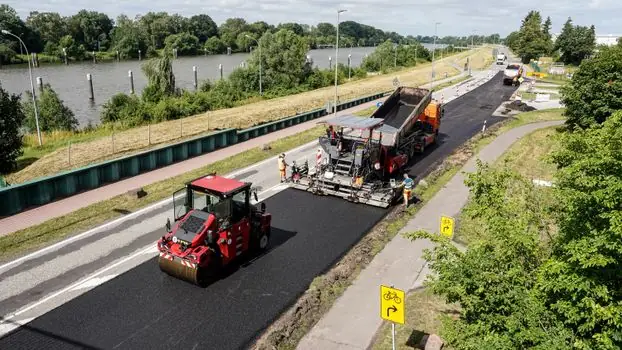
Municipal procurement language in 2026 commonly rejects anything below Tier 4 Final (US) or Stage V (EU) on pavers above 19 kW, which forces diesel particulate filter (DPF) and selective catalytic reduction (SCR) hardware into the spec. This rules out a meaningful slice of the used 10–15 year old fleet that small paving subcontractors had been running [S1].
For low-emission zones (LEZ) in European cities, the gate is even harder: Stage V is mandatory, idle-shutdown timers are commonly required, and electric or hybrid mini-pavers (typically 7–9 t class, 30–50 kWh on-board, 4–6 hours of paving duty per charge) are now purchasable from at least two majors for night-shift utility-cut work. Diesel exhaust fluid (DEF/AdBlue) consumption on a Tier 4 Final 75–130 kW paver typically runs 3–6% of fuel burn, which is a line item the estimator has to carry.
Screed Type, Pre-compaction, and Mat Quality
Hydraulic extendable screeds with tamper-plus-vibration pre-compaction are the default in the urban 2.5–5.0 m class, achieving 85–90% of theoretical density behind the screed before rollers close the lift. Fixed-width screeds with bolt-on extensions are cheaper and lighter, but joint quality at the extension seam is the recurring mat defect on hand-finished city patches [S1].
Heated screed plates (electric or diesel-fired) are not optional in cool-weather city paving, where ambient temperatures on a Canadian or northern-US job can sit at 5–15 °C in shoulder seasons: an unheated screed lifts the mat and tears the surface texture, which is a rejection trigger under most municipal QA specs. A paver selection primer that frames the screed-vs-class trade against subgrade condition for pipeline rights-of-way is in Asphalt Paver Selection for Pipeline Construction, where subgrade weakness drives the same low-ground-pressure call as urban utility cuts.
Operator Visibility, Noise, and Night-Shift Work

City paving is half night-shift by 2026, and noise ordinances in residential zones cap work at 72–78 dBA at 15 m. That puts a quiet-engine package, sound-attenuated enclosures, and a forward-mounted operator station with 270° visibility into the procurement spec, not the options list [S1].
Key visibility items to spec in writing: a sloped or pivoting console so the operator sees the auger chamber, a side-mounted screed-walk platform with joystick reach, and a rear-view camera tied to the millimetric back-up alarm. Without those, the paver is a safety-incident risk on a 2-man night crew and a lot of urban general contractors will not accept delivery.
Comparison of Urban Paver Classes
The city-fleet decision typically lands on one of three machine classes, lined up against the constraints that actually drive urban selection [S1]:
1. Mini tracked paver (1.7–2.5 m screed, 4–8 t operating weight): lowest ground pressure for utility cuts, fits through a 3 m gate, lowest hourly fuel burn. Limit: cannot pave a full traffic lane in one pass; handwork at edges.
2. Mid-size tracked paver (2.5–5.0 m hydraulic screed, 8–14 t): the workhorse for arterial resurfacing and most municipal contracts; balances single-pass arterial paving with 35–55 kPa ground pressure. This is the dominant class for city fleet renewals in 2026.
3. Wheeled highway-class paver (2.5–6.5 m screed, 14–20 t): the wrong tool for tight city work unless the job is a long, straight, recently-rebuilt arterial; the 18–20 km/h travel speed is its only urban advantage.
Selection within a class is then driven by engine emissions tier, screed heating type, and noise package, with mini electric units added where the LEZ or night-noise rule excludes diesel.
Sourcing, Standards, and Contractor Vetting

A contractor's WSIB/insurance clearance and written safety program are standard prequalification documents on city work, alongside the credit application paperwork visible on established city paving vendor sites [S1].
Verify the paver's rated paving speed (typically 0.5–30 m/min on tracked mid-size units, with sustained production at 4–8 m/min for a 50 mm lift), the hopper capacity (typically 6–13 t on the mid-size class for one truck-to-paver handoff), and the auger diameter (300–360 mm), as those three numbers set real production in t/h, not the marketing horsepower figure.
Closeout signal: watch 2026 municipal procurement portals for fleet-renewal RFPs on Tier 4 Final mid-size tracked pavers with hydraulic 2.5–5.0 m screeds, and a parallel track of electric mini-paver pilot buys in EU low-emission-zone cities, both of which will set the spec language that drives the next 18 months of city-fleet purchasing.
For component-level specifications, see asphalt paver, pressure transmitter, and flow meter.