EN ISO 20345 S3 or S5 boots with a 200 J toe cap and a puncture-resistant midsole are the baseline spec for both underground and open-pit mining footwear, with HRO heat-resistant outsoles specified wherever hot surfaces or weld splatter are present [S1][S5].
Procurement teams and PPE distributors in 2026 are choosing boots by the documented worksite hazard matrix, not by price, with regional certification (EN ISO 20345 in Europe, ASTM F2413-24 in North America, AS 2210.3:2019 in Australia, CSA Z195 in Canada) driving the shortlist [S1][S3][S5].
Hazard Matrix That Drives the Boot Specification
Falling rocks, rolling ore and dropped tools make 200 J toe impact resistance the non-negotiable baseline; many surface-mine and drill operators layer a metatarsal guard over the toe cap for fragment impact above the lace line [S5].
Sharp fragments, rebar, scrap wire and pit-floor nails drive a separate requirement: a steel or textile puncture-resistant midsole rated to EN ISO 20345 P or the equivalent ASTM F2413-24 PR plate, since toe protection alone leaves the sole exposed [S3][S5].
EN ISO 20345 S-Classes, ASTM F2413-24, and Regional Equivalents
EN ISO 20345 classes map cleanly onto mining risk: S1P for light surface roles, S3 for the common underground and open-pit case (closed seat region, plus puncture, plus cleated outsole), and S5 for wellington-style rubber/PVC boots used in dewatering, slurry and high-volume wash-down zones [S2][S5].
North American operations anchor to ASTM F2413-24 with the I/75/C/75 impact/compression designation as the analogue to 200 J toe protection, while Canadian sites commonly require the CSA Z195 green triangle / Grade 1 and Australian sites require AS 2210.3:2019 [S1][S3].
Underground vs Open-Pit vs Quarry: Different Footwear, Same Standard
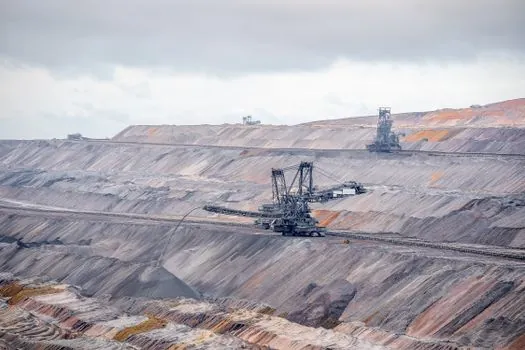
Underground coal and hard-rock mines prioritise waterproof S3 boots with metatarsal protection, ankle support to ~150 mm, and a cleated rubber or PU-rubber outsole for traction in mud and on rails; wellington S5 boots dominate dewatering and shotcrete zones [S3][S5].
Open-pit and quarry sites run leaner: S3 ankle boots with HRO outsoles handle haul-road crossings and scree slopes, and operators in hot arid pits frequently select lighter PU-PU dual-density outsoles over PU-rubber to cut mass for 12 h shifts [S2][S3].
Specialised roles branch off: foundry-adjacent smelter work shifts to EN ISO 20349 for weld splatter resistance, chainsaw clearing requires EN ISO 17249 Class 2 or 3, and South African operations require the NRCS approval mark in addition to the EN/ASTM base cert [S1].
Materials, Construction, and Comfort Spec That Decide the Final Pick
Toe-cap material splits the field: steel caps take the highest impact for the lowest cost and remain the default in most EN S3 ranges, while composite caps (fibreglass or carbon-fibre) weigh roughly 30 percent less per pair and are metal-free for sites with detector gates or spark risk [S2][S5].
Upper material drives both durability and shift comfort: full-grain leather, optionally Cordura-reinforced at flex points as on the TALAN Heavy Duty line, gives 1-2 year service life in abrasive pit conditions, and PneumaTex microfibre leather appears as a lighter vegan alternative in catalogues where the spec is written to a comfort rather than abrasion target [S1][S2].
Long-shift fatigue is controlled at three points: a shock-absorbing heel (SAFETOE markets this as Zorbtion™ in selected lines), a cushioned, antibacterial insole, and the boot's empty mass; mining buyers in 2026 commonly target 1.2-1.5 kg per pair as the upper comfort ceiling, with PU-PU construction landing on the low end and PU-rubber on the high end [S1][S2][S5].
Selection Criteria Comparison Across Main Options
Side-by-side, the four dominant mining footwear types line up against the criteria that drive the spec: S3 leather ankle boot (most common, 1.2-1.5 kg, EN ISO 20345 S3 SRC HRO, broad multi-hazard coverage), S5 PVC/nitrile wellington (heaviest, fully waterproof, S5 SRC, ideal for slurry and dewatering), metatarsal-overtoe S3 (same S3 base with TuffTarsal or external guard, +150-250 g per pair, used in draw-point and drill zones), and composite-toe S3 (lightest, metal-free, non-detectable, slightly higher unit cost) [S2][S5].
Decision rule of thumb from the supplier guidance: default the fleet to S3 SRC HRO with composite or steel toe per site detector policy, escalate to metatarsal-overtoe for any task with documented rockfall energy above 100 J, and step up to S5 wellingtons only where the upper would be submerged or coated in slurry for more than half the shift [S3][S5].
Failure Modes, Constraints, and What the Spec Won't Catch
Hydrolysis of PU midsoles is the dominant field failure: stored boots degrade from the inside out in 2-3 years even without wear, so EN ISO 20345 HRO PU-PU construction should be paired with rotation and date-of-manufacture tracking rather than a fixed replacement interval [S2][S5].
Standards, Sourcing, and What to Ask the Supplier
Ask for the four numbers on every quote: EN ISO 20345 class (S1P / S3 / S5), ASTM F2413-24 designation (I/75/C/75 plus optional Mt/75 metatarsal and PR puncture), regional mark (CSA Z195, AS 2210.3:2019, NRCS), and the outsole code (HRO, SRC, ESD) [S1][S3].
Confirm test lab and certificate validity: EN ISO 20345 tests are typically issued by notified bodies such as CTC, SATRA or TÜV, and the certificate number should be printed on the boot along with the month/year of manufacture [S1].
For broader PPE context, the same hazard-driven logic that picks the boot also picks the respirator (Respirator Selection for Mining: Spec Lines, APF Math, and MSHA/NIOSH Compliance), the protective clothing class, and the safety eyewear (Safety glasses types, ANSI Z87 ratings, and hazard-class selection), all of which line up under a shared worksite hazard assessment.
Two signals to track before the next quarterly PPE review: any tightening of ASTM F2413-24 metatarsal Mt/75 impact thresholds, and any movement by major miners to mandate EN ISO 20345 S5 wellingtons in dewatering zones as a fleet standard rather than a task-specific issue.
Spec-level background on the components involved: safety shoes, mining dump truck, and fire safety.