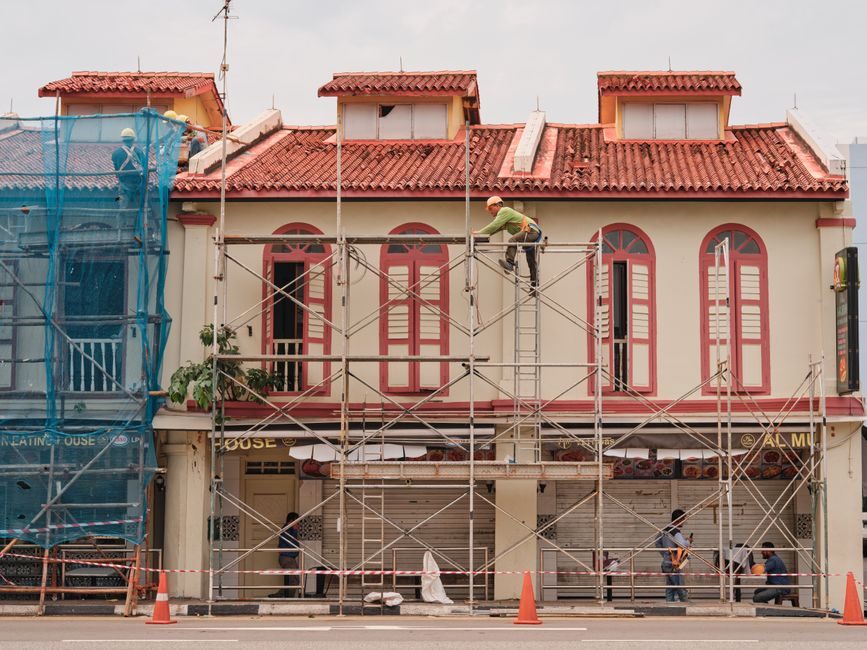
Mobile scaffold towers in current European catalogues are engineered around EN 1004-1 / DIN EN 1004 and split into narrow indoor aluminium units (≈0.58 m wide, 200 kg/m², working height up to 7.10 m) and modular facade towers (0.75 m wide, 1.80 m long, working height 3.35 m to 13.20 m) [S1][S2].
The SPEEDY 4+ from TUBESCA lists working heights of 2.6 m, 3.6 m, 5.35 m and 7.1 m on a 1.48 m × 0.58 m aluminium platform, with EN 1004-1 compliance and a 200 kg/m² uniformly distributed load rating [S1]. ZARGES MultiTower S-PLUS 1T covers 3.35 m to 13.20 m working height on a 1.80 m × 0.75 m frame, category 3 (200 kg/m²) per DIN EN 1004, with 200 mm height-adjustable swivel castors (Order No. 42917) for millimetre level correction [S2].
EN 1004-1 Scope and the Three Load Categories
DIN EN 1004-1 is the harmonised European standard for free-standing mobile access towers of working height up to 12 m (indoor) and 8 m (outdoor), and it groups platforms into load classes 1–6 by uniformly distributed load [S1][S2].
Both reference towers are rated category 3, which means a 200 kg/m² working platform capacity — enough for two tradesmen with hand tools but not for stacked plasterboard or a 100 kg generator set [S1][S2]. The ZARGES catalogue is explicit: “Scaffolding category 3 (maximum load of 200 kg/m²) according to DIN EN 1004” [S2]. If a job requires stone, mortar tubs, or multiple workers plus boards, step up to a class 4 (300 kg/m²) ringlock or frame tower; for ceiling-grid drywall alone, a class 2 (150 kg/m²) podium step is normally sufficient.
Width × Length: Indoor Narrow vs Facade Modular
The two geometries shown in the research address different access corridors: 0.58 m × 1.48 m for doorways and aisles, 0.75 m × 1.80 m for open facades. [S1]
The TUBESCA SPEEDY 4+ uses a 0.58 m frame width precisely so the folded base passes a standard doorway, and its 1.48 m platform length is the minimum that supports a toeboard and a single tradesman kneeling with a drill [S1]. The ZARGES MultiTower uses a 0.75 m width to keep a working kneeboard plus a tool tray, and a 1.80 m length so two tradesmen can pass on the platform — that length is also the 2 m vertical spacing of platforms (guardrail-to-platform distance) that DIN EN 1004 expects for integrated-guardrail assembly [S2]. The trade-off: a 0.58 m tower is one-person work, a 0.75 m tower is two-person work and accepts stabilisers and outriggers for the higher reaches.
Working Height, Platform Spacing and Stabilisers
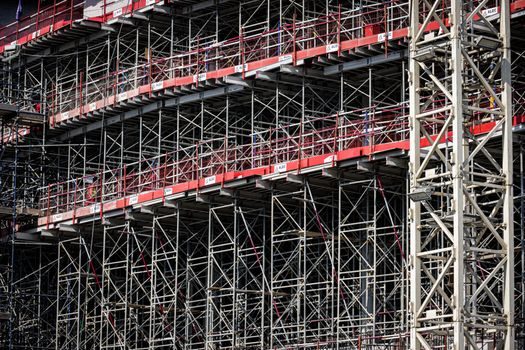
Working height on these mobile towers is field-adjustable in fixed increments, and standard parts — not custom sections — must cover the full range advertised. [S2]
SPEEDY 4+ is sold in packs that combine to any of the four pre-engineered working heights up to 7.10 m, with reinforced trays and removable folding bases for level offset [S1]. ZARGES MultiTower extends from 3.35 m to a maximum 13.20 m working height using the same standard parts, with platforms at 2 m intervals and an “advanced guardrail” that replaces the old separate rail-and-diagonal-brace pattern [S2]. Above 4 m platform height the ZARGES Z 600 line is designed to accept retrofitted S-PLUS stabilisers (outriggers) — this is the practical upper limit before static towers become mandatory on site [S2].
Castors, Level Adjustment and Floor Protection
Castor specification is the single most failure-prone component on a mobile tower and the easiest one to under-spec. [S3]
The ZARGES MultiTower ships with 200 mm height-adjustable swivel castors (Order No. 42917) that provide millimetre-precise level correction; the TUBESCA SPEEDY uses a removable folding base that the assembler can shim for uneven floors [S1][S2]. On flat industrial floors a 125 mm castor is adequate; on rough slabs or outdoor kerbs 200 mm rubber-tyred castors with foot-operated brakes are the practical minimum to prevent the tower from “walking” when a worker climbs. For indoor vinyl or resin floors always add a castor pad or rubber foot to stop black-mark transfer — this is a building-services requirement more than an EN 1004 requirement.
Material, Weight and Indoor Air Handling
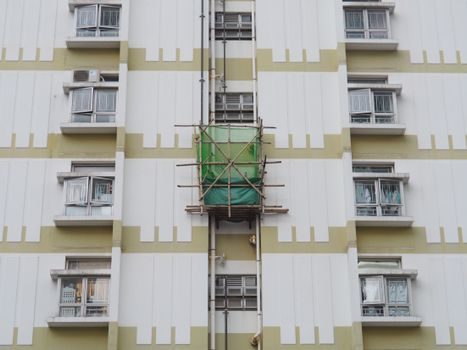
Aluminium is the default mobile-tower material in this class; steel mobile towers exist but are heavy and rare in this working-height range. [S4]
Both reference units are aluminium: TUBESCA explicitly lists “Material: Aluminium” with a 5-year warranty [S1]; ZARGES markets the MultiTower for “quick and safe erection due to advanced guardrails, two-metre platform spacing and fewer individual parts”, which is only practical because aluminium frames lift into place by hand [S2]. Aluminium keeps a 7 m tower under 100 kg total and a 13 m tower under 250 kg — light enough for two people to reposition on a slab without a forklift. A related reference architecture for modular access staging is laid out in the ringlock scaffolding spec map, which covers the heavier static class that takes over once mobile towers are out of their working-height envelope.
Selection Decision Table: Match Job to Tower
Four criteria, two tower classes — use this to shortlist a SKU before checking price. [S1]
For indoor fit-out, ceiling-grid or M&E work on a level slab, ≤7.1 m working height, single operator: choose a narrow aluminium tower such as SPEEDY 4+ (platform 1.48 m × 0.58 m, 200 kg/m², EN 1004-1) [S1]. For facade or external works up to 13.2 m, two operators plus materials on platform: choose a modular 0.75 m × 1.80 m tower such as MultiTower S-PLUS 1T (DIN EN 1004 class 3, 200 kg/m², 2 m platform spacing) [S2]. For loads above 200 kg/m², working heights above 12 m indoor / 8 m outdoor, or tied facades: leave the mobile category entirely and move to a ringlock or frame scaffold system engineered to the same DIN EN 12810/12811 series. For packaging, transport, or warehouse picking where a stable working platform matters more than height, the work bench capacity and frame logic guide gives the selection framework for the static-equipment alternative.
Failure Modes and What Specifiers Forget
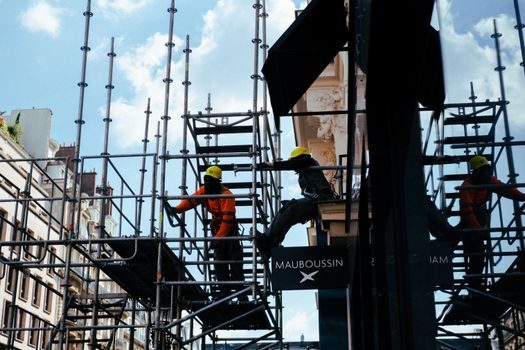
Most mobile-tower incidents are not EN 1004 spec failures — they are assembly and site-discipline failures that a careful spec can pre-empt. [S2]
Three patterns to spec out: (1) towers used above the manufacturer’s working-height limit because “it looks stable” — cap published working height at 7.10 m for narrow indoor units and 12 m indoor / 8 m outdoor for modular units unless a competent-person calculation is on file [S1][S2]. (2) Outriggers omitted on >4 m platform heights to save set-up time on tight sites — ZARGES explicitly offers retrofitted stabilisers for the Z 600 S-PLUS line, and the spec must mandate them above that threshold [S2]. (3) Mixed-component towers — a SPEEDY folding base frame combined with a MultiTower upper section is not covered by either manufacturer’s EN 1004-1 declaration and will fail an inspection [S1][S2]. For procurement, the indicative price of the MultiTower S-PLUS 1T is €4,990 ex-VAT [S2].
For component-level specifications, see mobile crane, linear guide, and tower crane.