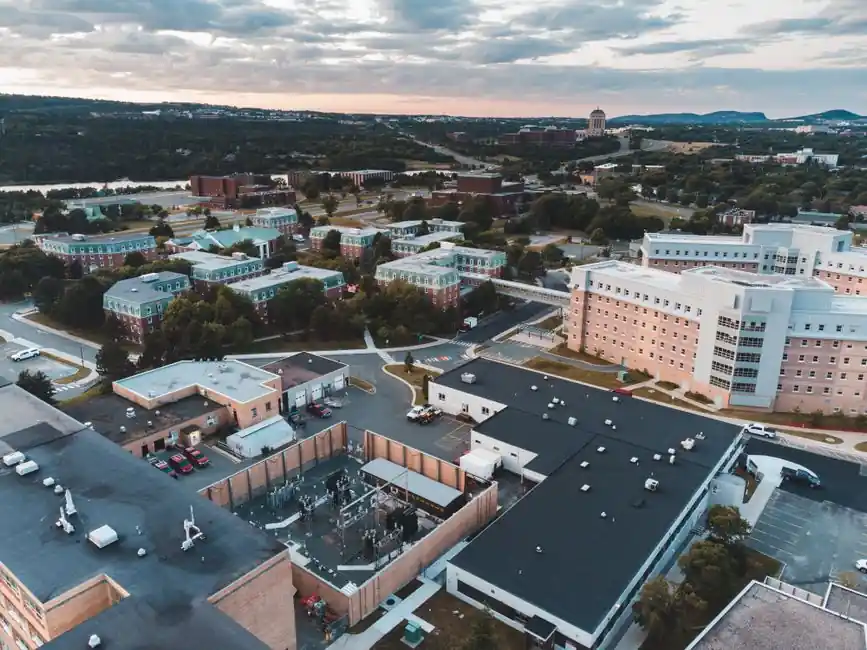
APP-modified bitumen membranes with 4.0-5.0 mm thickness, polyester reinforcement at 180-250 g/m², and a Ring & Ball softening point above 150 °C are the default specification for hospital roof areas exposed to direct solar load, per manufacturer data published in 2025 [S1][S5].
Hospital waterproofing differs from a standard commercial build because three risk zones coexist on the same site: exposed plant-room roofs, internal wet areas (toilets, sterilisation rooms, dialysis), and below-grade lift pits or foundation walls, each of which demands a different membrane chemistry and installation method [S3][S4].
Define the Risk Zone Before Picking a Chemistry
Hospitals combine solar-exposed roofs, internal wet rooms, and below-grade structures, so the first design move is to map each area to a polymer type: SBS elastomer for cold-flexibility down to -30 °C, APP plastomer for heat resistance up to 140 °C, or self-adhesive rubber-bitumen where torching is prohibited indoors [S3]. A specification that mixes the wrong chemistry on a critical area, for example a plain oxidised bitumen sheet on a plant-room roof in a 40 °C climate, typically fails within five to seven years, which is a non-starter for a healthcare asset expected to last 20 years or more [S3].
For a typical 8,000 m² hospital, the membrane split in linear metres of roll is roughly 55-60 percent exposed APP torch-applied, 30-35 percent self-adhesive HDPE-faced for internal wet areas, and 5-10 percent SBS for cold-store plant decks or north-facing shaded zones, based on the SikaShield project decision sequence [S3].
Spec Sheet Numbers That Matter on a Hospital Tender
Three parameters on the technical data sheet drive acceptance or rejection: cold flexibility in °C, tensile strength in N/5 cm, and elongation at break as a percentage. The Bituroll-P 3160 grade publishes 500/350 N/5 cm (longitudinal/transverse) tensile and 30/45 percent elongation at 3.0 mm, scaling to 1100/800 N/5 cm and 40/50 percent on the 4.0 mm, 250 g/m² polyester grade 4250/5250 [S1]. The higher-grading jump is what an estimator should look for when the hospital roof will carry a 100 mm+ ballast or paver layer, because the walking-load and creep cycles over 20 years consume the lower-reinforced grades faster.
Cold flexibility is the proxy for service life: the lower the temperature at which the sheet still bends without cracking, the higher the polymer loading and the longer the membrane holds up under thermal cycling, which matters for any hospital in a region with a winter design temperature below 0 °C [S3]. A grade rated 0 °C cold flexibility, such as BITUMODE DELTA-P at 3 or 4 mm and 110 °C heat resistance, is a regional-tropical choice and should not be substituted in a temperate-climate hospital roof without re-running the condensation and vapour-control calculation [S4].
APP vs SBS vs Self-Adhesive: Comparison for Hospital Areas
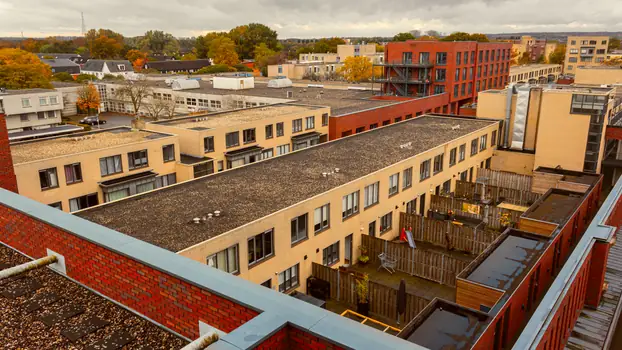
Three chemistries compete for the bulk of hospital waterproofing tonnage, and they line up against four decision criteria as follows. APP plastomeric sheets (for example Bituroll-P 3160-5250, BITUMODE DELTA-P) deliver heat resistance above 150 °C softening point (Bituroll-P) and 110 °C heat resistance (BITUMODE), a UV-stable exposed surface, and torch-applied speed on large plant roofs, but require naked-flame exclusion zones and are not acceptable inside operating theatres or MRI scan rooms [S1][S4]. SBS elastomeric sheets add cold flexibility down to -30 °C and tolerate thermal shock on cold-store plant decks, at the cost of higher unit price and a slightly lower softening point around 100-120 °C [S3][S5]. Self-adhesive HDPE-faced rubber-bitumen membranes such as Bituthene GP carry no open-flame risk, pass EN 13501-1 Class E reaction to fire, and resist a hydrostatic head up to 1 m when fully supported, which is the right call for internal plant-room risers, lift pits, and planter boxes adjacent to ambulance bays [S2].
For procurement, the decision matrix reads: APP on exposed plant-room roofs over 200 m², SBS on cold-store decks and any zone with a design temperature below -10 °C, self-adhesive Bituthene GP-grade on internal wet areas and below-grade lift pits where torching is banned by the hospital's fire safety code [S2][S3].
Installation Method and Fire-Safety Constraint Inside Hospital Buildings
Most modified bitumen membranes on the global market are torch-applied: the Bituroll-P, BITUMODE DELTA-P, and Waterproof Tapes G PY I II grades all use a gas torch to melt the underside PE film and bond to the primed substrate, which is fast on open roofs but is a hard exclusion inside an occupied hospital building [S1][S4][S6]. Bituthene GP, by contrast, is a cold-applied self-adhesive rubber-bitumen sheet on an HDPE carrier, with the carrier material being 1.0 mm thick high-density polyethylene, a total weight of 1.05 kg/m², and a 25 m x 1 m roll format that suits vertical lift-pit walls and internal planter upstands without hot works [S2].
For an internal hospital application, the specifier should confirm four EN-cited performance numbers before sign-off: watertightness at 60 kPa to EN 1928, impact resistance above 100 mm to EN 12691, joint strength above 130 N/50 mm to EN 12317-2, and tensile strength above 270 N/50 mm longitudinal to EN 12311-2, all of which Bituthene GP publishes in its NBS BIM data sheet [S2]. Reaction to fire to EN 13501-1 Class E and a BBA Agrément Certificate (97/3325) for low-risk applications are the two certifications hospital fire officers look for first, because they map directly to the local building code's interior-lining clause.
Reinforcement Grade and Surfacing for Hospital Roof Service Life
The reinforcement mat decides the mechanical performance of the sheet, and a hospital roof with rooftop HVAC, helipad-adjacent vibration, or regular maintenance foot traffic should be specified at the 180-250 g/m² polyester band rather than the 160 g/m² economy grade [S1][S3]. Bituroll-P publishes a five-grade table from 3160 (3.0 mm, 160 g/m²) to 5250 (5.0 mm, 250 g/m²), and the jump from 3.0 mm at 160 g/m² to 4.0 mm at 250 g/m² roughly doubles the tensile capacity from 500/350 N/5 cm to 1100/800 N/5 cm, a margin that buys back the membrane cost when a 20-year warranty is the contractual target [S1].
Surface finish is the other procurement lever: a smooth PE film or sand finish is the base sheet in a multi-ply build-up, a granule or slate finish is the exposed cap sheet, and aluminium foil acts as a vapour-control layer where the hospital has high internal humidity (operating theatres, CSSD, hydrotherapy pools) [S3][S4]. For a hospital over a basement carpark, the specifier typically asks for a three-layer build-up, primer plus 3 mm base sheet plus 4 mm granulated cap sheet, on a 180 g/m² polyester, which lines up with the standard detail in the Sika bitumen selection guide [S3].
Standards Compliance, Documentation, and Cross-Reference
A hospital tender typically requires proof of compliance against three standard families: ASTM D6162-D6509 in North America, EN 13707 and EN 13969 in Europe, and GB 18242/GB 18243 in China, with DIN EN 1849-1 (mass per unit area), DIN EN 12311-1 (tensile), DIN EN 1427 (softening point), and EN 1928 / EN 12691 / EN 12317-2 (self-adhesive performance) as the test-method citations on the data sheet [S1][S2][S5]. Bituthene GP's NBS BIM data sheet declares third-party certification to EN 13967 and BS 3177:1959, plus CE marking, which is the documentation package most UK and EU hospital trusts ask for at tender [S2].
For the broader waterproofing strategy on a hospital renovation, a layered approach that pairs APP torch-applied sheets on the exposed roof with self-adhesive HDPE-faced membranes in internal wet areas and below-grade walls, then a liquid polyurethane or acrylic coating at the detail junctions, is the typical 2025-2026 specification, as set out in our waterproofing coating selection guide for renovation projects. The full modified bitumen membrane encyclopedia entry carries the chemistry chart, EN/ASTM test-method map, and a step-by-step selection decision sequence for non-hospital projects that follows the same logic.
Verify on the next data pass: the cold-flexibility figure on the data sheet (a value closer to -20 °C or below is the more durable grade for temperate-climate hospital roofs), the BBA or equivalent third-party certificate number for any self-adhesive grade going into internal wet areas, and the manufacturer's published production capacity in m²/day to confirm the delivery window for a 5,000-10,000 m² hospital tender (BITUMODE publishes 60,000 m²/day, which is the throughput benchmark a procurement officer should match against) [S2][S4].
For component-level specifications, see waterproof membrane, and pressure transmitter.