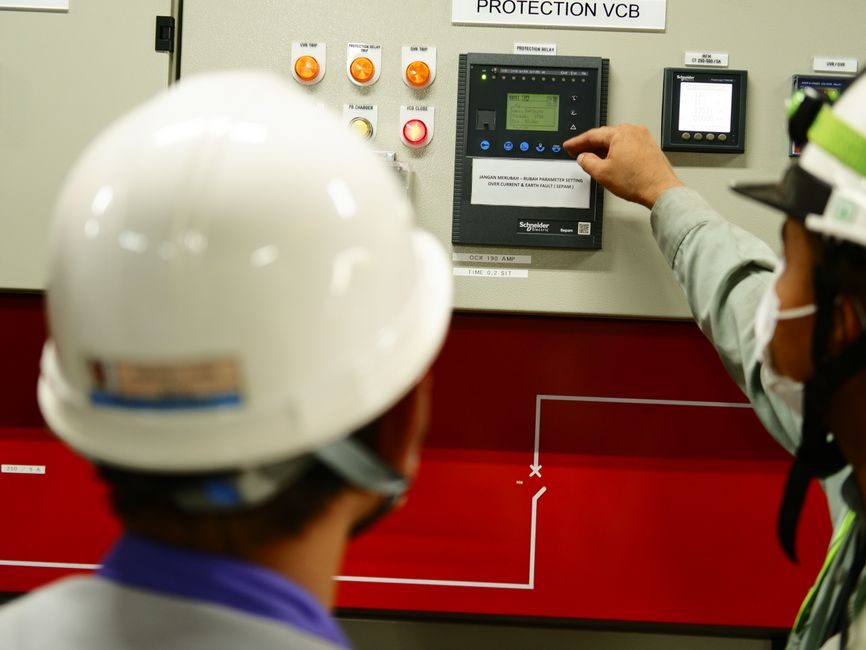
A molded case circuit breaker (MCCB) is selected by frame rating, interrupting capacity (Icu/Ics), trip unit technology, and pole count — with current ranges from 6A to 2000A and insulation voltages up to 800V documented across commercial product lines [S1].
For an industrial buyer, the shortlist logic starts with load current, prospective short-circuit current at the busbar, and whether adjustable protection is needed. Frame sizes span 6A–2000A, with 690V or 400V working voltage classes dominating the global supply catalog [S1][S2].
Frame Current and Working Voltage Bands
Mainstream MCCB frames cluster into four bands that map directly to feeder or branch duty: 6A–63A (small-frame), 63A–250A (standard distribution), 400A–630A (sub-feeder), and 800A–2000A (main incoming) [S1]. The SSM31 series is specified for AC 50Hz, rated insulation voltage 800V, working voltage 690V, and 6A–2000A current range [S1]. The ZMM10 series targets AC 50/60Hz with rated current 15–600A, insulation voltage 690V, and working voltage up to 400V [S2]. AutomationDirect catalogs UL489-rated MCCBs in 3-pole configurations up to 1200A, with thermal-magnetic or electronic trip units [S4].
Buyers should treat 690V/800V insulation parts as the safer pick for 400V–480V industrial networks with high available fault current, because the higher insulation rating gives margin against transient overvoltage and harmonic heating. The 400V-class ZMM10 line is appropriate for commercial and light-industrial distribution where cost per pole is the dominant factor [S2].
Trip Unit Choice: Thermal-Magnetic vs Electronic
Thermal-magnetic trip units remain the default for cost-sensitive branch and feeder circuits; electronic trip units deliver adjustable overload (Ir), short-time (Isd), and instantaneous (Ii) pickup curves, which are mandatory on large-frame or coordinated systems. AutomationDirect explicitly lists both thermal-magnetic and electronic trip units as the two product options in the UL489 line [S4]. Caterpillar's ATC transfer-switch line uses a molded-case switch rated 30A–1000A with open-transition transfer, illustrating the same platform stretched across the mid-current band [S3].
Selection rule: specify electronic trip when the design needs selective coordination, ground-fault protection, or long-time delay tuning; thermal-magnetic remains the lower-cost choice for non-coordinated, fixed-threshold feeder duty. For 6A–63A branch protection, a miniature circuit breaker is the typical alternative — see the MCB pricing tier map for cost-driven trade-offs.
Interrupting Capacity and Short-Circuit Coordination
Interrupting capacity (Icu) must exceed the prospective short-circuit current at the installation point; underspecifying Icu is the single most common MCCB failure mode in switchgear retrofits. Industrial low-voltage assemblies commonly demand 35kA, 50kA, or 65kA Icu at 400/415V, with higher Icu parts (85kA–100kA) reserved for locations close to large transformers or generator busbars. The published SSM31 description states protection against overload, short-circuit, and under-voltage as core functions, alongside insulation voltage 800V and working voltage 690V [S1].
Cascading (or back-up protection) is permissible when the upstream breaker has a verified let-through energy below the downstream breaker's Icu at the same test duty. Selective coordination — where only the nearest breaker trips on a fault — is achievable with electronic trip units and Isd short-time delay; thermal-magnetic parts cannot delay instantaneous pickup, so coordination depth is limited. For DC systems, DC-rated MCCBs use special arc-chute designs, and the DC MCCB category is documented separately in current supplier catalogs [S6].
Application Fit: Branch, Feeder, Main, and DC Duty
Application fit breaks into four duties with different selection logic. Branch protection (final sub-circuit) typically uses 6A–63A frames in 1P/2P/3P; feeder protection uses 100A–630A frames, almost always 3P; main incoming uses 800A–2000A frames, often draw-out, with electronic trip; DC MCCBs are specified for solar combiner, battery storage, and traction DC busbars [S1][S2][S6].
For motor protection, an MCCB with adjustable magnetic trip only — no thermal element — is preferred, so the breaker does not trip on the inrush. The ZMM10 description notes suitability for distributing electric energy and protecting circuits against overload, short-circuit, and under-voltage, under normal conditions [S2]. Caterpillar's ATC line shows 30A–1000A and open-transition transfer for generator-to-utility switching duty [S3]. The DC MCCB product category explicitly protects against overload, short circuits, and other DC-bus malfunctions in solar and storage systems [S6].
Standards, Certification, and Cross-Border Sourcing
International MCCB shipments should carry the relevant certification for the destination market: UL489 for North America, IEC 60947-2 for IEC-type markets, CE-CCC for China, and ATEX/IECEx where the breaker is installed in a hazardous area. AutomationDirect publishes the line as "UL489 rated MCCBs" in 3-pole configurations, signalling the North American compliance anchor for that catalog [S4]. Foretech Electric, a Jiangsu-based supplier, lists Circuit Breakers, MCCB, MCB, ACB, and SPD as main products, with a stated supply ability of 2000 sets/day and minimum order 20 sets [S5].
A spec note for the buyer: UL489 and IEC 60947-2 are NOT interchangeable — a UL489 part is not automatically legal on an IEC-only switchboard, and an IEC 60947-2 part is not automatically legal in a UL panel without a NA-listed assembly. Cross-reference the certification mark on the nameplate, not the catalog blurb. For hazardous-area (Ex) zones, only ATEX/IECEx-marked enclosures with the right gas group and temperature class are acceptable, and the breaker inside must be rated to the same Ex requirements as the enclosure.
Who Should NOT Pick the Lowest-Cost Frame
Three applications are wrong for the cheapest small-frame MCCB: (1) any feeder where the available fault current exceeds the breaker's Icu, (2) motor circuits where adjustable magnetic-only trip is required to ride through inrush, and (3) DC busbars where an AC-rated MCCB will not safely interrupt DC arcs. SSM31 and ZMM10 are both explicitly AC 50/60Hz designs [S1][S2]; using either on a DC circuit is a code violation. For DC duty, a DC MCCB with verified DC voltage rating (commonly 250V, 500V, 750V, or 1000V DC) is the only correct choice [S6].
Buyers should also reject "MCB-as-MCCB" substitutions on the 100A+ end of the range; the miniature circuit breaker cost map shows why the form factor changes materially past 63A. A related reference for non-breaker selection appears in the lab portable gas detector selection guide, which uses a similar frame/certification/application logic.
Comparison Table: MCCB Variant vs Selection Criteria
A side-by-side selection view across four mainstream variants clarifies the call:
Small-frame thermal-magnetic (6A–63A): low cost per pole, fixed trip curve, branch duty, limited Icu, 1P/2P/3P. Standard thermal-magnetic (63A–250A): mid cost, fixed trip, feeder duty, mid Icu, 3P. Large-frame electronic (400A–2000A): higher cost, adjustable Ir/Isd/Ii, main/feeder duty, high Icu, 3P/4P [S1][S4]. DC MCCB (50A–630A typical): DC-rated arc chute, solar/storage/traction duty, voltage-class dependent (250V/500V/750V/1000V DC) [S6].
Shortlist Logic and Next Sourcing Signal
Build the shortlist in three steps: pick frame band from load current (1.25× design current minimum), pick Icu from prospective short-circuit study, and pick trip unit from coordination requirement. If the panel is UL-listed, restrict to UL489 parts [S4]; if IEC 60947-2, match Icu/Ics values to the busbar study. For the hazardous-area edge case, verify ATEX/IECEx marking on the breaker AND the enclosure before issuing a PO. Next, request the manufacturer's certified Icu/Ics test report at the actual installation voltage — and confirm frame dimensions against the existing cubicle cut-out before ordering. The Chinese supply side remains active: Foretech Electric publishes a 20-set MOQ and 2000 sets/day capacity for the MCCB/ACB/MCB/SPD line [S5], which sets a reference for small-lot sourcing windows in 2026.
Detailed specification references: circuit breaker, case packing machine, and linear guide.