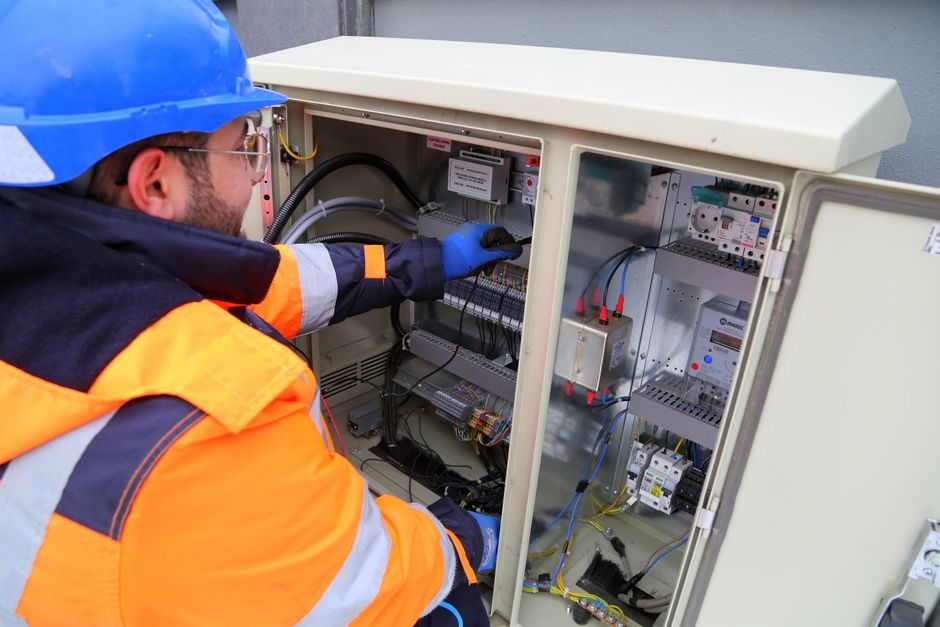
An MCB is sized by four independent parameters — In, Icn, trip curve, and poles — and a wrong choice on any one of them either nuisance-trips on motor inrush or fails to clear a bolted fault at the busbar. Selection starts with the prospective short-circuit current (Icc) at the point of installation, not the breaker nameplate alone, because Icn must exceed Icc at that node [S1][S3].
Mainstream residential and light-commercial MCBs cover 1 A to 63 A with 6 kA, 10 kA, or 15 kA breaking capacity, in 1P / 1P+N / 2P / 3P / 4P configurations, and the catalog price band for the volume tier sits between roughly US$0.62 and US$2.20 per pole on Chinese OEM listings dated 2026-07-15 [S4]. Industrial and test-facility breakers (vacuum / LW36 class) sit a tier above at US$1,500–2,000 per unit and follow different selection rules entirely [S8].
Definition, Scope, and the Two Certification Tracks
An MCB is a thermo-magnetic protective device built to a single-pole footprint up to 63 A at voltages up to 440 V AC (per pole DC ratings of 55 V are also published for specific Siemens 5SX2 references) [S1]. Two parallel certification tracks govern the global market: IEC 60898-1 for residential and similar installations, and UL 1077 for supplementary protection inside equipment — the Siemens 5SX2 family ships in both formats, with UL 1077 maximum AC ratings of 277 V on 1-pole and 480 V on 2- and 3-pole versions [S1].
Below 63 A and inside 6 kA / 10 kA Icn, the dominant Chinese export model code is the DZ47-63 family (also labelled KNB2-63, NB1, or by the OEM's house code), typically rated 230/400 V AC at 50/60 Hz, in 1P through 4P with C-curve trip elements as stock [S3][S4][S7]. Buyers who need IEC 60898-1 + CE + CB + SEMKO + RoHS stack for European distribution should match those certificate codes to the lot certificate, not to the family name.
Selection Criteria: The Four Decision Gates
Gate 2 is the trip curve: B (3–5 × In) for purely resistive loads, C (5–10 × In) for general lighting and socket circuits, and D (10–20 × In) for motors and transformer inrush — a 6 kA / 63 A C-curve KNB2-63 in 4P is a typical stock line for European distribution boards [S4][S9].
Gate 3 is the breaking capacity: 6 kA covers most residential panels fed from a transformer with low impedance, 10 kA covers small commercial boards, and 15 kA is reserved for nodes close to the transformer secondary or busbars with high short-circuit power. Siemens 5SY series maps 6 kA to 5SY6, 10 kA to 5SY4 and 5SP4, and 15 kA to 5SY7, with the 5SP5 universal-current line bridging several duties [S1]. Gate 4 is the pole count: 1P for single-phase final circuits, 2P for split-phase or 230 V circuits requiring a switched neutral, 3P for three-phase motors, and 4P for three-phase with neutral on a 400 V system.
Comparison: 6 kA vs 10 kA vs 15 kA MCBs on Decision Criteria
For a given frame size (63 A, C-curve, 3P), the three breaking-capacity tiers line up against four buyer criteria as follows. On cost, 6 kA KNB2-63 lists at roughly US$0.72 per pole and 10 kA equivalents at US$0.72–2.20, while 15 kA Siemens 5SY7 sits at the top of the range [S4]. On short-circuit tolerance, 6 kA clears faults up to 6,000 A, 10 kA clears up to 10,000 A, and 15 kA up to 15,000 A — values that must be matched to the Icc at the installation node, not the transformer rating.
On coordination with upstream protection, 15 kA frames allow greater distance from the transformer without de-rating the backup fuse, and on supply chain, 6 kA / 10 kA DZ47-63 and KNB2-63 are off-the-shelf from Wenzhou and Liushi clusters with 1,000-piece MOQs and 30-day production cycles, whereas 15 kA units carry longer lead times [S3][S6][S7]. The thumb rule: if the calculated Icc at the busbar is below 6 kA, the cheapest breaker on the shelf is also the technically correct one — paying for 15 kA adds no safety margin in that case.
Who an MCB Is For — and Who It Is NOT For
MCBs are the right device for final-circuit protection in residential, commercial, and light-industrial distribution, for motor branch circuits up to the trip-curve limit, and for any application where Icc stays within the 6–15 kA Icn envelope. They are NOT for: main incoming protection above 630 A (use air circuit breakers or moulded-case circuit breakers), DC strings above 55 V per pole (use DC-rated MCBs or fuses), short-circuit currents above 15 kA at the node (step up to MCCB or fuse-backs), or applications requiring adjustable trip settings (use MCCBs with electronic trips such as the Siemens ETU45B / 3WL family) [S1].
A common error is specifying a 6 kA MCB on a commercial board where the utility's transformer impedance drives Icc above 6 kA — the breaker will clear one or two faults and then fail. A second common error is using a B-curve on a motor circuit, which trips during the first inrush cycle. Match the curve to the load class, and verify Icc with a short-circuit study, not a nameplate [S9].
Real Use Cases: Residential, Light Commercial, and Industrial

A 230 V residential final circuit feeding 16 A sockets uses a 1P+N, 16 A, C-curve, 6 kA MCB — the DZ47-63 in this rating is a stock item at roughly CN¥ 3.5 per piece at 10-piece MOQ from Yiwu exporters and roughly US$0.62–2.20 in bulk from Wenzhou and Ningbo manufacturers [S4][S7]. A 400 V three-phase motor branch up to 7.5 kW uses a 3P, 16–25 A, D-curve, 10 kA MCB, again a stock KNB2-63 reference, sized so that locked-rotor current at 6–8 × FLA sits below the D-curve 10–20 × In threshold [S3][S4].
For test facilities and industrial switchboards with vacuum contactor controls, the MCB is replaced by a dedicated vacuum breaker (e.g. LW36 class) at US$1,500–2,000 per unit with quality-certification documentation — that is a different selection path and a different price band entirely [S8]. For OEM equipment sold into North America, the supplementary-protector track under UL 1077 is the right citation, not IEC 60898-1; Siemens publishes the 5SX2 family in both versions with the voltage deltas stated above [S1].
Limitations, Failure Modes, and Sourcing Constraints
The primary failure modes of an MCB are nuisance tripping (wrong curve, missing derate, harmonics), failure to trip (undersized Icn, welded contacts after a previous fault), and thermal derating in high-temperature cabinets — at 50 °C ambient a standard 6 kA / 63 A MCB will deliver roughly 0.9 × In continuous, and at 60 °C closer to 0.8 × In, so a 63 A breaker in a 60 °C cabinet is effectively a 50 A breaker [S9]. Inrush from LED drivers and switching power supplies can push C-curve breakers into the trip band even when the average load is well below In; in dense LED-lighting panels a D-curve upstream or a 1.3–1.5 × In oversize is sometimes specified.
Sourcing constraints to track: MOQs of 1,000 pieces are standard for export-tier DZ47-63 / KNB2-63 lines, with production lead times of roughly 30 days from Wenzhou and Ningbo suppliers [S3][S6]. Pay attention to which certificates cover the specific lot — CE, CB, SEMKO, TÜV, and RoHS are commonly claimed, but a CE mark without a DoC (Declaration of Conformity) traceable to the actual production lot is not a valid European import document. For European projects, anchor the order to the IEC 60898-1 / EN 60898-1 certificate number printed on the device, not the family datasheet [S4][S7].
Standards Reference and Shortlist Logic
The governing standard for residential and similar MCBs is IEC 60898-1 (with the European harmonised designation EN 60898-1); for North American OEM integration it is UL 1077, and for industrial assemblies it is IEC 60947-2. Trip-curve definitions B, C, and D are codified within IEC 60898-1 — B trips at 3–5 × In, C at 5–10 × In, D at 10–20 × In, with the exact test currents and calibration tolerances defined there [S1][S9].
Shortlist logic in three lines: (1) compute Icc at the busbar, pick Icn ≥ Icc from {6, 10, 15} kA; (2) pick In ≥ 1.25 × continuous load with derate applied for cabinet temperature; (3) pick the trip curve from the load class — B for resistive, C for general, D for motors and transformers. A 10 kA / 63 A / C-curve / 3P DZ47-63 (or KNB2-63 equivalent) is the default for a 400 V European commercial board; a 15 kA / 5SY7 from Siemens is the step-up when Icc exceeds 10 kA at the node; a UL 1077 5SX2 is the track for North American OEM equipment builds. For broader spec maps of low-voltage protection components, see the reference page on circuit breakers and, where motor branch circuits interface with mechanical drives, the entries on linear guides and crossed-roller guides for the downstream machine-tool context.
Background reading: Investment Casting Suppliers 2026: Capacity, Pricing, and Selection Map.