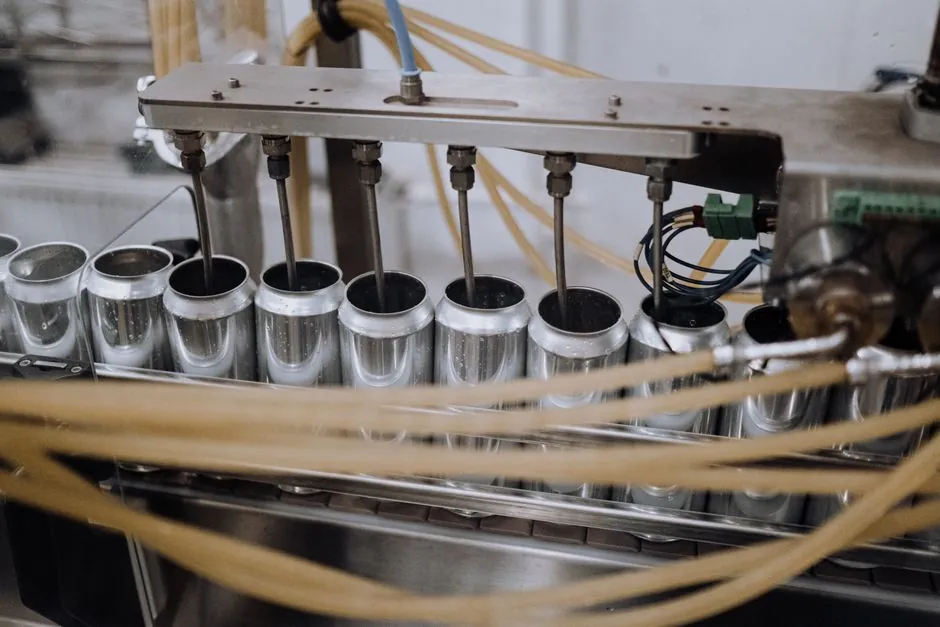
Tonnage on a zinc die casting machine is set by projected area times metal injection pressure divided by 2000, so adding cavities is a question of total projected area, not cavity count per se [S2].
Multiple-cavity dies produce several identical parts per cycle, lifting throughput on a single press, but each cavity multiplies the projected parting-line area the machine must clamp against, and most production runs at 10,000 to 12,000 PSI metal pressure [S1][S2].
Tonnage Formula and the Real Cavity Constraint
The standard sizing relationship is Machine Tonnage = (Projected Parting Line Area × Metal Pressure) / 2000, so an 8-cavity die with 214.6 in² projected area at 10,000 PSI demands 1073 tons and a 1000-ton class press [S2]. Doubling the cavity count roughly doubles the projected area only when the gate and runner system scales with the cavities, which is the practical limit a die designer hits before the press does [S2].
In principle a 50-cavity die can be built to run on a 3000-ton machine, but the source notes such stacks are typically reserved for large, high-volume castings because larger presses are more expensive to buy and operate [S2]. A die casting machine selection chart shows 400 to 1000-ton presses are common, while 1200 to 4500-ton machines are less common and used for high-volume automotive work such as engine blocks and transmission cases [S2].
Why Zinc Specifically Lends Itself to Multi-Cavity Tooling
Zinc alloys (notably Zamak 3) flow more readily than aluminum or magnesium and solidify quickly, which lets die builders push thinner walls and more intricate geometry without fill defects [S1]. This fluidity is the same property that lets a zinc die hold a higher cavity density on a given platen, because the runner and gating can be made smaller while still feeding all cavities reliably [S1][S5].
Cycle economics reinforce the case: zinc uses hot-chamber die casting at 4 to 5 shots per minute, and proprietary multi-slide zinc systems reach up to 45 shots per minute, versus 2 to 3 shots per minute for cold-chamber aluminum [S5]. Since cycle time can drive roughly 60 percent of final part cost, packing more cavities into a single shot is one of the most direct ways to drop piece price on zinc work [S5]. Zinc dies also last up to 10 times longer than aluminum dies and 5 times longer than magnesium dies because of the low melt temperature, which matters more as cavity count rises and tool replacement risk grows [S5].
Cavity Count Limits That Are Not Tonnage-Related

Even with a press that has the clamp force, three other constraints cap cavity count on a zinc die. First, slide mechanisms consume die space: a 2-cavity die with 4 slides per cavity is workable, but the source flags that going beyond 2 cavities should only be considered if multiple dies running in parallel are needed to meet demand [S2]. Second, each additional cavity adds critical features that must hold tolerance, so dimensional control becomes the gating issue long before tonnage does on tight-tolerance zinc parts [S2].
Third, surface area, not weight, is the sizing input, so a small, dense connector at 8 cavities may demand more tonnage than a larger, thin-walled housing at 4 cavities, even though the latter is physically bigger [S2]. Comparing the main zinc process variants on a few decision criteria: hot-chamber zinc (the standard) supports 4 to 5 standard shots per minute and the highest cavity density at lowest cost; multi-slide zinc pushes 45 shots per minute on smaller, complex geometry; and vacuum-assisted zinc is the choice when porosity from trapped air in deep multi-cavity runners becomes a defect concern on otherwise clamp-feasible tools [S5].
Tooling Cost, PPAP, and Replacement Cavity Economics
Higher cavitation raises upfront die cost but lowers piece price, and the breakeven shifts as machine size increases because larger presses cost more per hour [S2]. Replacement cavities are not free: each rebuilt cavity bank must be sampled and PPAP-approved, a hidden cost that erodes the per-piece advantage of a maxed-out multi-cavity die on long programs [S2].
The practical ceiling on cavity count is therefore set by four numbers in series: available platen area, clamp tonnage at 10,000 to 12,000 PSI, slide count per cavity, and tolerance budget per critical feature [S2]. For a typical zinc hardware part in the 2 to 8 cavity range on a 400 to 1000-ton zinc die casting machine, tonnage is rarely the binding constraint; the die layout, slide count, and PPAP cost of replacement cavity blocks are [S2].
When Full-Tonnage Multi-Cavity Zinc Is the Wrong Choice
For low- to medium-volume zinc parts, the higher tooling cost of a multi-cavity die is hard to amortize, and the source data confirms that traditional die casting in North America and Europe needs minimum volume to cover tooling investment [S4]. On parts with multiple slide cores, a 2-cavity die is often the productivity ceiling, and additional capacity should be added by running parallel dies rather than packing more cavities into one [S2].
gravity die casting machine workflows and vacuum die casting machine setups are worth evaluating when the part is large, the cavity count is low, and the defect concern is air entrapment rather than tonnage. For an automotive zinc bracket where volume justifies it, a higher-cavity die on a properly sized hot-chamber press is the lower piece-price path; for a 500-piece specialty hardware run, the same die would be a cost trap [S2][S4][S5].
Trackable signals for buyers: NADCA-spec tool drawings citing a target projected area in square inches, the per-cavity slide count, and the rebuilt-cavity PPAP line item on the quote, all of which determine whether a multi-cavity zinc die will actually run at full tonnage on the chosen press [S2][S4].
Related analysis: Composite vs metal housing on air impact wrenches: durability trade-offs.