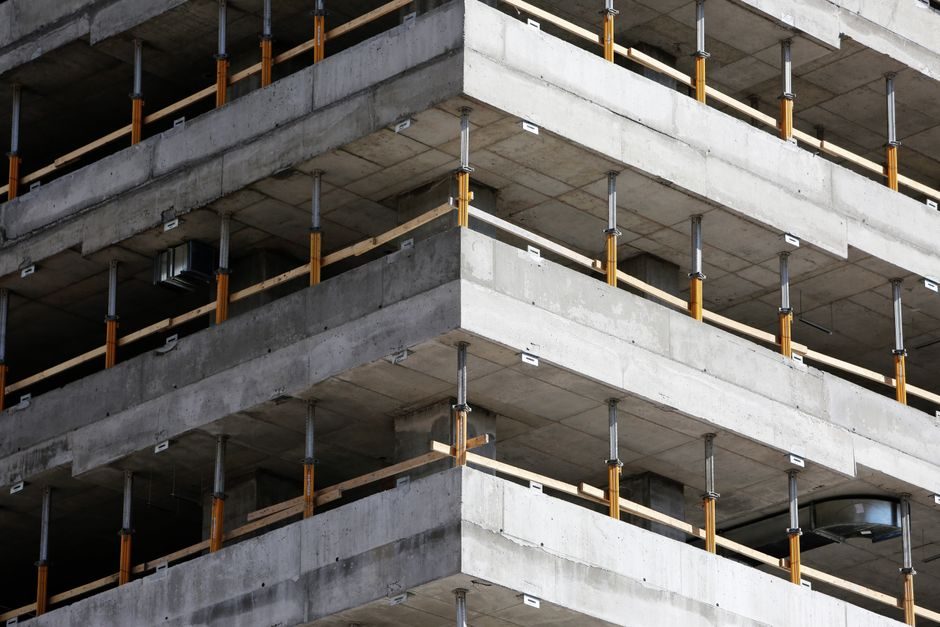
For work-at-height operations — tower erection, scaffolding, aerial work platforms, rope-access on process columns — a 4-gas diffusion multi-gas detector (O2, LEL, CO, H2S) on every harness is the baseline spec, with a minimum ingress rating of IP67 and a drop test ≥6 m onto concrete [S4].
Height work is not, by itself, a gas hazard — but the elevated plant is, and the same atmosphere a worker breathes at grade sits in their face at 20 m. Multi-gas detector selection at height is therefore governed by the atmosphere the worker will be in, not the altitude, and the engineering choices come down to sensor stack, ingress protection, mounting, and certification. The multi-gas detector category in 2026 still centres on the O2 / combustible / CO / H2S quad, with options for SO2, NO2, HCN and PID sensors when solvent vapour is present [S1][S2].
Sensor Stack: The O2 / LEL / CO / H2S Quad and When to Add Channels
The K60-IV multi-gas detector is a compact 4-sensor portable unit that monitors oxygen, combustibles, hydrogen sulfide and carbon monoxide in a single housing, marketed for oil & gas, fire service, marine and smelting applications [S2]. GasDog's portable GD200 series follows the same 4-gas diffusion pattern for industrial personal monitoring [S1].
For work at height, the default 4-sensor stack matches the typical hazards: oxygen deficiency/enrichment, methane or pentane LEL, carbon monoxide from engine exhaust on adjacent plant, and H2S from sour-crude or biogas headers. Add a fifth channel — SO2 or NO2 — only when the site has a known oxidising-gas risk such as a smelter stack, catalytic cracker vent, or diesel confined-space pre-entry. A built-in pump (K60-V PID type) is required only for remote sampling or pre-entry testing; for direct-attached personal monitoring, a diffusion head keeps the unit light on a harness [S2].
Ingress, Drop, and Vibration: The Non-Negotiable Mechanical Floor
MSA's Altair 4X specifies a 6 m drop survivability onto concrete plus IP67 ingress, and that mechanical floor is the de-facto benchmark for work-at-height multi-gas detectors [S4]. Process plants frequently specify the same 6 m drop for elevated work because instruments are dropped during harness donning, lanyard snags, or when carried onto scissor lifts.
A work-at-height spec should therefore demand IP67 minimum (dust-tight, 1 m submersion for 30 min), a drop test ≥6 m, and a confirmed operating temperature window that covers the worst-case site exposure — typically −20 °C to +50 °C for outdoor tower work, +55 °C for desert pipeline right-of-way, and −40 °C cold-start for arctic terminals. Mounting hardware matters as much as the spec: an alligator or crocodile clip rated to MIL-STD-810G vibration, plus a tether loop, is mandatory for harness attachment. Without these, the detector becomes a dropped-object hazard for the worker below.
Certifications: ATEX, IECEx, and the Height-Plant Reality
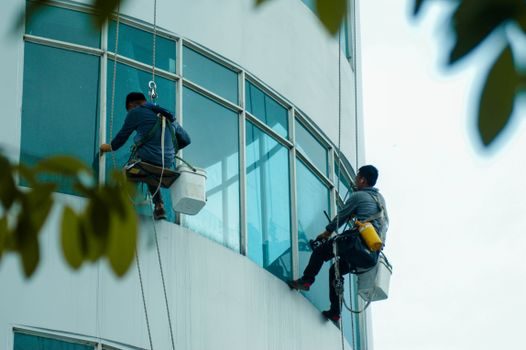
ATEX category 2 (zone 1) or IECEx zone 1 intrinsic-safety certification is the standard requirement for any portable gas detector carried onto an oil-and-gas or chemical elevated plant, and the K60-IV family is offered with ATEX approval on the fixed K800 sibling, indicating the same IS design philosophy runs across the portable line [S2].
Specifying engineers should treat ATEX/IECEx as a binary gate, not a preference. A detector without an ATEX/IECEx zone-1 IS rating cannot be carried into a classified elevated area regardless of its sensor quality. For non-classified work at height — wind turbines, telecom towers, building façades — IECEx/ATEX is unnecessary and a lower-cost UL/c-UL or CE unit is acceptable. Pairing combustible gas detector sensor technology with the site hazard list is the second leg: catalytic-bead (pellistor) sensors handle 0–100 % LEL on most hydrocarbons, while NDIR sensors are immune to poisoning and preferred for environments with silicone or H2S-rich streams that would otherwise poison a pellistor.
Selection Criteria: A 4-Criteria Compare Across Form Factors
For work-at-height multi-gas detection, the practical decision reduces to four criteria — sensor count, sampling method, ingress/drop, and certification. [S2]
Portable 4-sensor diffusion (K60-IV, GD200, Altair 4X family) scores 4 channels / diffusion / IP67 + 6 m drop / ATEX-IECEx zone 1 IS on most vendor offerings [S1][S2][S4]. Portable 4-sensor pumped (K60-V PID, BW Ultra with pump) scores 4–5 channels / pumped / IP66–IP67 / ATEX-IECEx IS, with added weight and hose snagging on harnesses [S2]. Fixed 4-gas wall-mounted (GasDog fixed line) scores 4 channels / diffusion wall-mount / IP65 typical / ATEX zone 1 Ex d, and is not suitable for mobile harness mounting [S1]. Area monitors (Oldham BM25 type) score up to 5 channels / pumped / IP66 / ATEX zone 1, but are too heavy for harness work and are deployed at grade to protect the work zone [S3].
For harness-mounted work at height, the diffusion 4-sensor form factor wins on three of four criteria; pumped units are only justified when the worker is doing pre-entry testing on a confined space before climbing.
Use Cases: Scaffolding, Aerial Lifts, Tower, and Rope-Access
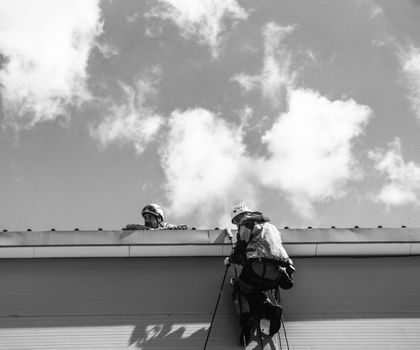
Work at height on industrial sites breaks into four operational patterns, and the detector spec shifts with each. On scaffolding around a process column, the aerial work platform crew works in still air where a leak from a flange above will pool — a diffusion 4-sensor unit with a crocodile clip to the harness chest strap is the right answer. On a bucket truck or aerial work truck dispatched for transmission-line or refinery flare-tip work, the same diffusion 4-sensor plus a tether to the bucket is the typical configuration. [S3]
On telecom towers or wind turbines outside hazardous-area classification, a gas detector without ATEX is acceptable and the cost can drop 30–50 %. Rope-access on a chimney or flare stack typically calls for a pumped 4-sensor with a 1 m sample probe to test the atmosphere before the worker crosses the stack top — diffusion alone cannot take a remote sample. See the warehouse multi-gas detector selection guide for the equivalent sensor-stack discussion at grade, which shares the O2/LEL/CO/H2S baseline but adds ventilation-driven drift concerns that do not apply at height.
Limitations and Failure Modes at Height
Three failure modes drive most work-at-height gas incidents. Sensor poisoning — H2S or silicone exposure permanently killing a catalytic-bead LEL or CO sensor — is the most common cause of false-zero readings on detectors returned from oil-and-gas sites; the cure is sensor replacement on a documented interval (typically 24 months for LEL, 12 months for H2S) and bump-testing before each shift. Alarm audibility is the second mode: a 95 dB alarm at 30 cm is fine at grade, but at 20 m elevation in wind, ambient noise from the height gauge tools or rigging gear easily masks the buzzer — high-output 100 dB+ units and a vibration alarm on the wrist or chest harness are now standard. [S1]
Battery life is the third mode. Diffusion 4-sensor units typically run 12–24 hours on a single charge; pumped units drop to 8–14 hours. A 10-hour shift on a tower without a charging plan is the difference between a working instrument and a brick. Always specify a hot-swap battery or USB-C in-cab charging, and log the calibration date — most sites reject an instrument whose calibration is older than 30 days.
Sourcing, Standards, and Calibration Discipline

Buy instruments that arrive with a current calibration certificate traceable to NIST or NPL, and refuse any unit whose last bump test is older than 30 days. For sour-service sites, NACE MR0175 / ISO 15156-1 compliance of the surrounding materials is a separate question from the detector itself, but the multi-gas detector spec should reference the same gas list the plant is designed for. KELISAIKE publishes the K60-IV for oil & gas, fire service, marine and smelting [S2]; GasDog offers matching 4-gas diffusion portables with 365-day warranty support [S1]; the Oldham BM25 area monitor covers the larger work-zone picture from the ground [S3].
For budget-grade Canadian distribution, ITM.com stocks a multi-gas category with multiple brand options and 100 % Canadian-owned sourcing [S5]. Watch for: (1) sensor cross-sensitivity statements in the manual, especially CO sensors responding to H2; (2) documented response time T90 — a slow sensor defeats the purpose of personal monitoring on a moving harness; (3) firmware revision on the data-logger output, since 2026-era units increasingly log to Bluetooth apps that older procurement specs do not allow. The next signal worth tracking is whether more vendors begin shipping diffusion 4-sensor units with a built-in man-down alarm and radio link, mirroring the migration lone-worker lone-worker apps took after 2023.