Multi-gas detectors and dust detectors solve two different occupational hazards, and the wrong purchase order can mean either a silenced toxic-gas alarm or a $0 fine for a missed PM2.5 reading. As of 2026-06-30, the portable multi-gas market is anchored on 4-sensor LEL/O2/CO/H2S packages priced for confined-space entry, while dust detectors are still split between optical PM2.5/PM10 monitors and the older black-smoke densitometry used for stack opacity [S1][S2][S3][S4].
Both families live under the same ATEX/IECEx umbrella for hazardous areas, and both now ship with data logging, audible + visual alarms, and IP65–IP66 housings as table stakes. The spec that actually drives the buy decision is the <strong>target hazard class</strong>: flammable or toxic gas in %LEL / ppm / %VOL, or airborne particulate in mg/m³. Everything downstream — sensor count, calibration gas, pump vs diffusion sampling, cert zone — falls out of that first call [S1][S3].
Multi-Gas Detector Sensor Stack and Typical 2026 Ranges
The 4-gas LEL/O2/CO/H2S configuration is the de facto industrial baseline and shows up across essentially every supplier listing in the 2026 Q2 catalogue window [S1][S2][S5]. Crowcon's Tetra 3 lists CO, O2, CH4 plus an expandable channel that takes NH3, H2S, O3 or SO2 on the same board [S1]. New Cosmos's XA-4400II extends that envelope to a 4-sensor pump-drawn package with audible/visual alarms, data logging and a water- and dust-proof housing [S2]. The common sensor technologies behind those channels are electrochemical (CO, H2S, O2), catalytic bead or NDIR (LEL/CH4), and PID or semiconductor for VOCs — Hanwei's E4000 catalog literally enumerates that stack: semiconductor, electrochemical, catalytic, PID, MOS, thermal conductivity, infrared, in one IP66 package with built-in pump [S3].
For a refinery, wastewater or paint-booth buyer, the 4-gas configuration covers roughly 80–90% of confined-space entry tickets on its own. The remaining 10–20% — benzene, ozone, ethylene oxide, refrigerant leaks — need a PID channel or an IR channel added; the SKY2000-C2H4 portable ethylene detector on a Chinese supplier page shows 0–100 ppm range at 0.1 ppm resolution with sound/light/vibration alarms, illustrating the narrower-but-higher-resolution branch of the family [S6]. For single-point combustible leaks (LPG, propane, methane, ethanol), New Cosmos's XP-3000II semiconductor series is the alternative path, sacrificing toxic coverage for cheaper per-unit leak sniffing [S4]. For a primer on the sensor category, see the multi-gas detector reference page.
Dust Detector Sensing Method: Optical Scattering vs Beta Attenuation
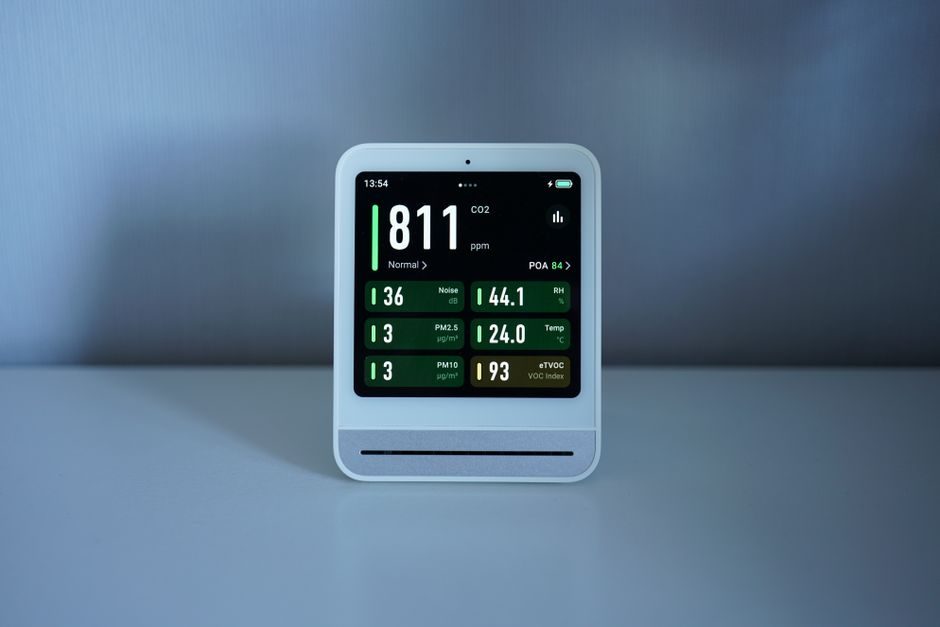
Dust detectors answer a different physical question: how much mass of particulate is in the air, expressed as PM1.0, PM2.5 or PM10 in mg/m³. The dominant 2026 method is laser optical scattering, where a photodetector counts the pulse pattern of light scattered by single particles and infers a mass concentration from a built-in density model. This is the working principle of every hand-held PM meter you'll see on a factory or construction site. Real-time readout, battery operation and a data logger are standard; the 0–1000 µg/m³ range with 1 µg/m³ resolution covers indoor air-quality and outdoor ambient monitoring. For more on the instrument class, the dust detector reference page covers operating principles and regulatory context. [S1]
For stack emissions and combustion plants, the older black-smoke or beta-attenuation methods are still in use, but those are fixed installations outside the portable category. Field-portable dust meters are typically used for occupational hygiene checks against the respirable dust fractions, walk-through surveys on construction sites, and cleanroom verification. They share the IP rating and alarm output philosophy with gas detectors (audible + visual + data log) but they do NOT replace a four-gas meter in a manhole — the hazards are non-overlapping.
Selection Criteria: 7 Gates That Decide Which Family You Buy

For a 2026 purchasing decision, run the spec sheet against these gates in order. (1) Target hazard: flammable/toxic gas or particulate. (2) Cert zone: ATEX/IECEx Ex d ia IIC T4 Gb for Zone 1, or non-certified for ambient air work. (3) Sensor count: 1, 2 or 4 gases, or single-channel PM. (4) Sampling: diffusion for spot checks, pump-drawn for pre-entry surveys. (5) IP rating: IP65 minimum for outdoor, IP66/IP67 for wash-down or offshore. (6) Alarm outputs: audible 95 dB, visual LED stack, vibrating, plus 4–20 mA / RS-485 for fixed. (7) Calibration interval and warranty — most 4-gas units spec 6-month bump-test interval and a 2-year sensor life on CO/H2S [S1][S2][S3][S5].
A gas detector that fails gate 1 is the wrong tool — no matter how good its IP rating. A common 2026 specification pattern: 4 gases, IP66, 95 dB alarm, ATEX Ex d ia IIC T4, 90 dB / visual / vibration, 4–20 mA + RS-485, 24 VDC, and a stainless or reinforced-polymer head. Hanwei's E4000 spec sheet fits that line item by item, and it's a useful template for RFQ comparisons [S3]. For an in-depth walk on the fixed-instrument cost levers, see Fixed Gas Detector 2026 Price & Cost Guide.
Decision Comparison: Multi-Gas vs Dust, on 4 Hard Criteria
On target hazard, a multi-gas unit covers LEL/O2/CO/H2S as a baseline; a dust unit covers PM1/PM2.5/PM10 — they are complementary, not substitutes. On cert scope, the 4-gas portable is commonly ATEX/IECEx Zone 1 + MED (marine) for petrochemical and offshore, while a dust meter is usually non-EX but with the same IP65/IP66 ingress discipline. On sampling, multi-gas pre-entry kits ship with an electric pump and 5–10 m sample draw; dust meters usually rely on internal fans with a 1–2 L/min flow. On data, both classes now support USB-C or Bluetooth download, but the multi-gas units typically include a peak/TWA/STEL exposure suite per OSHA/NIOSH methodology, while dust meters focus on short-term mass and 8-h time-weighted averages [S1][S2][S3][S6].
For buyers who need both, the practical 2026 answer is two separate instruments. Bundling a 4-gas monitor with a PM2.5/PM10 meter is standard in a hygiene contractor's kit: gas for the air the worker breathes (toxic/flammable risk), particulate for the dust they inhale (respirable risk). Pair the gas spec with the gas detector overview, and the particulate spec with the dust particle meter entry.
Who Needs Which — and Who Definitely Doesn't

Buy a multi-gas detector if you are doing confined-space entry, refinery turnarounds, wastewater work, paint-booth exposure checks, fire service response, or any LEL-monitored hot work. Buy a dust detector if you are running occupational hygiene surveys on construction sites, verifying cleanroom ISO 14644 classifications, monitoring ambient PM2.5 for community exposure compliance, or auditing combustible-dust housekeeping against NFPA 652. If your site has neither a flammable/toxic atmosphere nor a respirable particulate risk — say, a finished-goods warehouse with mechanical handling only — you likely do not need either, and the spend is better directed at PPE audits. [S2]
Note one failure mode I see regularly: buyers specify a 4-gas monitor for a flour mill or grain silo and skip the dust meter. Combustible dust under NFPA 652 is a real explosion hazard, and a CO/LEL sensor will not see it. Conversely, a PM2.5 meter in a paint spray booth without a LEL channel is a forensic instrument after a fire, not a life-safety device. The PPE complement matters too — for any dust-rated work, the dust mask reference page covers the respirator selection that sits behind the instrument. For a cost comparison on the portable gas side, see Portable Gas Detector 2026 Price & Cost Guide.
2026 Sourcing Notes: China Supply Base, Catalog Reality
The Q2 2026 catalog window shows a deep Chinese supply base for both families. Hanwei Electronics Group, New Cosmos Electric, Crowcon (UK/JP), KELISAIKE (Nanjing KELISAIKE), Shandong Dory and several SKY2000-series OEMs all list on directindustry or their own storefronts in the same six-week window [S1][S2][S3][S4][S5]. On the supply side, the K60-IV 4-sensor KELISAIKE package covers O2, LEL, H2S, CO with data logging, IP-rated housing and is positioned as a compact 4-gas entry [S5]. The SKY2000 series on multi-gasdetector.com adds a built-in pump and a sound/light/vibration alarm package with a stated response time of ≤20 s [S6].
For the dust side, the same OEM/supplier cluster produces laser-scattering PM2.5/PM10 meters in the 0–1000 µg/m³ or 0–10 mg/m³ range, typically IP65, with USB-C charging. For a single-source vendor that builds both families, the combustible gas detector reference page is the natural cross-link. RFQ advice: ask the supplier for the sensor part numbers, the bump-test gas certificate, the ATEX/IECEx certificate number (Zone 1) or a clean IEC 60079-aligned test report, and the manufacturer's warranty — and verify the calibration-gas cross-sensitivity matrix, not just the headline range.
For buyers who need a fixed-instrument spec walk alongside the portable comparison, Fixed Gas Detector 2026 Selection lines up the four hard gates: sensor, range, cert, output. For selection criteria on the gas-detection family, Multi-Gas Detector 2026 Selection is the direct cross-link for the portable side.