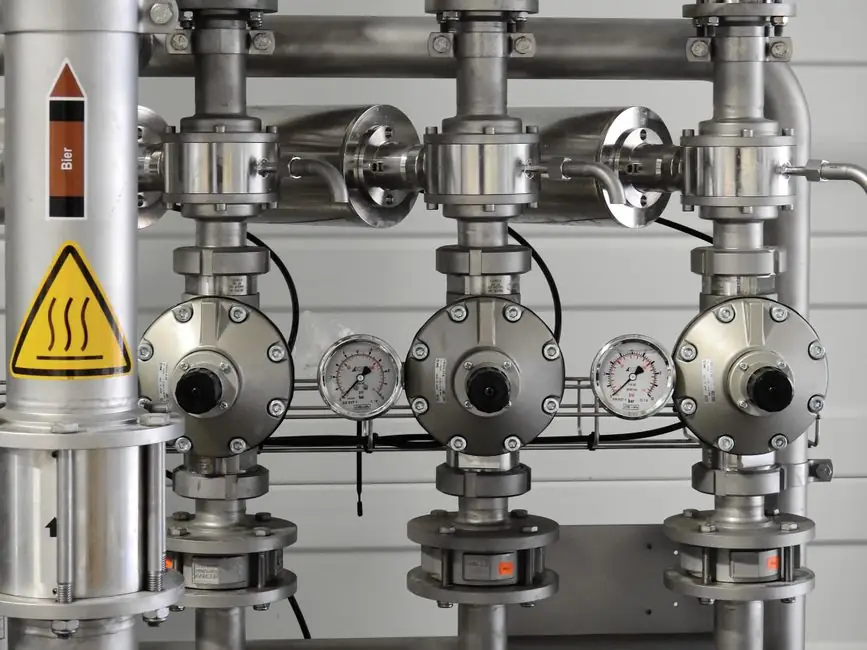
A Fluke Calibration P3100 hydraulic deadweight tester reaches 0.015% of reading accuracy as standard, with an optional 0.008% of reading class, and spans pressures to 20,000 psi (1,400 bar) in oil-operated single or dual piston formats [S3]. A REED Instruments multifunction process calibrator targets the opposite end of the workload: a single handheld that sources and measures electrical, temperature, and pressure signals at lower absolute accuracy but high portability [S2].
The two instrument families are not competing products, they are tiered layers in a calibration hierarchy. A deadweight tester is a primary pressure standard that defines pressure from mass, area, and local gravity, so it is the reference against which a multifunction calibrator's pressure module is itself verified [S1][S3]. Specifiers routinely need both: the DWT lives on a metrology bench or in a standards lab, the multifunction calibrator rides in a technician's tool bag for in-situ checks on pressure transmitters, gauges, and loops [S1][S2].
Operating Principle: Primary Standard vs Working Standard
A deadweight tester defines pressure as force divided by area: calibrated weight masses loaded on a precision-lapped piston generate an upward force that balances the applied pressure from a screw press or hand pump, with the readout taken when the piston is correctly spinning and floating inside its cylinder [S3]. Standard masses on the Fluke P3100 are series 3 non-magnetic austenitic stainless steel at 7.8 g/cm³, with optional solution heat-treated aluminum fractional weights at 2.7 g/cm³ [S3].
A multifunction process calibrator, by contrast, uses internal electronic references and sensors to source and measure mA, V, RTD, thermocouple, frequency, and pressure, applying digital compensation rather than a fundamental physical constant. That is why process calibration work treats DWTs as primary or transfer standards and treats multifunction calibrators as working standards suitable for routine field verification [S1][S2]. The two-tier model is visible in supplier catalogs: Fluke lists the P3100, P3800, and E-DWT as pressure calibrators under its calibration tools family, while REED groups multifunction process calibrators alongside temperature and sound level calibrators as field instruments [S2][S3][S4][S5].
Accuracy Classes and What They Actually Mean
Fluke rates the P3100 at ±0.015% of reading from 10% to 100% of piston range, with an optional ±0.008% of reading class, plus ±(accuracy class) × 10% of piston range below 10% [S3]. The P3800 series extends the same architecture to 60,000 psi (4,000 bar), offered in 0.02% or 0.015% of reading classes and including a hand pump plus intensifier to reach that high end [S4]. These are % of reading specifications, which is what makes deadweight testers usable across a wide pressure band without losing resolution at the top of the range.
Multifunction process calibrators are usually specified as % of full scale for pressure modules, often in the 0.05% to 0.1% FS band, with electrical functions (mA, V, RTD, TC) at similarly coarse but traceable accuracies. For an instrument engineer, the practical difference is: a 0.015% of reading DWT at 1,000 psi reads to about ±0.15 psi anywhere on the scale, while a 0.1% FS handheld at the same point might read ±1 psi, an order of magnitude looser. That gap is why deadweight testers remain the anchor for any multifunction process calibrator pressure channel that is used to release product [S1][S3].
Pressure Range, Medium, and Piston Format

Hydraulic deadweight testers dominate the high-pressure work. The WIKA CPB5000HP covers 0–5,000 bar (oil operated), the CPB5800 covers 0–1,400 bar, and the CPB5000 pneumatic variant covers 0–400 bar [S1]. Ashcroft's 1305D / 1305DH portable hydraulic units span 15–10,000 psi, the Type T laboratory hydraulic tester reaches 0–15,000 psi, and the PK II floating-ball pneumatic tester covers 0–30 psi for low-pressure and vacuum work [S1].
Fluke P3100 ships in three hydraulic configurations, single low pressure, single high pressure, and dual piston, all with built-in priming pumps and a screw press for fine control; the piston is tungsten carbide with nickel binder at 15.0 g/cm³, and the cylinder is hardened martensitic steel, or tungsten carbide when water is used above 500 psi (35 bar) [S3]. Thermal expansion is specified at 16.5 ppm/°C for the oil piston/cylinder and 11 ppm/°C for water operation above 35 bar, and every unit is trimmed to local gravity at no charge, with 980.665 cm/s² as the standard gravity fallback [S3].
Multifunction process calibrators cover a much narrower pressure window. Typical internal pressure modules are specified from about ±1 psi up to 150 psi or 300 psi, with optional external pressure modules pushing higher. The instrument handles gas and liquid on the same port with selectable units, but it is not designed for sustained 1,000 bar work and should not be specified where a DWT is the correct tier [S2].
Decision Matrix: DWT vs Multifunction Calibrator
Four criteria separate the two instrument families in practice. First, accuracy tier: a DWT at 0.008–0.02% of reading is a primary or transfer standard, a multifunction calibrator at roughly 0.05–0.1% FS is a working standard. Second, range and medium: DWTs span vacuum to 5,000 bar across hydraulic and pneumatic variants, while multifunction calibrators typically cap out near 10 bar internal, with external modules to higher pressures [S1][S3].
Third, portability and footprint: a bench DWT with full weight set is a 30–80 kg cart, while a multifunction calibrator is a 1–2 kg handheld that runs on battery for a full shift [S2]. Fourth, parameter coverage: a DWT measures one thing, pressure, defined by physics, while a multifunction calibrator sources and measures mA, V, RTD, TC, frequency, and pressure in a single box, which is why it is the de facto tool for loop checks on v-process lines and skid commissioning [S1][S2].
Electronic Deadweight Testers: The Hybrid Tier
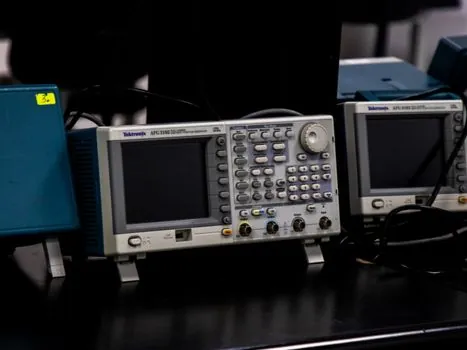
Fluke's E-DWT electronic deadweight tester removes the physical mass stack and the piston-cylinder swap workflow, replacing them with an electronically generated, real-time pressure indication that does not require floating-piston corrections [S5]. The marketing language is direct: the E-DWT "eliminates the need for weights and piston-cylinder changes" and lets the user "set and read any pressure value" rather than the discrete steps of a classic mass stack [S5].
For a working metrologist, the E-DWT occupies a specific slot. It is faster and more flexible than a traditional DWT for high-volume gauge calibration, but it is still a bench or lab instrument with a defined class, not a handheld. Chinese OEM product lines such as the YUNYI7000 series go further into automation with servo-controlled pressure generation and a binary automatic weight-loading subsystem, advertising unattended pressurization over a 0.6–2,500 bar band [S1]. Shelok, a Chinese instrument vendor active as of 2026-08-14, lists the same family of products, dead weight testers, digital pressure gauges, and pressure calibrators, as well as pressure transmitters, on its current catalog [S6].
Use Cases and Selection Guidance
Specify a hydraulic DWT, such as the Fluke P3100 or P3800, a WIKA CPB5000HP, or an Ashcroft 1305D, when the job is releasing a new pressure transmitter, calibrating a master gauge, providing traceability for a calibration lab, or auditing field instruments against a primary standard [S1][S3][S4]. Specify a pneumatic DWT, such as the WIKA CPB5000 (0–400 bar) or the PK II (0–30 psi), when the working medium is air, the pressure is low, or the application involves cleanroom, pharmaceutical, or low-pressure gas flow work [S1].
Specify a multifunction process calibrator when one technician must source 4–20 mA, read RTD or thermocouple outputs, check loop power, and verify a pressure gauge at the same instrument skid, in the same shift, without walking back to a bench. This is the everyday reality of instrument maintenance on process plants, and it is why REED's catalog groups multifunction process calibrators with HVAC/R, facilities maintenance, and industrial maintenance use cases [S2]. Cost is the other axis: a quality hydraulic DWT is a capital purchase, often in the five-figure USD range, while a multifunction process calibrator is a per-technician tool in the low four figures, so the two are typically budgeted on different lines and procured against different selection criteria [S1][S2].
Limitations, Failure Modes, and Standards Discipline

DWTs are sensitive to local gravity, ambient temperature, piston float quality, and operator technique, which is why Fluke's P3100 datasheet explicitly calls out the 10% of range floor on the accuracy spec, the gravity-trim option, and the thermal coefficients of the piston/cylinder pair [S3]. Multifunction calibrators are sensitive to sensor drift, battery state, reference-junction compensation on thermocouples, and abuse of the pressure port; their pressure modules usually need annual recalibration against a DWT, which closes the loop between the two tiers [S2][S3].
Standards-wise, deadweight testers are typically treated as primary or secondary pressure standards under ISO/IEC 17025 calibration programs, and individual labs will quote their own uncertainty budgets rather than a single published class. Multifunction process calibrators are working standards and should not be used to release product without a traceable path back to a DWT or equivalent primary standard. None of the source material supplied with this article pins a specific ISO or IEC clause number to a specific accuracy threshold, so any project-specific compliance question should be checked against the actual standard text and the lab's scope of accreditation, not against a vendor datasheet.
For specifiers building a 2026 calibration program, the practical rule is: buy one DWT per lab or per site standards room, sized to the highest pressure and the dominant medium (oil, water, or air) on that site, and equip every instrument technician with a multifunction process calibrator that covers the electrical and thermal parameters they touch daily. The two instruments do not compete, they stack. Pairing a Fluke P3100 hydraulic DWT on the metrology bench with REED-class multifunction calibrators in the field is the standard configuration across most oil and gas, chemical, and power plants, and the same logic extends to spec-first decisions on adjacent tools such as torque and dynamometer benches and loop calibrators [S1][S2][S3].