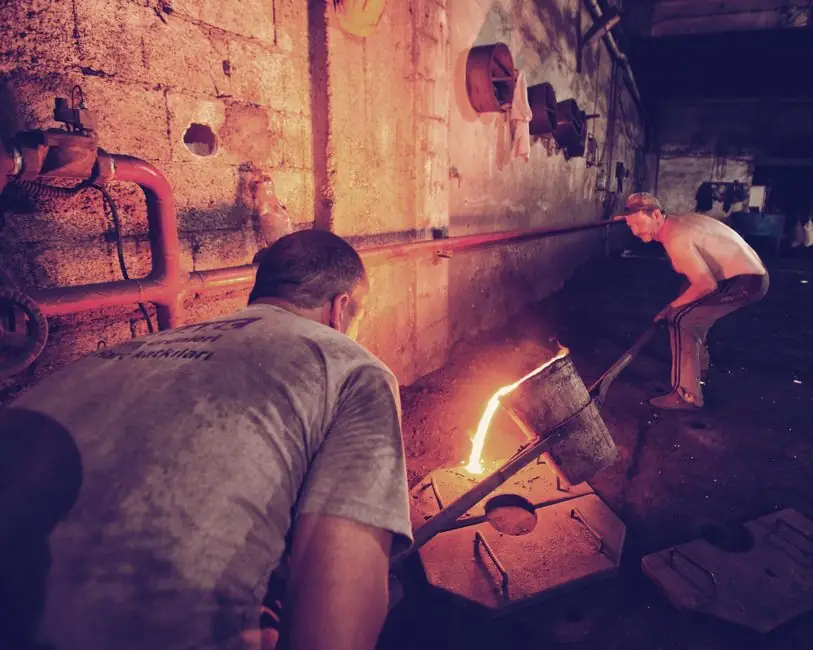
Gas-fired crucible furnaces consume 130–150 m³ of natural gas per tonne of aluminum melted to 720°C when fired with cold-air burners, with the exact figure scaling with crucible size and charge condition [S5]. At 2026 industrial gas prices in the $0.30–$0.80 per m³ band, that translates to roughly $0.04–$0.10 of fuel per kg of aluminum melted, before electricity for blowers, refractories, and labor.
The per-kg fuel figure is set by three engineering variables that plant managers can actually move: combustion-air preheat, melt-to-720°C thermal load, and burner modulation under holding duty. Stationary round-crucible units like the gas-fired GM-A line (silicon-carbide or graphite crucibles, PLC control, bale-out configuration) are the typical workhorses for foundries in the 100–1,000 kg batch range, and their published melting rates anchor the calculation [S1].
Where the 130–150 m³/t figure comes from
The reference consumption of 130–150 m³ of natural gas per tonne of aluminum at 720°C is documented in the Foundry Lexicon entry on crucible furnaces, which explicitly contrasts cold-air burners against recuperative systems [S5]. The same source puts fuel-fired crucible melting output at up to about 400 kg Al/h versus 250 kg Al/h for comparable electrically heated units (specifications per StrikoWestofen GmbH) [S5]. For an operator, the implication is direct: gas units roughly halve melt time at the cost of a fuel line that can swing 15–20% of operating cost depending on local gas tariffs.
For perspective, a small propane-fired bench unit such as the 180,000 BTU DFC burner (≈53 kW) on a 10 kg brass/4.4 kg aluminum charge reaches 1,450°C and demonstrates the same physics at hobby scale, but it is rated for butane/propane/LPG and explicitly not for natural gas, so it cannot be used to derive NG consumption [S2]. The bench unit also illustrates why small batches carry a worse per-kg ratio: crucible cold-start losses dominate at 4–10 kg charges, and that scaling penalty persists up to roughly 100–200 kg charges before the cold-air burner curve flattens.
Cost drivers a buyer can actually move
Burner configuration is the largest single knob. Recuperative preheating of combustion air cuts gas consumption 25–38% versus cold-air burners, so a plant running 150 m³/t cold-air can drop to 92–112 m³/t by switching to a recuperator-equipped tiltable crucible furnace [S5]. At $0.50/m³ gas, that is a $0.020–$0.029 per kg swing, which over 1,000 t/yr of melted aluminum is $20,000–$29,000 in annual fuel savings, well above the cost premium on a recuperative burner.
Capacity class drives capital cost separately: small electric induction units run $3,000–$9,999, 100 kg to 1 t units run $10,000–$50,000, 1–5 t units run $50,000–$150,000, and 5–20 t industrial systems run $150,000–$300,000, with gas crucible furnaces sitting on the lower-cost end of the spectrum for the same capacity [S4]. Because the gas units cost less up front and have fewer moving parts than tilting or automated systems, maintenance overhead also drops, which is why GM-A-style stationary crucible designs are positioned for cost-sensitive small and medium foundries [S1].
Recuperative vs cold-air: numeric comparison
Stacking the two main burner types against the cost question gives a clean side-by-side. A cold-air gas-fired crucible furnace at 150 m³/t of aluminum, $0.50/m³ gas, and 1,000 t/yr throughput burns through $75,000 of fuel annually, or $0.075 per kg. A recuperative unit at 92 m³/t (38% reduction, the upper end of the published range) on the same throughput burns $46,000, or $0.046 per kg [S5]. The 38% figure is the documented upper bound from the Foundry Lexicon, so 25% is the conservative planning number for a real installation with imperfect heat recovery.
Crucible material is a secondary driver: silicon-carbide (SiC) crucibles tolerate higher flame impingement and have lower thermal mass losses than clay-graphite, so a SiC-lined unit in a GM-A-style design delivers a tighter per-kg fuel figure for the same burner setting, with the trade-off being higher crucible purchase cost and a typical service-life penalty under thermal cycling [S1]. For a foundry choosing between holding-dominant and melting-dominant duty, fixed non-tiltable units charged with pre-melted metal hold temperature with less fuel per kg, while separately positioned tiltable recuperator units are best suited for the pre-melt step that consumes most of the gas.
Use cases where gas crucible makes economic sense
Gas-fired crucible furnaces fit small to medium foundries producing 100–1,000 kg aluminum batches, prototype shops, R&D labs, and the pre-melt side of die-casting cells where melt cleanliness and batch flexibility matter more than throughput per square meter [S1]. For gravity, sand, and permanent-mold operations, the bale-out configuration with ladle transfer keeps the per-kg cost predictable as long as crucible size matches hourly demand plus a holding reserve. The gas path also suits remote sites without three-phase power, which is a hidden driver in many regional casting-job-shop decisions.
For die-casting support in HPDC/LPDC cells, sizing should be driven by actual hourly demand, holding reserve, and ladle transfer distance rather than nameplate melt rate; over-sized furnaces waste fuel per kg because cold-start losses get amortized across too few batches, while under-sized furnaces force continuous melting that erodes the fuel advantage [S1]. This sizing logic is the same one used in spec-driven selections for crucible furnaces across the industry.
Use cases where gas crucible does not make sense
Continuous high-throughput operations above 5 t/h are a poor fit: an electric holding furnace paired with a central melter is usually cheaper per kg at that scale, and the gas unit's per-kg fuel advantage disappears once cold-start losses are amortized over very large batches. Plants located in regions with industrial gas tariffs above $0.80/m³ also see the per-kg fuel bill climb past $0.12, at which point induction melting on a favorable electricity tariff pulls ahead on total cost of ownership, even with higher capital outlay [S4].
Cleanrooms, indoor operations under tight emissions caps, and any site where flue gas contacts the melt (older hood-vented designs) are also weak fits; modern gas crucible designs vent flue gas around the crucible rather than across the bath, which is the configuration to insist on for any food-contact or aerospace alloy work where hydrogen pickup and inclusion control are non-negotiable [S5]. For a deeper dive into the gas-versus-electric decision on a like-for-like basis, the spec comparison at Gas-Fired vs Electric Resistance Crucible Furnace Spec Comparison lays the same trade-off across a different cost vector.
Standards, sourcing, and verification
No single ISO or ASTM standard pins down "m³ of natural gas per kg of aluminum melted", because the number is a function of furnace design, charge condition, and burner efficiency rather than a material property. The 130–150 m³/t benchmark and the 25–38% recuperator savings range are published in the Foundry Lexicon's crucible-furnace entry and are widely cited by StrikoWestofen and other European OEM documentation [S5]. Plant-side verification should always be done on a metered gas basis over a minimum 5-batch run, with charge mass, start temperature, and final pour temperature logged, so the per-kg figure a manager budgets against reflects actual operating practice rather than the OEM's nameplate.
Trackable signals to watch over the next two quarters: regional industrial gas tariff movements, OEM announcements on recuperative burner retrofits for the GM-A and similar stationary crucible platforms, and any tightening of EU industrial emissions rules that would change the relative cost of gas versus electric induction.