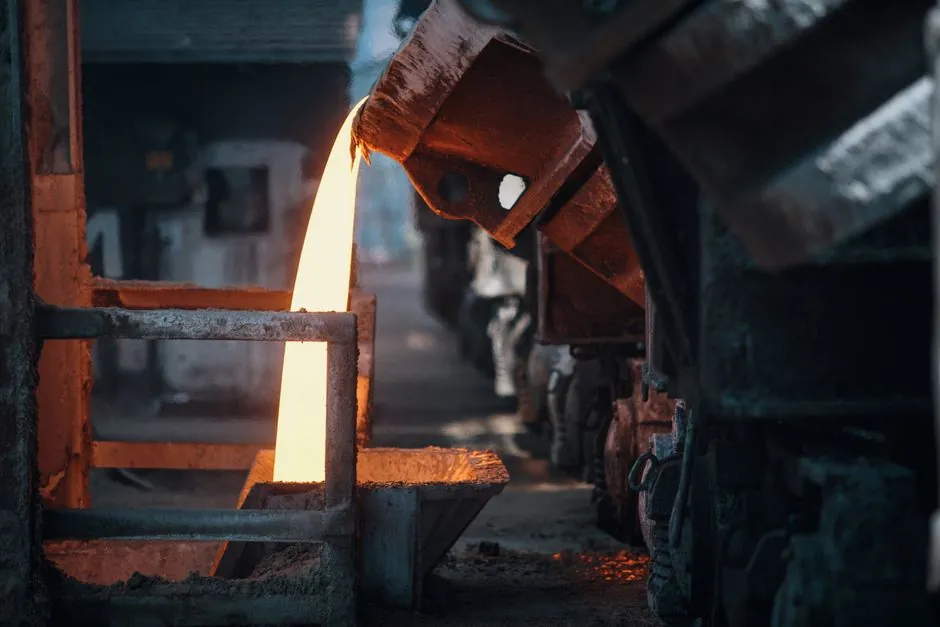
For natural-gas-fired crucible furnaces melting aluminum to 720 °C, the reference consumption range sits at 130 to 150 m³ of gas per tonne of metal, with the exact value scaling with crucible size and operating practice [S7]. That single figure is the anchor every shop-level per-cycle calculation starts from, and it also exposes why small-batch, propane-fired hobby and jewelry furnaces land an order of magnitude off the same per-tonne metric.
Per-melt gas use is driven by three inputs that compound: charge mass, target temperature rise, and the fraction of fuel energy that actually reaches the metal. Once those three are fixed, fuel cost and cycle time follow directly, and so does whether a stationary or tilting crucible furnace makes economic sense for the operation.
What "per melt cycle" actually means in gas terms
A "melt cycle" in a stationary gas-fired crucible is not just the liquidus-to-pour window. It is charge-in to empty-out, including preheat, melt-down, superheat to pouring temperature, and any alloying or degassing hold. Published industrial data for aluminum sets the gas demand at 130 to 150 m³ of natural gas per tonne to reach 720 °C, depending on crucible size, with the higher end of the range corresponding to smaller vessels where surface-to-volume losses dominate [S7].
For non-aluminum alloys, the energy floor shifts because the specific heat and latent heat both rise. A worked calculation for a 5.5 kg LG2 gunmetal bronze charge starting at 10 °C and reaching roughly 1100 °C (100 °C superheat above the 1010 °C melt point) yields a useful heat of about 3243 kJ, or roughly 900 Wh, before any furnace losses are added [S2]. Real fuel consumption is then the useful heat divided by furnace efficiency, which is where the gas number stops being a clean stoichiometric figure and becomes a heavily accounting-driven estimate.
The calculator model: how a 25 kg charge is run
The published 2026 gas-crucible heat-input calculator (Apr 29, 2026) sets out the canonical worked numbers for a small propane-fired unit and is explicit about what it is and is not solving: average fuel heat input, charge mass, temperature rise, melt time, and an assumed efficiency applied once [S5]. For a 25 kg charge, 920 K temperature rise, 25-minute melt time, and 8.93% assumed efficiency, the calculator returns a 35002 BTU/hr fuel input, a 102.6 kW heat input, a 7.96 kg/hr propane burn rate, and a 60 kg/hr melt rate [S5].
The same model uses fixed illustrative properties: specific heat 0.38 kJ/kg-K and latent heat 200 kJ/kg. These are stated as assumptions, not certified for every brass alloy, and the model notes that alloy-specific enthalpy, furnace warm-up, and the actual firing schedule are not solved separately [S5]. Propane is converted using 46.4 MJ/kg lower heating value, which is the number a process engineer should pin on a calc sheet rather than the rounded 49 MJ/kg figure that older forum references use [S2][S5].
For a 25 kg brass-style charge melted in 25 minutes, that translates to a per-cycle propane use of roughly 3.3 kg (7.96 kg/hr × 25/60). Scale the same model to a 250 kg batch and 60-minute cycle, and the burner demand drops sharply because the surface-to-volume ratio improves and efficiency rises with bath depth; this is the mechanism behind the per-tonne figure compressing at industrial scale.
Industrial-scale numbers: 80 to 1000 kg and beyond
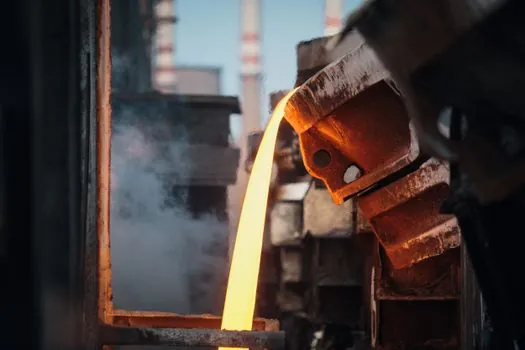
Commercial gas-fired crucible melting furnaces in the 80–1000 kg aluminum class are sold as standard product, with published model lines covering fixed-stationary and tilting variants [S3][S6]. The Hormesa HORCF fixed gas crucible furnace, for example, is offered in 50 kg to 800 kg crucible sizes, with the design intent of stable thermal performance and ladle transfer to a downstream gas crucible holding furnace [S3]. The Dynamo GM-A series, by contrast, is positioned for smaller foundries and covers melting throughput from 77 lbs/hr up to 770 lbs/hr in round-crucible form, with the metal held inside silicon-carbide or graphite crucibles isolated from direct flame contact [S1].
Across this 50–1000 kg class, the published guidance is consistent on what drives real versus rated melt rate: burner input, furnace condition, charge form, starting temperature, alloy, lid practice, and the operating cycle itself [S6]. A foundry that closes the lid, charges dry ingots at room temperature, and pours at the minimum superheat will land at the lower end of the 130–150 m³/tonne range [S7]; a shop that charges oily sows with the lid open and superheats 100 K past target will run closer to the upper end, and may exceed it if the burner is over-fired for cycle-time reasons.
Where the published efficiency number (8.93%) comes from
The 8.93% efficiency used by the 2026 calculator is not arbitrary; it lines up with field-measured performance for small, fuel-fired crucible furnaces. The referenced "why fuel-fired crucible furnaces run at 12% thermal efficiency" piece, and operator threads on fuel consumption measurement, both frame the small-crucible fuel-fired case as low double digits at best, with the rest of the input leaving through exhaust gas, wall losses, and the open lid [S5]. Forum-level discussions of forge and crucible fuel consumption recommend weighing the bottle before and after the melt as the most accurate per-cycle measurement, because nameplate burner ratings over-predict real fuel use in shop conditions [S4].
Two practical implications follow. First, holding a foundry-level efficiency assumption at 8–12% is defensible for small gas crucibles; pushing it to 25–30% in a calc sheet is wishful and will understate gas cost. Second, the same calc that returns 7.96 kg/hr propane at 8.93% returns roughly 2.8 kg/hr at the 25% mark, which is the difference between an uneconomic small-batch operation and a competitive one. Operators chasing that gap typically look at holding furnace integration, regenerative burners, or simply larger crucibles, not at the burner itself.
Selection criteria: stationary versus tilting, bale-out versus pumped
For a shop choosing how to deploy a gas crucible, the per-cycle gas number is only one leg of the decision. The other is pour method. Stationary units such as the GM-A and HORCF rely on ladle transfer after melt-down, which keeps the furnace geometry simple and the maintenance cost low, but adds 2–5% metal temperature loss in the transfer step [S1][S3]. Tilting units, by contrast, use the same gas-burner architecture but rotate the entire furnace assembly to pour, which suits larger or more frequent controlled pours but adds moving parts and refractory wear [S1][S5].
Selection on per-cycle gas use alone favors the largest crucible the casting schedule can swallow, because per-tonne gas demand compresses with bath mass. Selection on cycle flexibility favors stationary bale-out, because the furnace can hold metal between pours without the operator having to commit to a tilt sequence. Selection on melt rate per footprint, for a die-casting cell, favors gas aluminum melting furnace configurations matched to the casting machine hourly demand plus a holding reserve sized for ladle transfer distance.
Comparison: gas crucible versus electric and versus cupola
Across the same throughput class, the three main options line up differently on per-cycle energy, capex, and operating skill. A cupola furnace is continuous and lower per-tonne in fuel cost for iron, but cannot do small batch alloy changes; a line-frequency coreless induction furnace is electric, has a higher per-cycle kWh but tighter melt-rate control; a gas crucible sits in the middle on capex, with the highest per-cycle fuel volume of the three at the small end of the size scale [S2][S7].
The 2016 forum reference captures the trade bluntly: 1 kg of LPG yields 49 MJ on the Elgas figure, so 6 kg of LPG corresponds to 294 MJ (294000 kJ) of fuel input, of which only the ~3200 kJ that actually goes into a 5.5 kg bronze melt is useful work, the rest leaving as exhaust and wall loss [S2]. That is exactly why a 3 kW electric furnace running four hours at 17 cents/kWh can compete head-to-head with a propane-fired unit on a small melt: the electric case wastes less of its input even when the kWh price looks high. The same comparison, scaled to 250 kg of aluminum, swings back toward gas because per-tonne gas demand compresses with crucible size and electricity demand per tonne stays roughly flat.
Limits, failure modes, and what the numbers do not cover

The 130–150 m³/tonne figure is an industrial steady-state reference, not a guarantee, and the calculator's 8.93% efficiency is a single-pass assumption [S5][S7].
Three failure modes hit per-cycle gas use without warning. First, burner orifice wear shifts the air-fuel ratio off the calibration map and silently wastes fuel. Second, a wet or oily charge adds latent heat load that the operator does not see in the temperature controller but the gas meter does. Third, charging in small increments instead of a single batch multiplies the wall-loss term because the cold charge re-cools the lining on every addition. All three are reasons a process engineer should meter gas on the actual rig, not trust nameplate data, and why the forum recommendation to weigh the cylinder before and after is the most defensible per-cycle measurement at the small scale [S4].
Standards, sourcing, and how to read the numbers
No single ISO or ASME standard fixes "per-cycle gas consumption" for a crucible furnace; the number is a function of charge, alloy, and efficiency assumptions, not a regulatory threshold. The 130–150 m³/tonne aluminum figure is published in the German Foundry Lexicon, an industry reference work, and the 7.96 kg/hr propane figure is from the 2026 Firgelli calculator, which is explicit about the fixed-property assumption set it uses [S5][S7]. For propane, the 46.4 MJ/kg LHV used in the calculator is the conversion factor to keep on the calc sheet; the older 49 MJ/kg figure from the Elgas reference overstates the available heat by roughly 5% and should be retired in new work [S2][S5].
For shop decisions, the working method is: pick a charge mass, a target temperature rise, a melt time, and an efficiency in the 8–12% band for a small gas crucible or 15–25% for a large industrial unit, then run the Q_burner = m × (cp·dT + Lf) / (η·t) form of the calculator and convert to gas mass with the propane LHV or to volume with the natural-gas energy density [S5]. The encyclopedia entry on gas aluminum melting furnace configurations is the natural next stop for a reader scaling that workflow into a full die-casting cell.