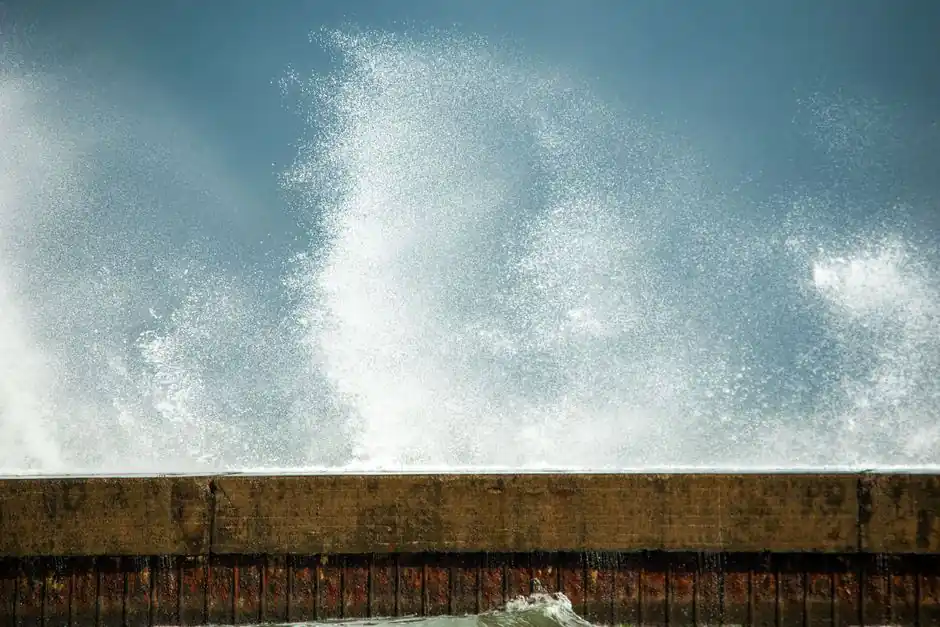
Offshore splash-zone steel requires a coating that resists saltwater corrosion, wave impact, abrasion, and repeated wetting, with Interzone 954GF providing glass-flake reinforced corrosion and abrasion protection at a typical DFT of 200–500 µm.
For new construction and major repairs, compare zinc-rich primer, high-build epoxy, glass-flake epoxy, thermal-spray metallic, and polyurethane systems against ISO 12944-9 CX exposure, immersion behavior, mechanical damage, substrate preparation, and maintenance access.
Splash Zone Exposure and Corrosion Mechanism
The splash zone is the most aggressive offshore exposure because steel is repeatedly wetted and dried, aerated seawater remains highly corrosive, and cathodic protection does not protect an alternately submerged surface effectively. Splash-zone corrosion rates can be 10 times higher than in the fully submerged zone, while the soil or mud zone has a typical corrosion rate of 0.02–0.05 mm/yr [S3].
The splash zone lies outside the reach of cathodic protection and is alternately wet and dry as waves wash over it [S3]. The practical consequence is that a system qualified only for atmospheric or continuous immersion performance cannot be assumed to survive splash-zone service.
Coating failure is driven by several mechanisms at once: osmotic pressure generated during repeated wetting, salt concentration after evaporation, ultraviolet exposure above the waterline, wave impact, abrasive grit and debris, and mechanical damage during handling or operation. A high-build barrier system must therefore address electrochemical protection, adhesion, water uptake, abrasion resistance, and impact resistance together [S3][S4].
Compare the Main Coating Options
High-build glass-flake epoxy is the preferred first-line option for continuously exposed splash-zone steel when the structure permits controlled abrasive preparation and application. Interzone 954GF provides glass-flake reinforced corrosion and abrasion protection for splash-zone steel at a typical DFT of 200–500 µm.
For a controlled comparison, glass-flake epoxy offers stronger abrasion and mechanical protection than conventional high-build epoxy, while zinc-rich systems provide sacrificial galvanic action but normally require a compatible barrier coat. Polyurethane adds ultraviolet resistance above the waterline, and thermal-spray metallic coating is a project-specific option rather than a default splash-zone repair material [S1][S2][S7].
Zinc-Rich Primer Role in New Construction
Zinc-rich primer provides galvanic protection that can suppress localized corrosion when the coating film is damaged, making it valuable in controlled systems exposed to ISO 12944-9 CX conditions [S1]. Its benefit is strongest as part of a compatible primer, intermediate, and topcoat system, not as an isolated coating for a severe tidal band.
This arrangement separates functions: zinc-rich primer supplies sacrificial protection, glass-flake epoxy supplies barrier and mechanical resistance, and polyurethane protects the atmospheric surface from ultraviolet degradation.
For a continuously wetted and exposed splash zone, increasing DFT and using a monolithic or reinforced epoxy barrier is generally more defensible than relying on the zinc layer to bridge repeated wet-dry, abrasion, and impact cycles [S3]. Zinc-rich primer remains appropriate where the approved system architecture, fabrication controls, and exposure classification support it.
Tidal Repairs, Immersion Timing, and Product Selection
Tidal application requires a product with documented curing behavior during early seawater immersion, not merely a general marine-coating description. For the products examined, Interzone 954 is a two-component, high-build modified epoxy with a cited early-immersion allowance within 30 minutes when applied between tides; Interzone 954GF has a cited allowance after 2 hours; and Intershield 300 has no equivalent early-tidal-immersion allowance specified [S5].
Interzone 954 is positioned for splash-zone and tidal maintenance, with typical DFT of 250–500 µm. For direct-to-steel application, the cited guidance calls for at least 350 µm in atmospheric service and 450 µm in immersion, subject to the specified system. Airless spraying can achieve the required film build in one coat [S5].
Interzone 954GF is a glass-flake reinforced modified epoxy for corrosion, abrasion, and impact exposure, with typical DFT of 200–500 µm. Its early-immersion timing is longer than that of Interzone 954, so the selection cannot be based on generic epoxy suitability alone; the product data sheet and project exposure schedule control [S5].
Surface Preparation, Film Thickness, and Application Control

Coating performance depends on preparation, profile, cleanliness, mixing, application, and curing, not on the product name alone. Offshore systems commonly require abrasive blast cleaning to remove corrosion products, salts, oils, and loose contaminants before coating, but the exact preparation grade, surface profile, and salt-contamination limit must be taken from the governing product data sheet and project specification. [S5]
For glass-flake epoxy, controlled application is critical because the performance depends on a dense, continuous film containing the required reinforcement. The 600–1,500 µm DFT cited for a dedicated splash-zone system is much higher than ordinary atmospheric coating builds, so verify material quantity, theoretical volume, wet-film control, batch life, pot life, and cure schedule before approving the work plan [S3].
Use a dry-film thickness gauge appropriate to the coating and substrate, and inspect continuity, holidays, pinholes, edge coverage, surface profile, and intercoat adhesion. The available material also contains technical guidance for industrial coating selection, but it does not replace project-specific test methods or manufacturer instructions.
Failure Modes and Service Limitations
The principal failure mode in a splash zone is loss of barrier continuity followed by under-film corrosion, rather than uniform loss of coating thickness. Alternating immersion can create osmotic blistering, while wave impact, grit, and floating debris abrade the film; salt deposits then increase the electrolyte severity at damaged areas [S3][S6].
Impact resistance is a distinct requirement from corrosion resistance. A study of offshore protective coating systems concluded that effective systems should either be highly resistant to impact or compensate for underlying steel corrosion, while flange connections presented a vulnerable geometry requiring particular attention [S6]. Edge retention, weld treatment, bolted connections, drainage, and inaccessible crevices therefore deserve separate review even when the main pile coating has passed a laboratory test.
Cathodic protection should not be treated as a substitute for splash-zone coating. It is effective for submerged steel and may contribute within a compatible system, but the intermittently exposed band remains outside reliable cathodic protection [S3]. Do not select a system by extrapolating from continuous immersion data or atmospheric salt-spray data alone.
Standards, Certification, and Procurement Requirements
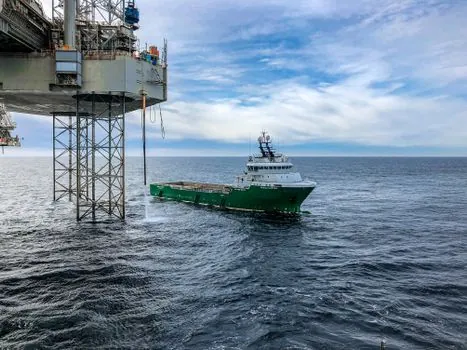
ISO 12944-9 provides the relevant offshore exposure classification framework, with CX for extreme offshore atmospheric corrosiveness and Im4 for seawater immersion with cathodic protection [S2]. NORSOK M-501 is also used to guide offshore coating-system selection, and certification can support coating choice, but the applicable category, surface preparation, DFT, test regime, and qualification must be checked against the project specification [S3][S8].
Procurement documents should state the exact substrate, exposure band, coating function, product name, DFT range, surface preparation, salt-contamination limits, temperature and humidity limits, surface-profile requirement, minimum and maximum overcoating interval, early-immersion allowance, curing condition, and compatibility with cathodic protection [S3][S5].
For a coating system that also serves internal or atmospheric areas, define the boundary between atmospheric, splash, tidal, and continuous immersion zones on the construction drawing. NORSOK M-501, ISO 12944, and manufacturer qualification data can support this package, but they do not replace performance testing for the actual substrate, geometry, exposure cycle, and service conditions [S8].
Shortlist Logic for Offshore Splash Zones
Choose a 600–1,500 µm solvent-free glass-flake epoxy for continuous severe splash-zone exposure, subject to verified surface preparation, application access, curing conditions, and adhesion to the specified steel treatment [S3]. Choose Interzone 954 for tidal maintenance where a 30-minute early-immersion allowance and 250–500 µm DFT are specifically required, or Interzone 954GF where abrasion resistance justifies the 2-hour early-immersion allowance and 200–500 µm DFT [S5].
Use zinc-rich primer within a validated multi-coat system where galvanic protection and new-build quality control are priorities; use polyurethane only as the UV-facing component of an atmospheric system; and use thermal-spray metallic coating only where the project specification, application process, and sealing system support it [S1][S2][S7]. Track the approved DFT, surface preparation, curing window, early-immersion condition, and holiday inspection as the five acceptance gates before release of the splash-zone work package.