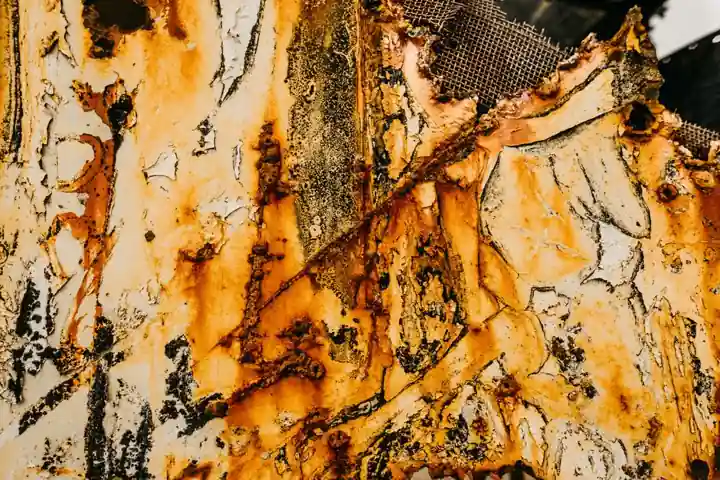
Stainless steel contains at least 10.5% chromium, creating a passive oxide layer, while carbon steel generally requires coatings for corrosion protection in wet or aggressive service.
The decision depends on exposure severity, coating integrity, fabrication method, maintenance access, and life-cycle cost rather than on coating type alone.
Material Behavior Sets the Coating Requirement
High-strength stainless steel’s chromium content, typically 10.5% or higher, forms a passive, self-healing oxide layer that regenerates when damaged and can provide long-term protection without additional coatings or treatments. The film has no meaningful dimensional effect, but chloride-contaminated environments can still produce localized attack [S3][S4].
Carbon steel oxidizes progressively when exposed to moisture and oxygen, while high-strength stainless steel retains its structural integrity more effectively in aggressive environments [S3]. Material selection and corrosion control must still be balanced against end use, initial cost, and future maintenance cost [S1].
For comparison between the two substrates, stainless steel provides inherent passive protection but does not eliminate the need for grade, finish, crevice, and chloride assessment. Carbon steel offers lower substrate cost but depends more heavily on coating continuity, surface preparation, environmental severity, and inspection.
Coating Options Compared by Decision Criteria
Zinc suits general structural protection where coating damage will not immediately expose active steel.
Paint and conventional polymer coatings provide a barrier, but they depend heavily on adhesion, surface preparation, dry-film thickness, and damage control.
Conversion coating is a distinct route: EonCoat chemically bonds to carbon steel, forms a 2 µm amorphous magnesium iron phosphate layer, and adds a white ceramic layer over it [S5]. In a Tabar abrasion-wheel test, polymer coatings required 75 cycles, epoxies 125–250 cycles, and EonCoat more than 1,200 cycles to reach 0.001 inch wear [S5]. This is a product-specific test result, not a universal coating ranking.
Exposure Class Drives System Selection
A saltwater bridge exposed to stagnant moisture and electrolytes presents a higher corrosion risk than an internal structural beam in a commercial building, and both require protection at different levels [S1]. Environmental severity should be defined before choosing a coating rather than after the first corrosion site appears [S1].
Unlike high-strength stainless steel, carbon steel rusts continuously when exposed to moisture and oxygen. Stainless steel improves the baseline corrosion resistance, but neither alloy selection nor coating can correct trapped water, poor drainage, or incompatible metal contacts [S1].
For carbon steel, options range from zinc-rich paint, hot-dip galvanizing, electro-galvanizing, mechanical plating, and zinc plating to paint, plating, and conversion treatments [S2][S4]. Fasteners are a poor fit for ordinary paint because it tends to rack and interfere with assembly, so their coating system must suit function as well as corrosion exposure [S4].
Stainless Steel Coating Use Cases
This treatment should be specified for a measurable surface function rather than assumed to replace the stainless grade’s passive resistance. A chromium-nickel CrCu alloy coating has also been investigated for corrosion protection of stainless steel, with the work published in 2023 [S7].
Stainless steel suits marine structures, chemical facilities, architectural components, and fasteners where retained appearance, low coating-maintenance burden, or contamination control justifies its higher initial material cost [S3][S4]. The carbon steel versus stainless steel structural-parts comparison provides additional context for strength, fabrication, and service-life trade-offs.
Stainless steel is not automatically the correct answer for every corrosive atmosphere. Marine Grade 316 stainless steel, for example, has greater chloride resistance than common 304 stainless steel, but neither grade removes the need to control crevices, deposits, and stagnant conditions. Material grade, surface condition, and service chemistry must be reviewed together [S3][S4].
Coating Failure Modes and Inspection Priorities

Coatings do not protect against every corrosion mechanism. AMPP specifically notes that coatings are effective for controlling uniform corrosion but less effective against localized attacks such as pitting [S1]. Water traps are intrinsically corrosion-prone because retained moisture accelerates corrosion, especially when dirt and debris also remain in the joint [S1].
Dissimilar metals in one structural-steel system can create galvanic corrosion, so fastener and attachment-material selection belongs in the corrosion design review [S1]. Coating specification should identify the exposed substrate, surface preparation, coating type, application thickness, cure requirements, and compatibility with adjacent materials. Structural-steel guidance treats service environment, design details, surface preparation, and coatings as linked decisions rather than separate purchasing items [S8].
Protection may also require more than a coating. Limiting atmospheric exposure, preventing water collection, and avoiding dissimilar-metal contacts can reduce the required coating burden before fabrication begins [S1]. These design measures are unavailable after construction without reconstruction, which makes early corrosion-engineering input materially valuable.
Selection Rules by Application and Budget
Specify stainless steel without a functional coating when the chosen grade has adequate resistance in the actual environment and appearance or dimensional stability is sufficient. This is usually the lower-maintenance route, but local chlorides, crevices, and surface contamination still govern performance [S3][S4].
Specify coated carbon steel when initial material cost dominates and the structure can be prepared, coated, inspected, and maintained. Epoxy systems fit moderate corrosion risk, zinc systems provide sacrificial protection, and conversion coatings warrant review where abrasion resistance is a specified need [S1][S2][S5]. The system must be matched to the exposure category, not selected from a generic corrosion-resistance table [S1].
Use nickel plating on stainless steel for a defined surface, hardness, solderability, or contamination requirement [S2]. For coated fasteners, specify the process around assembly geometry and service life; ordinary paint is generally unsuitable because it racks during handling [S4]. For structural carbon steel, balance first cost, maintenance access, expected service life, and the consequence of coating failure rather than choosing by coating cost alone [S1][S4].
Record the selected environment, substrate grade, surface preparation, coating system, application thickness, compatibility checks, and inspection interval in the project specification, then verify the final system against the service exposure and adjacent materials before release.