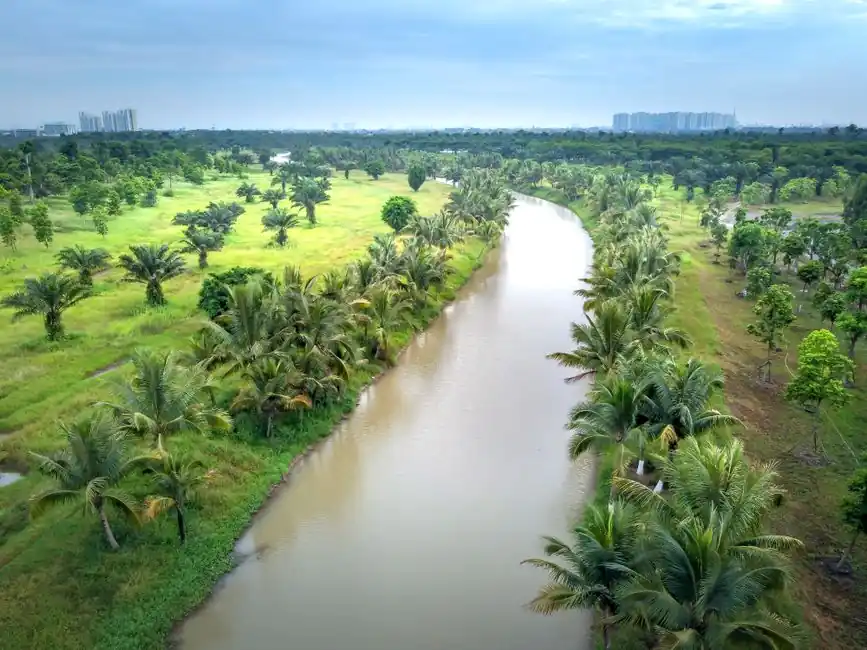
Open channel flow measurement is its own discipline because the cross-section is not fixed: a flow meter must reconstruct the area from a level reading and combine it with either a primary device equation (Manning, weir, flume) or a measured velocity. The reference architecture is the ultrasonic-level / Manning pair, where a non-contact sensor resolves the water surface to 1 mm or 0.2% of full span (whichever is greater) and the transmitter converts that level into instantaneous plus cumulative flow using channel geometry [S2][S8].
Doppler velocity-area meters are the second main family: a probe emits an ultrasonic beam, captures the Doppler shift from suspended particles or bubbles, and pairs the resulting flow velocity (typically 0.02 to 5 m/s, ±1% FS) with a pressure-sensed level (0 to 10 m, ±0.5% FS) to compute Q = V × S on the fly [S3][S4]. A third, newer option uses 24 GHz planar microwave radar to read both level and surface velocity non-contact, useful where foam, steam, or aggressive chemistry would blind an ultrasonic transducer [S10].
Three Sensing Architectures, One Q = V × S or Q = f(h) Outcome
Ultrasonic-level / Manning-equation meters are the right pick when the channel has a fixed shape and a primary device (rectangular or V-notch weir, Parshall flume) has already been civil-engineered. The meter's job is then purely a level-to-flow conversion, and the spec sheet looks like this: DC 24 V (±5%) / 0.2 A or AC 220 V / 0.1 A supply, backlit LCD, instantaneous range 0 to 99999 L/s or m³/h, cumulative total 9,999,999.9 m³/h, and a 1 mm or 0.2% FS level accuracy [S2][S8]. They are passive to water quality because nothing touches the stream, which is the reason Royce Water and other municipal integrators default to this architecture for clean-water weirs [S1].
Doppler velocity-area meters replace the weir with software. Because velocity is measured directly (not inferred from level), there is no civil works, and the same unit can be moved between a circular, rectangular, trapezoidal, or triangular cross-section by selecting a built-in pipeline model [S3][S4]. The trade-off is that the water must carry a minimum scatterer density (suspended solids, micro-bubbles); a perfectly clear ultrapure stream returns no Doppler shift and the meter reads zero. Power draw is well under 25 mA at DC 9 to 28 V, so a small solar panel and battery run it indefinitely, and the housing is ABS with IP68 protection for permanent submersion [S3][S4].
24 GHz planar radar flowmeters are the non-contact alternative to Doppler. They measure both surface velocity (via Doppler at microwave frequencies) and water level (via FMCW radar) without any submerged transducer, which lets them operate in fouling, foaming, or chemically aggressive streams that would coat an ultrasonic face. Output is 4 to 20 mA plus RS-485/Modbus, and the technology is now appearing in irrigation-canal and river-monitoring tenders [S10]. A useful side note for buyers cross-shopping other meter types: radar is to open-channel what electromagnetic flowmeters are to full-pipe conductive liquids, and where neither fits, the Coriolis flowmeter family remains the high-accuracy mass-flow reference for closed pipes.
Spec Bands That Actually Drive the Decision
Level accuracy is the headline spec and also the most often misread. Ultrasonic-level / Manning meters state 1 mm or 0.2% FS (whichever is greater), meaning that at a 1 m span the spec is dominated by 0.2% (2 mm), not 1 mm; only above 0.5 m span does the 1 mm floor bind [S2][S8]. Doppler meters take a different route: ±0.5% FS on level and ±1% FS on velocity, with a flow-rate accuracy around ±3% once cross-section morphology is included [S3][S4]. When comparing these numbers, normalise them the way you would for any ultrasonic flowmeter datasheet: percentage of full scale against your expected working range, not the headline best-case.
Operating envelope matters more than people expect. Industrial and outdoor units share a common -20 to +60 °C water-temperature window, 0 to 95% RH non-condensing humidity, and atmospheric-pressure rating [S3][S5][S7]. Power-supply options split the field: mains-powered wall or panel units (DC 24 V / AC 220 V) for permanent plant installations, and DC 9 to 28 V solar / battery units drawing under 25 mA for remote canal and river sites [S2][S3][S4]. For hazardous-area deployments, the broader flowmeter market has standardised on ATEX/IECEx dual certification, but none of the open-channel datasheets in this set carry an Ex rating, which is itself a useful signal: open-channel meters are normally installed in non-classified civil works.
Outputs and integration are converging on the same pattern. Almost every modern open-channel meter offers a 4 to 20 mA analogue loop plus RS-485 / Modbus RTU, often with on-board storage (one supplier lists up to 2 years of internal data) and EEPROM to retain totals across power loss [S5][S6][S3]. Where high accuracy on a full pipe is required instead, the decision usually migrates to a turbine flowmeter, but that is a different measurement problem: a closed, pressurised line, not a gravity-fed open channel.
Where the Open-Channel Architecture Loses to Other Meters
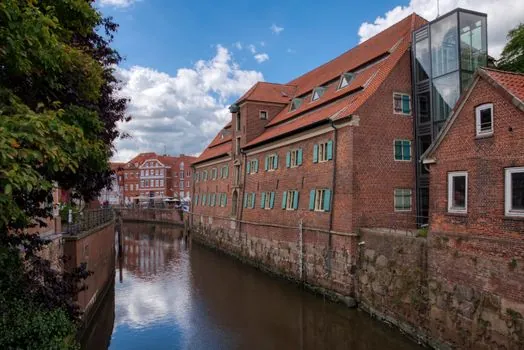
Open-channel measurement is fundamentally an indirect calculation, so its accuracy ceiling is lower than closed-pipe meters. A Doppler velocity-area unit's ±3% flow accuracy [S3][S4] is a real-world budget after the level sensor, the velocity sensor, and the cross-section assumption are stacked; by comparison, a properly sized Coriolis flowmeter on a full pipe can reach ±0.1% on mass flow. If the process line is fully filled, clean, and conductive, an electromagnetic flowmeter is the better answer and the open-channel meter is the wrong tool.
There are also sites where open-channel measurement should not be attempted at all: very clean deionised or RO water with no scatterers (Doppler returns nothing), channels with severe turbulence, hydraulic jumps, or backflow within 5 to 10 hydraulic-radii of the sensor (the straight-pipe rule stated in the installation guides) [S4], and any application where the stream temperature exceeds 60 °C or where the channel walls and water share an aggressive chemistry that would attack an ABS or polyether-ether-ketone housing. In those cases the right answer is to redesign the civil works (install a Parshall flume) or move to a closed-pipe meter. The deeper question, of how to choose an open-channel flowmeter for a specific duty, is essentially answered by answering four upstream questions first: fixed primary device or not, water clarity, power budget, and required level accuracy.
Selection Criteria and Side-by-Side Comparison
Buyers should score the three options against four criteria. (1) Channel geometry: fixed weir / flume favours ultrasonic-level / Manning; variable or unknown cross-section favours Doppler or radar. (2) Water quality: clean water suits all three; dirty / foaming / chemically aggressive water favours radar. (3) Power: mains available suits all; remote solar-battery sites need a sub-25 mA Doppler or radar unit. (4) Required level accuracy: 1 mm or 0.2% FS is the ultrasonic benchmark; ±0.5% FS is the Doppler benchmark. [S2]
Side-by-side at a glance, against the data in the source set: ultrasonic-level / Manning (Q&T, CBRO, Enviro Empirical) gives the best level accuracy at 1 mm / 0.2% FS and the lowest cost, but needs a civil primary device and is blind in foam [S2][S5][S8]. Doppler velocity-area (Shandong Vientiane, Fengtu) gives ±1% FS velocity and ±0.5% FS level, no civil works, ABS IP68 housing, but needs scatterers in the water and accepts ±3% flow accuracy [S3][S4]. 24 GHz planar radar (Sino-Instruments) gives non-contact level and velocity, tolerates foam and aggressive media, runs on a 24 V supply, but is the newest and least field-proven of the three [S10]. Reading the same matrix, the cost ranking is roughly ultrasonic-Manning at the bottom, Doppler in the middle, radar at the top.
Who Should Not Pick the Mainstream Option, and Why
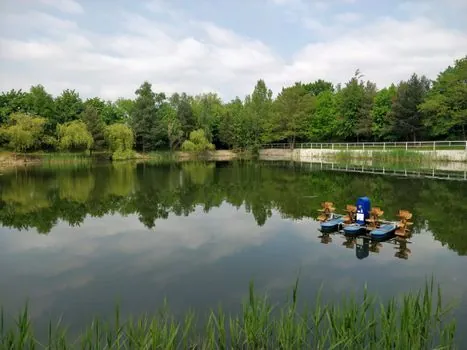
Engineers tend to default to the ultrasonic-level / Manning meter because it is the cheapest and the most familiar. That default is wrong in three common scenarios. (1) Greenfield sites with no existing weir or flume: the civil cost of building a Parshall flume usually exceeds the price difference between an ultrasonic-level unit and a Doppler velocity-area unit, and the Doppler arrives as a single IP68 package on a 2 m pole with no wet concrete [S3][S4]. (2) Sites with rag-carrying wastewater (municipal influent, food-processing effluent, pulp-and-paper white water): the same impurities that defeat an ultrasonic face by fouling or scattering will give a Doppler meter its needed return signal, and a radar meter will see through the foam layer that blinds ultrasonics. (3) Remote, unmanned canal-of-river sites: a Doppler unit under 25 mA on DC 9 to 28 V is genuinely solar-viable, while an AC 220 V ultrasonic-level / Manning unit is not [S3][S4][S2].
For buyers who do pick the mainstream option, the deployment list is short: match the transmitter to the primary device, run DC 24 V or AC 220 V to it, calibrate the K factor or Manning coefficient against a manual level reading, and verify the 1 mm or 0.2% FS level spec with a portable staff gauge on commissioning. The wider procurement question of how an open-channel meter fits into a plant's flow strategy is covered in the open channel flowmeter reference page, and buyers who are sizing a broader instrumentation package should also read the turbine flowmeter and ultrasonic flowmeter notes to see where a closed-pipe meter would be a better fit than an open-channel one.
Installation and Sourcing Constraints
Three installation constraints are quoted consistently across the source set and should be treated as design inputs, not afterthoughts. (1) Upstream straight channel: the sensor must sit downstream of a straight section at least 5 to 10 hydraulic-radii long, with no sluice, weir, or overflow obstruction in that reach [S4]. (2) Sensor elevation: the level transducer must read off a calm water surface; stilling wells, bubble tubes, or radar mounting at the correct stand-off are all used to clean up the level signal. (3) Power and cabling: standard cable length is 10 m and is customisable; for solar-powered Doppler units, the load budget must include a temperature sensor and the Modbus tail [S3][S4].
Sourcing-wise, the open-channel market is fragmented and dominated by Chinese OEMs (Q&T, Sino-Instruments, Shandong Vientiane, Fengtu, Tianwei, Royce Water as a South African integrator) plus Indian manufacturers (Enviro Empirical, CBRO). MOQ is typically 10 pieces for the smaller exporters, and 4 to 20 mA plus RS-485 / Modbus RTU is the universal I/O package, so a buyer can mix and match vendors on the same SCADA without protocol converters [S2][S3][S4][S5][S6][S7][S8][S9][S10]. For projects that already include welding, automation, or other capital equipment, the procurement playbook in Welding Robot Procurement: Payload, Reach, Process, and Cell Sizing follows the same vendor-evaluation logic that an open-channel meter tender would.
Trackable signals for the next buying cycle: (a) more 24 GHz planar radar SKUs entering the canal-monitoring segment through 2026 as foam and fouling issues push integrators off ultrasonics [S10]; (b) tighter coupling between Doppler velocity-area meters and SCADA via Modbus TCP and LoRaWAN, following the existing RS-485 baseline [S3][S4]; (c) continued pressure on the 1 mm or 0.2% FS level spec as the de-facto industry benchmark, with new entrants expected to either match it or quote a percentage-of-reading figure to differentiate.