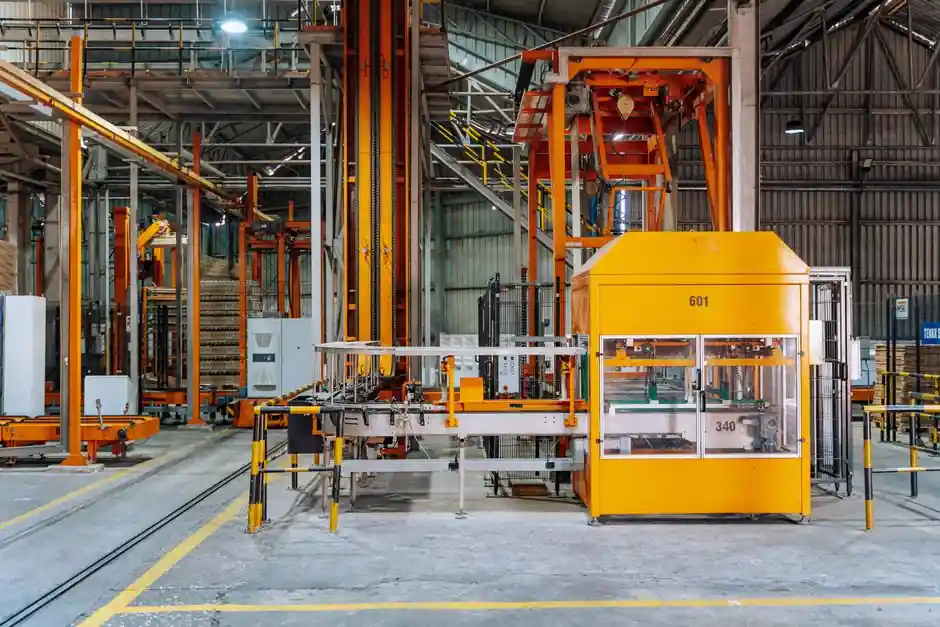
Order pickers, also called stock pickers, are narrow-aisle lift trucks whose defining trait is that the operator platform rises with the forks, letting a worker retrieve individual items or full cases directly from the rack face rather than transporting whole pallets [S1][S3].
That single design choice separates the order picker from every other narrow-aisle truck: it is a human-elevating platform first, a load carrier second, and that dictates the entire selection logic around operator safety, pick height, and aisle geometry [S1][S3].
Order Picker vs Reach Truck: A Function, Not a Niche, Decision
The cleanest way to draw the line is by primary job: a reach truck moves pallets in and out of the rack, while an order picker lifts operators so they can pick directly from rack bays, with reach trucks built for narrow-aisle pallet handling and order pickers usable across a broader range of aisle widths depending on the picking process [S1]. Typical load profile differs by an order of magnitude: full pallets for the reach truck versus picked cases or individual items for the order picker, and the throughput driver shifts from travel speed and pallet-handling efficiency to pick ergonomics and pick-path optimisation [S1]. A useful working rule: if more than 60 percent of the shift is moving a pallet rather than a person to a slot, the reach truck wins; if the work is selecting eaches or broken cases, the order picker wins. For mixed facilities, the practical answer is rarely either/or; an order picker fleet handles piece and case work while reach trucks take putaway and replenishment.
Selection Criteria: Pick Height, Lift Capacity, and Power Class
Electric order picker trucks are designed to lift operators to the required picking height, allowing them to retrieve individual items directly from warehouse racking, with modern units combining precision handling, ergonomic controls, and compact dimensions to maximise productivity in busy environments [S3]. A useful spec envelope for sit-down low-level order pickers: platform heights from roughly 200 mm to about 1.0 m, pick-face capacity 100–250 kg, and travel speeds of 8–10 km/h empty, used at ground or first-level rack faces where the operator walks alongside or rides at floor level [S3][S1]. For man-up high-level order pickers, mast lift heights commonly reach 6–10 m with platform capacities of 200–450 kg, narrow-aisle guided or wire-guided chassis, and lifting speeds around 0.3–0.5 m/s, used where vertical storage density is the binding constraint [S3][S1]. The lift motor class is electric throughout for indoor units, with 24 V, 48 V, and 80 V battery platforms deployed depending on duty cycle; this choice also drives electrical automation planning for charging bays, opportunity charging, and battery-swap rooms. Selecting the right electric order picker truck starts with three numbers: peak pick height, peak single-pick load, and shifts per day.
Workflow Match: Discrete, Batch, Cluster, Zone, Wave, or Goods-to-Person
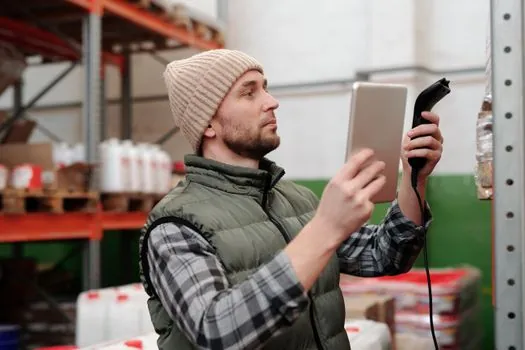
Six picking strategies dominate current warehouse practice, and each maps to a different order picker class [S5]. Single-order (discrete) picking fits low-level order pickers in smaller facilities with limited SKUs and short routes; it is the simplest approach but throughput depends heavily on how quickly workers can move through the facility, so it does not scale with volume without adding more labour [S5]. Batch picking fits where many orders share SKUs and is often paired with medium-level order pickers, with the trade-off that a post-pick sort step can become a bottleneck if totes are not organised efficiently after the run [S5]. Zone picking, where each worker or robot owns a zone and orders move zone-to-zone, fits man-up high-level order pickers because workers become familiar with their zones and avoid long travel paths; the failure mode is that if one zone falls behind the entire order is delayed [S5]. Wave picking groups orders by carrier cutoffs or product type, scheduling them in batches; it is inflexible once a wave begins, making it less effective in environments with frequent demand fluctuations [S5]. Cluster picking lets one worker pick multiple orders simultaneously using a cart or automated system with multiple bins or totes, with each item placed directly into its assigned container, eliminating the post-pick sort step; it works well for small-item, high-volume e-commerce but travel time between pick locations can still dominate in larger facilities [S5]. Goods-to-person (GTP) and AS/RS substitution removes the picker from travel entirely, a different cost-and-throughput regime that usually displaces the order picker at high SKU counts rather than supplementing it [S6].
How Electric Pickers Move the Throughput Needle
Order picking is one of the most labour-intensive activities within a warehouse, often accounting for a significant proportion of operating costs, and every unnecessary journey, delayed lift, or inefficient picking route adds time to the fulfilment process [S3]. Three design features of modern electric order pickers drive most of the throughput gain: electric drive systems with smooth acceleration and responsive handling that reduce travel time between pick locations; high-rack capability that lets operators safely access goods stored in tall rack systems, making better use of vertical warehouse space; and ergonomic controls that reduce repeated lifting, lowering, and travelling fatigue across a full shift [S3]. The reference voice-picking deployment described in case-picking literature is described as "a paperless, hands-free order fulfillment system where warehouse workers receive picking instructions through voice commands via a headset and confirm actions through spoken responses" [S2]. That voice layer is the highest-leverage add-on for an existing picker fleet, because it cuts the 4–8 seconds per pick spent looking at a screen or paper list, and it composes cleanly with cluster or batch strategies [S2]. For an e-commerce or multi-channel DC running more than 500 orders per day, the realistic contribution of switching to voice-plus-cluster on a low-level picker fleet is in the 10–25 percent throughput range, which is the same order of magnitude as a one-class step-change in picker hardware. Reference workload figures from case-picking practice show regional food distributors handling 500 orders daily with each order containing 30 to 50 different products spread across 100,000-square-foot facilities, illustrating the volume band where voice and cluster methods start paying back [S2].
Where Order Pickers Lose: Failure Modes and Adjacent Technologies

An order picker is the wrong tool when the unit load is a pallet, when the pick face exceeds the operator's reach without a stable platform, or when throughput targets outrun a human-elevating platform's cycle time. Pickers also underperform in freezer zones below roughly -20 °C unless specified for cold-store duty, since battery capacity drops and standard hydraulics thicken; cold-store variants add heated cabs, low-temperature lubricants, and stainless-steel hardware, and the cost premium versus a standard unit is typically 25–40 percent. A second failure mode is sortation: in a pure cluster-pick deployment with more than 12 totes per cart, picker hesitation rises faster than line throughput, and AMR or GTP topologies take over. A third is rack interface risk at heights above 6 m without a guided wire or rail system, where lateral drift can damage uprights; the practical mitigation is wire or rail guidance for high-level man-up fleets, not wider aisles. Picking automation, in the goods-to-person sense, "reduces travel and unnecessary handling through goods-to-person (GTP) systems, pick-to-light, voice-directed picking, AMRs, and pick-to-voice approaches" [S6]. For a 2026 spec deep-dive on cold-store and F&B-specific duty cycles, the Order Picker Spec Map for Food and Beverage Warehouses companion piece lines up the regulatory and material-construction deltas. For broader facility-side decisions such as partition and column-grid planning that drive aisle width in the first place, see the Lightweight Partition Panel Selection for Warehouses: 2026 Spec Map.
Buying Specification: A 10-Item Checklist
A defensible order picker spec carries at least these ten numbers, and skipping any one of them typically forces a redesign during commissioning [S1][S3][S5]. (1) Maximum pick height required, with 200 mm headroom; (2) platform or fork capacity at full lift; (3) aisle width as-built, measured at the tightest sweep, not nominal; (4) load centre distance for forks or platform; (5) battery voltage and amp-hour rating sized for a full shift with 20 percent reserve; (6) travel, lift, and lower speeds empty and at rated load; (7) gradeability in percent with full load; (8) free-aisle, right-angle-stack, and 90-degree-corner-clearance dimensions; (9) operator-restraint and fall-protection package for any unit lifting above 1.2 m; (10) on-board software, telemetry, and WMS/handheld interface ports. A working comparison of the main classes against decision criteria: low-level order picker suits piece picking under 3 m and narrow-or-conventional aisles, with a typical pick rate of 80–150 picks per hour, lower capex, and is the right default for e-commerce floor picking; mid-level order picker reaches 3–6 m with wire guidance and is the practical choice for grocery and pharmaceutical DCs running case and batch picks at moderate density; high-level man-up order picker reaches 6–10 m, needs guided aisles, and is the answer when vertical storage density is the binding constraint and pick rates above 250 per hour must be sustained; the reach truck and counterbalance forklift are the alternatives only when the load unit is a pallet, not a pick face, and the throughput driver is pallet movement rather than person-elevation [S1][S3]. The piece-picking approach where warehouse employees select individual items to fulfill customer orders is the dominant workload that justifies order picker fleets in 2026 DC builds, distinct from case or pallet regimes that may favour different equipment [S7][S8].
Trackable signals for the next buying cycle: the broader rollout of wire- and rail-guided man-up pickers in 8–10 m AS/RS-adjacent racks, the consolidation of voice-picking and pick-to-light into single headset hardware, and the convergence of AMR top-modules with low-level order picker chassis on shared 24 V and 48 V electrical platforms.
Spec-level background on the components involved: pressure transmitter.