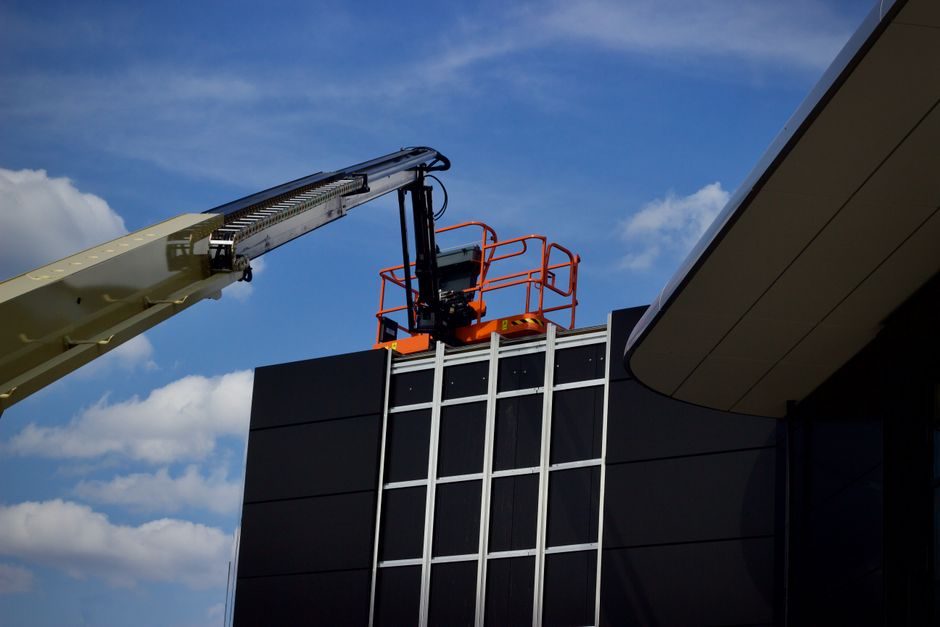
Specifying an aerial work platform for an unpaved outdoor yard without locking reach envelope, deck capacity, chassis type and power source first is the single most common cause of mid-project re-rentals and stop-work incidents on industrial sites.
Yard work in 2026 splits into three product families — self-propelled scissor lifts, articulated boom lifts, and telescopic boom lifts — with a fourth niche of tracked spider lifts for soft ground or finished-floor access [S1][S2][S3]. Each family has a distinct reach envelope, deck envelope, drive chassis, and wind-rating profile, and the selection error rate drops sharply when those four are fixed in that order before any brand or price conversation [S1][S2].
Working-Height Bands and the Reach Envelope Gate
Self-propelled electric scissor lifts cover a working-height band of roughly 6 m to 14 m for routine yard work such as lighting, signage, and pipe-rack maintenance, with platform decks in the 1.0 m × 2.0 m to 1.5 m × 3.0 m class and deck capacities typically rated between 230 kg and 450 kg depending on model [S1][S3]. Articulated booms extend the working envelope to 12–18 m and add horizontal outreach of 6–11 m, which is the deciding gate when the task is over a fixed obstacle such as a tank, generator, or parked container [S3]. Telescopic booms take working height past 20 m and add straight-line horizontal outreach of 12–18 m, the configuration typically chosen for steel erection and shipyard hull work [S3].
For each candidate unit, lock three numbers from the OEM data plate before sign-off: maximum working height, maximum horizontal outreach at platform height, and unrestricted platform capacity. A frequent yard-spec failure is choosing a scissor lift for a job that needs 7 m of horizontal outreach — the scissor geometry delivers vertical lift with negligible outreach, so the platform will not reach over a parked trailer or generator set [S1][S3].
Chassis, Gradeability and Yard Surface Gate
Yard surfaces in 2026 are rarely finished concrete, so chassis class is the second decision gate and it must be matched to ground condition rather than to lift height. Rough-terrain scissor lifts run 4-wheel drive with oscillating axles and a published gradeability of roughly 30–45%, sized for compacted gravel, mud, or unfinished sub-base [S1][S3]. Crawler-mounted scissor lifts add a tracked undercarriage for soft ground or turf, at the cost of lower travel speed and higher ground pressure per cm² [S1]. Wheeled electric scissor lifts are limited to flat, finished concrete and are routinely over-specified onto yard work where the surface cannot carry them, leading to rutting, immobilization, and tire damage [S1][S3].
For outdoor yard work where the surface is uneven, soft, or transitions between asphalt, gravel, and soil, the spec should default to a rough-terrain or tracked chassis rather than a slab-rated electric scissor, even when working height is below 10 m [S1][S3]. Tracked spider lifts are the niche option when the yard has finished surfaces that cannot be marked by tires or tracks, or when access is through a standard personnel door [S3].
Deck Load, Outreach-Zone Loading and Wind Gate
Deck capacity is not a single number: it must be cross-checked against the load chart in the operator's cab, because capacity drops as outreach and platform height increase on boom lifts, and the limiting number is rarely the headline spec on the sales sheet [S1][S3]. Two operators plus tools plus a 50 kg gas analyzer is a typical 280–320 kg payload, which is inside the capacity envelope of mid-size scissor lifts but at the upper end for some 6 m electric units rated at 230 kg [S1]. Wind rating is the third hard gate for outdoor work, and booms are typically rated to 12.5 m/s operating wind speed, with operations suspended above that threshold [S3].
For an outdoor yard, lock the wind-rating figure with the operating manual and note that gust factors are not the same as sustained wind; the OEM sustained-wind figure is the binding spec, and a site anemometer log is what actually triggers a stop [S3]. For enclosed or partially sheltered yards — a common case inside a container terminal or steel stockyard — wind exposure can drop, but it must be verified, not assumed [S2].
Power Source: Diesel, Electric, Hybrid and Lithium
Power source ties to both emissions rules and duty cycle. Diesel rough-terrain scissor and boom lifts are the default for outdoor yards where charging infrastructure is absent and where 8–12 hour shifts are common [S1][S2][S3]. Electric scissor lifts dominate indoor and finished-surface work because they are quieter and zero-emission at the point of use, but battery capacity drops in cold weather and the duty cycle shrinks accordingly — a key yard-spec item in northern climates [S1][S3]. Lithium-ion conversions of legacy electric scissor platforms extend runtime and reduce charging time, and are becoming the default for fleets with mixed indoor and outdoor use [S1][S3].
For an outdoor yard with no emission restriction, diesel remains the lower-risk default. For a yard inside a low-emission zone, on a covered slab, or shared with food-grade or pharmaceutical storage, electric or hybrid is the spec [S1][S3]. When diesel and electric are both candidates, match by daily kWh or liter consumption at the rated duty cycle, not by sticker fuel type, because the all-in operating cost difference is driven by hours of use and shift pattern [S1][S3].
Safety, Standards and Operator Gate
Yard work at height in 2026 is governed by the EN 280 series for aerial work platforms in Europe, with ANSI A92.20 / A92.22 / A92.24 governing design, calculation, and training requirements in North America, and IPAF's operator category system as the practical training framework widely adopted outside the standards themselves [S3]. Pre-use inspection, familiarization training, and documented familiarization on the specific model are mandatory before first use on site, and that is the operator gate most often skipped on rental units [S3].
A yard-side procedure should bind four things: a documented risk assessment for the specific platform on the specific yard surface, a pre-use inspection log, an anemometer-trigger wind stop at the OEM sustained-wind figure, and operator card verification on the specific category [S3]. Skipping the operator card on a telehandler-proficient crew is a common yard-spec error, because telehandler and boom-lift operator categories are not interchangeable [S3].
Rental vs Purchase: A Yard-Use Decision Frame
For yard work under 60 days per year, rental is the lower total-cost path, because the rental rate includes delivery, service, and the OEM familiarization in one line item [S3].
The crossover sits between 60 and 120 days per year and is sensitive to local delivery distance, service response time, and the cost of the mandatory operator familiarization, which is billable on a rental but fixed on a purchased fleet [S3]. For a procurement manager, the right comparison is delivered cost per operating hour including familiarization, not headline daily rate [S3].
Selection Criteria Frame: Six Gates Before RFQ
Before an RFQ goes out, six gates should be locked: working-height band, horizontal outreach requirement, deck capacity and outreach-zone loading, chassis class for the actual yard surface, power source tied to emission rules and duty cycle, and the operating wind rating with the OEM stop threshold. A unit that clears all six with margin on the binding numbers is a viable candidate; a unit that fails any one of them is rejected regardless of price [S1][S2][S3].
For a yard with mixed indoor and outdoor work and tight cycle time, a self-propelled rough-terrain scissor typically wins on cost-per-hour. For a yard with reach over fixed obstacles or with work above 14 m, an articulated or telescopic boom wins on reach. For a yard with finished surfaces, soft ground, or restricted access, a tracked spider lift is the only configuration that can land on the surface and reach the work point in one set-up [S1][S3]. The frame above lines up with the broader forklift selection criteria gates, where chassis, capacity, power, and surface also lead the decision tree before any commercial term.
Trackable signals for the next procurement cycle: OEM publication of revised EN 280 / ANSI A92 aligned load charts for lithium-ion boom platforms, updated OEM rough-terrain scissor gradeability figures for tracked undercarriages, and any site-level anemometer logs that push the operating wind threshold above 12.5 m/s [S3]. These three nodes will reset the upper bound on outdoor yard reach in the second half of 2026.
For component-level specifications, see aerial work truck, and platform scale.