
Selecting a forklift in 2026 comes down to five sequential gates — power source, capacity rating, mast configuration, tire/terrain match, and duty cycle — and getting any of them wrong typically inflates total cost of ownership 30-50% over the truck's 10,000-12,000 hour service life [S1][S6].
The first filter is always the OSHA/ANSI B56.1 truck class (I-VII), which bins equipment by power type and operating environment; only after the class is locked should buyers compare specific forklift models from manufacturers such as Toyota, CAT, Jungheinrich, Hyster-Yale and Crown [S1][S6]. Service-and-parts coverage, not headline price, is the second-order filter — Tri-Lift NJ in Sayerville and Forklifts Services BC in Vancouver both emphasise on-site repair and parts inventory as the differentiator over dealer sticker price [S1][S6].
Gate 1 — Power Source: Electric, Diesel, LPG or Hydrogen
Class I electric trucks produce zero tailpipe emissions, run at noise levels below 75 dB(A), and qualify for indoor food, pharmaceutical and cold-storage duty where diesel and LPG are excluded by ventilation code.
Diesel and LPG trucks (Class IV/V) remain the default for outdoor yards, lumber, ports and rough terrain where continuous 8-16 hour shifts exceed battery opportunity-charge windows. Hydrogen fuel cell units (Class I) are specified in California and EU distribution centres where 3-shift operation and fast refuelling outweigh the ~$80,000 fuel cell premium. Wuxi Everwin, a Tier-2 seat supplier serving North American and European OEMs, lists FOB seat pricing at $150-180 per piece on 50-piece MOQ, illustrating the BOM granularity on Class I-III trucks [S1].
Gate 2 — Load Capacity, Load Centre and Mast Height
Rated capacity is specified at a 24-inch (600 mm) load centre — the distance from the fork face to the load's centre of gravity. Doubling the load centre from 24" to 48" roughly halves the truck's safe capacity, so a 5,000 lb truck at 24" LC becomes a 2,500 lb truck at 48" LC. Standard sit-down counterbalanced trucks (Class IV/V) span 3,000-35,000 lb capacity, with electric Class I units topping out around 19,000 lb for cushion-tire indoor service. [S1]
Mast height, free lift, and collapsed height drive the second sub-decision. Triple-stage mast with full free lift adds 18-30% to mast cost but allows passthrough under 80-inch doorways with a 200-inch lift — a common spec for cross-dock applications. For rough terrain forklifts on construction or lumber yards, mast heights are typically 21-31 feet and chassis articulation replaces pure lift height as the operating constraint [S1].
Gate 3 — Tire and Terrain Match
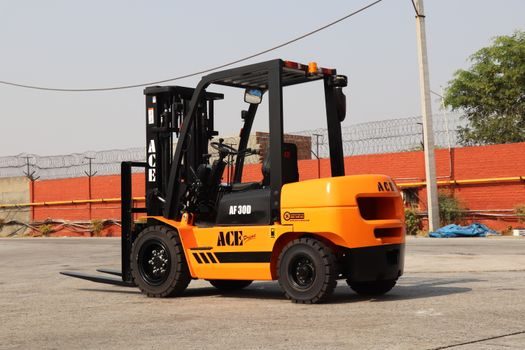
Cushion tires (smooth solid rubber) suit smooth indoor concrete, offer tightest turning radius (typically 65-80 inches for a 5,000 lb truck), and are lighter by 800-1,200 lb than pneumatic equivalents. Pneumatic tires are mandatory for outdoor surfaces, debris, and rough terrain; foam-filled pneumatics eliminate flats at a 30-40% tire-cost premium. [S2]
Non-marking tires are specified in white-room and food-grade operations where scuff marks trigger rejection. For true off-road duty — quarries, ports, unprepared yards — Class VII rough terrain forklifts with 4-wheel drive, oscillating axles, and high-flotation 14.00-24 tires replace standard Class V trucks, and their operating weight (often 10,000-30,000 lb) requires a separate site-survey before deployment [S1][S6].
Gate 4 — Duty Cycle, Aisle Width and Operator Ergonomics
Duty cycle is the hours-per-day and cycles-per-hour profile, not the headline capacity. A truck running 2 shifts at 60 cycles/hour needs a different cooling package, brake spec and battery (or fuel) capacity than one running 1 shift at 15 cycles/hour — typically a 25-40% jump in upfront price for the higher-duty build. Lithium-ion opportunity charging in 15-minute windows during breaks is now standard on 3-shift Class I duty, removing the battery-swap room requirement. [S3]
Operator ergonomics, a soft variable, is the hardest to retrofit. Suspended seats with 3-inch vertical travel, low-effort fingertip hydraulic controls (load-sense valves cut lever effort by 30-50%), and adjustable armrests are baseline on new Toyota, Jungheinrich and Hyster units, while Wuxi-supplied high-back mower seats at $150-180 FOB are typical on the lower-end Chinese OEM Class I exports [S1][S6].
Gate 5 — Total Cost of Ownership, Service Network and Standards
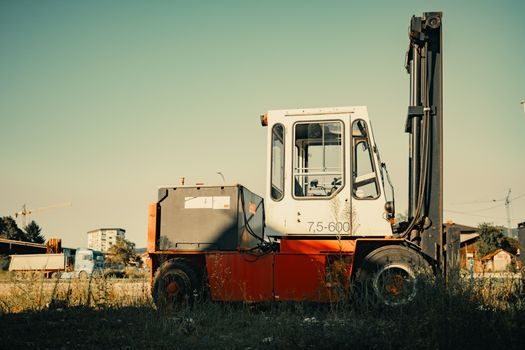
Total cost of ownership over a 10,000-hour life breaks down roughly as: acquisition 35%, fuel/electricity 20-25%, operator wages 25-30%, maintenance and parts 10-15%, and disposal 2-3%. Electric trucks win on fuel and maintenance; diesel wins on acquisition and high-throughput continuous duty. Comparing the 2 axes simultaneously — power source × duty cycle — gives a 4-quadrant matrix buyers can score against. [S4]
Standards to lock before RFQ: OSHA 1910.178 (operator training, daily inspection), ANSI/ITSDF B56.1 (truck design and rating), UL 583 (electric truck electrical safety), and for hazardous areas NFPA 505 and the relevant IEC 60079 zone classification. Service network is the operational gate — Toyota's dealer model (F-M Forklift Sales & Service is a typical authorized dealer) ties parts availability to model+serial plate lookup, which is why the data plate should be the first artefact in any selection memo [S1][S6].
For component-level specifications, see pressure transmitter.
For related coverage, see Zinc Die Casting Machine Selection: 2026 Spec-Driven Buyer's Frame.