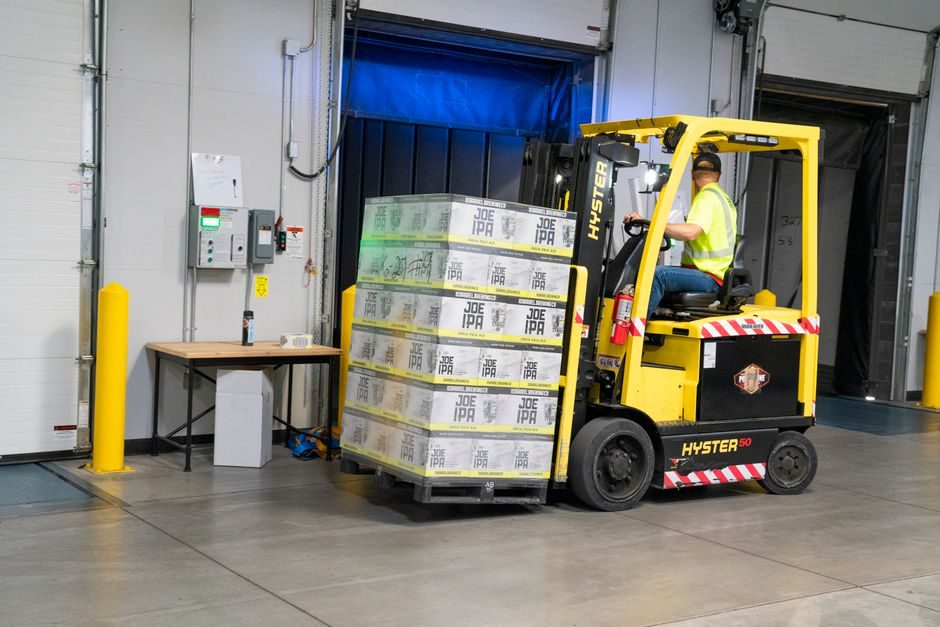
Walkie pallet stackers in the 1000–2000 kg capacity band and stand-on ride-on double-pallet units up to 2500 kg define the bulk of 2026 electric stacker offerings tracked on manufacturer channels, with lift heights clustering around 1600–5500 mm for the entry segment [S1][S2][S6].
For buyers cross-checking stackers against pallet stacker design constraints, the practical decision sequence is fixed: rated load × pallet mass, required lift height + load-backrest, minimum aisle (Aisle Width = pallet length + 200–300 mm clearance for walkie, + 600–900 mm for counter-balance ride-on), and power source (24 V / 48 V battery, semi-electric hand-pump, or fully electric) [S2][S3].
Capacity Bands and What Each One Is For
Three capacity tiers cover roughly 90 % of warehouse demand: light-duty 1000–1500 kg walkie stackers for retail back-of-house and light e-commerce, mid-duty 1500–2000 kg walkie/stand-on for 3PL cross-dock, and heavy-duty 2000–3500 kg ride-on for manufacturing line feed and pallet-to-floor transfer [S1][S2][S3].
The mid-duty 1500–2000 kg band is the volume sweet spot — electric walkie stackers on 24 V / 60–210 Ah batteries dominate this tier, with mast configurations of single-stage (1600–2500 mm), two-stage (3000–4500 mm), and three-stage full-free-lift (4500–5500 mm) being standard catalog options [S2][S3]. For operations targeting higher density, a walkie stacker is the lowest-cost entry, but once SKU velocity pushes pallet-turns above roughly 25 per hour per operator, a stacker crane typically becomes the throughput-economic choice.
Lift Height, Mast Type and Free-Lift Logic
Maximum fork height — not platform height — is the number to lock in, and a 150 mm safety margin above the top beam or rack shelf must be added before sizing; common spec levels are 1600, 2500, 3000, 3500, 4500 and 5500 mm [S1][S2].
Three mast families appear across catalogs: single-stage simplex (cheapest, no free-lift, suited to low-clearance doorways ≤ 2000 mm), two-stage duplex (workhorse for 3000–4500 mm), and three-stage triplex full-free-lift (the only practical option above 4500 mm or where the operator must clear a closed pallet deck on the ground) [S1][S2][S3]. For operations interfacing with pallet rack beams, full free-lift of 1300–1500 mm is usually mandatory on triplex masts so the operator can lower the fork onto the lower beam without first tilting the mast back.
Power Class: Manual, Semi-Electric, Full Electric
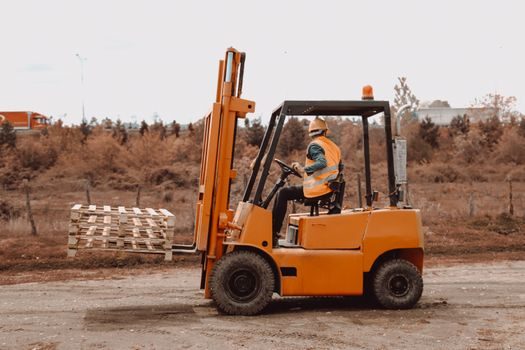
Semi-electric stackers use a manual hydraulic hand-pump for lift and an electric drive for traverse; they cap out at roughly 1000–1500 kg and 1600–3000 mm lift, and remain the lowest-cost entry for low-frequency use below 10 cycles/shift [S2][S3].
Full-electric stackers in the 1000–2000 kg class run 24 V lead-acid or Li-ion packs of 60–210 Ah, with onboard chargers as standard on 2026 models; the ride-on double-pallet SRD series from TCM runs larger battery packs to support the heavier chassis and simultaneous fork pair handling [S1][S3]. For buyers considering a plastic pallet program (block pallets weigh 14–22 kg vs. 20–35 kg for wood stringer), the saved tare of roughly 6–13 kg per pallet directly raises net payload headroom inside the same capacity class.
Aisle Width, Turning Radius and Wheel Geometry
For walkie stackers, the practical aisle width is governed by the formula: pallet length (typically 1200 mm EUR / 1219 mm ISO) plus 200–300 mm clearance each side = 1600–1800 mm working aisle; for stand-on ride-on double-pallet units, the wider chassis and longer wheelbase typically push the minimum aisle to 2200–2400 mm [S1][S2].
Wheel configuration is the second aisle lever: a single-load-wheel drive with polyurethane tread (Ø 250 mm drive / Ø 80 mm tandem load) keeps the body length short but caps gradeability at 5–8 % loaded; a dual-load-wheel design raises the chassis and improves stability on uneven floors at the cost of 80–120 mm extra length [S3]. For sites sharing aisles with linear guide rail-based transfer cars or conveyors, the stacker's outer turning radius (typically 1450–1750 mm for walkie) must be validated against any floor-embedded track clearances.
Operator Class, Ergonomics and Safety Stack
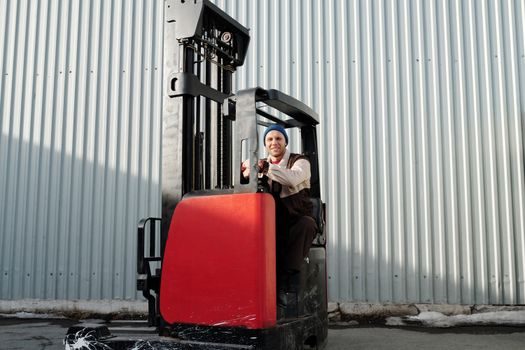
Three operator classes appear in the spec sheets: pedestrian walkie (operator walks behind, tiller arm steering, ≤ 6 km/h travel), stand-on ride-on (operator stands on a folding platform, ≤ 9–10 km/h, mandatory for double-pallet handling), and seated ride-on (used on heavier 2500+ kg units) [S1][S3].
Fork dimensions are tightly standardized — 1150 mm length × 180 mm width for EUR pallets, 1220 mm × 100 mm for ISO — but the rated load center is 600 mm from the fork face, and exceeding that (e.g., using 1500 mm-long forks on a 1000 kg-rated unit) drops capacity by 20–30 %.
Selection Criteria Comparison: Walkie vs Stand-On vs Automated Dispenser
Three decision axes separate the main classes: load (1000–2000 kg walkie, 2000–3500 kg stand-on/seated, unlimited automated), lift height (≤ 5500 mm walkie, ≤ 6500 mm ride-on, 1500–2500 mm dispenser magazine), and throughput (≤ 25 pallets/h operator-driven, ≤ 45 pallets/h automated dispenser magazine) [S1][S3][S4][S5].
On cost-per-pallet-position, walkie stackers in the 1000–2000 kg class typically run 25–40 % below ride-on units at equivalent lift, while automated pallet dispensers such as the PalletMaster 1–5 magazine swap the operator-variable throughput for a fixed 8–15 second stack/unstack cycle and handle 1–5 pallet stacks without human intervention [S4][S5]. Where floor space is the binding constraint, an automated stacker/dispenser paired with a crossed-roller guide shuttle can replace 3–4 manual stacker positions, but the capex crossover sits at roughly 80,000–120,000 pallet cycles per year depending on local labor rates [S4][S5].
Standards, Compliance and Sourcing Levers
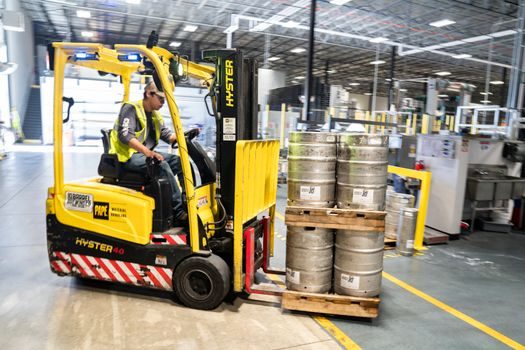
Stackers sold into the EU must carry CE marking under the Machinery Directive 2006/42/EC, with EN ISO 3691-1 (safety of industrial trucks — self-propelled) and EN 1726-1 (operator-controlled variable-reach) being the most commonly cited conformity standards on EU spec sheets [S3][S6].
Common spec markers to verify on the nameplate: rated capacity (kg) at 600 mm load center, max lift height (mm), battery voltage (V) and capacity (Ah), travel speed loaded/unloaded (km/h), turning radius (mm), and noise emission LpA (typically 70–74 dB(A) for electric units) [S1][S2][S3]. For sourcing, 2026 OEM catalogs show three viable channels — direct from the manufacturer (TCM, Niuli, EBILTECH), regional dealer/distributor (typical 12–18 % markup over OEM list), and refurbished/remanufactured units at 40–55 % of new list with 6–12 month warranty from specialist dealers [S3][S4][S6]. Lead times from Chinese OEM channels in mid-2026 sit at 25–40 days for standard catalog units and 60–90 days for non-standard mast heights or battery configurations [S3][S5][S6].
Buyers refining a stacker spec should pull a hydraulic power unit sizing reference alongside the stacker RFQ — the stacker's lift cylinder flow/pressure envelope drives the HPU spec, not the reverse. For operations moving toward full-pallet automation, the AS/RS throughput-vs-density decision matrix is the next escalation step once a walkie or ride-on stacker fleet is saturating the available aisle time.