The remaining share covers dry film, gold salts, solder mask, and silkscreen ink, all of which move with the CCL base spec.
For procurement engineers, the practical implication is simple: locking the CCL grade, copper weight, and resin system early in the design cycle controls 40-45% of board cost and most of the lead-time exposure to upstream glass and copper supply.
What a PCB Is Actually Made Of: Substrate, Copper, Prepreg
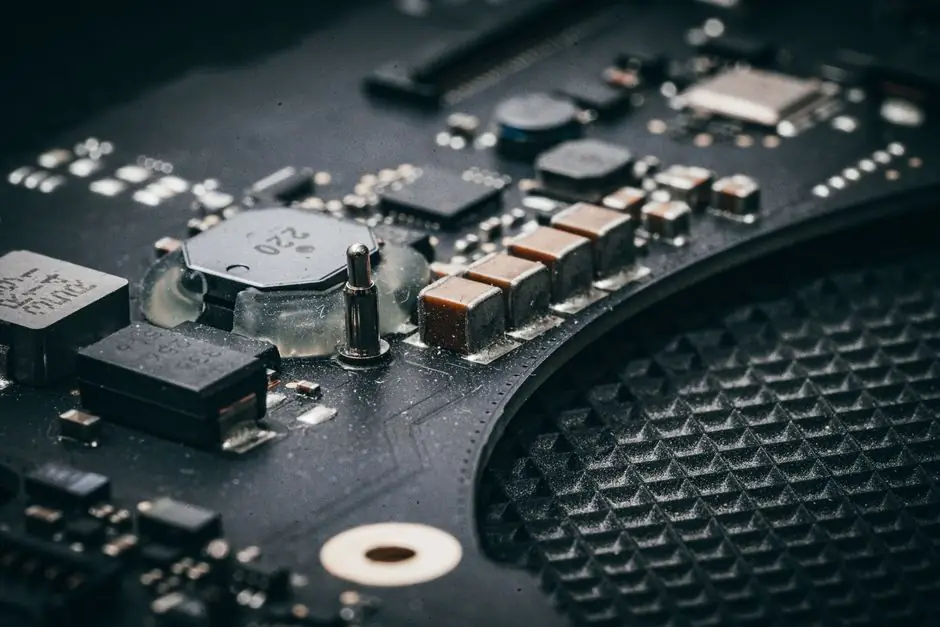
Every rigid PCB is a four-layer laminate heat-pressed into a single panel: silkscreen, soldermask, copper, and the FR-family substrate, per PCBCart's material reference [S3]. The substrate is the structural dielectric, almost always woven glass fabric bonded with epoxy resin; the "FR" prefix denotes flame retardant, with FR-4 (epoxy) the volume workhorse and FR-5 the higher-glass-transition variant.
Copper foil weight is specified in ounces per square foot, with 0.5 oz to 2 oz being the common production range and 1 oz standard for most multilayer builds, per AllPCB's capacity guide [S1]. On a multilayer board copper appears on both sides of each core, and additional copper is built up electrolytically in plated through-holes, so a "4-layer, 1 oz" board is not just four copper foils but four plus plated barrel copper.
Prepreg (B-stage resin-impregnated glass) is the glue layer between cores; its resin content and flow behavior control multilayer board thickness tolerance and Z-axis expansion, which is why most fabricators will not let you swap prepreg suppliers without re-qualifying the stackup.
CCL Classification: Resin Base, Reinforcement, and Flame Rating
Copper-clad laminate is classified along two axes that procurement must read on the data sheet: reinforcement material and resin system, per PCBCart's CCL taxonomy [S3]. Paper-base CCLs use phenolic (XPC, FR1, FR2) or epoxy (FE-3) resins for low-cost consumer goods; glass-cloth-base CCLs use epoxy (FR-4, FR-5) for the bulk of industrial and automotive work; composite epoxy (CEM) sits between them on cost and performance.
For high-frequency, high-reliability builds the resin system shifts away from standard epoxy to BT, PI (polyimide), PPO, or MS, all of which carry higher dielectric stability and thermal endurance but also longer lead times [S3]. The flame-rating axis is governed by UL94: UL94-V0 is the standard requirement for most industrial and automotive electronics, UL94-V1 is acceptable for some commercial products, and UL94-HB (horizontal burn) is the non-flameproof class limited to non-critical applications.
Bottom line for sourcing: do not order to a generic "FR-4" data sheet. Specify (1) resin type, (2) glass style (e.g. 106, 1080, 2116, 7628), (3) Tg value, (4) UL94 rating, and (5) copper foil weight, because every one of those five fields changes price and lead-time independently.
Selection Criteria: When Standard FR-4 Stops Working
Standard FR-4 with epoxy resin is the right default for consumer, industrial controls, and most automotive non-powertrain electronics; it is also the cheapest and shortest-lead-time option, which is why fabricators stock it in 0.5-2 oz copper weights [S1]. The first place FR-4 fails is thermal: Tg of standard FR-4 sits at 130-140°C, and lead-free reflow at 245-260°C peak pushes the board close to its glass transition, raising the risk of delamination and via barrel cracking.
For lead-free assembly, high-layer-count (16+ layer) boards, or any build that sees sustained operation above 130°C, specify mid-Tg (150-160°C) or high-Tg (170-180°C) FR-4 as the minimum, per the Sierra Circuits material design guide [S5]. For RF, microwave, and high-speed digital above 5 Gbps, epoxy's high dissipation factor (Df ~0.02 at 1 GHz) is the binding constraint; you need to step up to low-Df resin systems (PPO, modified epoxy, or PTFE) where Df drops below 0.005, accepting the cost and lead-time penalty that comes with non-epoxy chemistries.
Copper selection is the second decision that procurement must own: 0.5 oz foil suits fine-line consumer logic, 1 oz is the multilayer default, and 2 oz or heavier is required for high-current power electronics where trace cross-section and thermal mass matter, per AllPCB's capacity breakdown [S1]. Skin-effect loss at high frequency also drives foil choice: rolled annealed (RA) copper has a smoother surface than standard electrodeposited (ED) foil and lower conductor loss above ~1 GHz, which is why RF shops will not accept ED copper for microwave builds.
Comparison: CCL Material Options Against Decision Criteria
The main CCL families line up against procurement-relevant criteria roughly as follows. Standard FR-4 (epoxy/glass) is the cheapest, shortest-lead-time, UL94-V0 rated, Tg 130-140°C, and is suitable for consumer, industrial, and non-powertrain automotive. Mid/high-Tg FR-4 costs roughly 10-25% more, extends lead time modestly, holds UL94-V0, raises Tg to 150-180°C, and is required for lead-free assembly and 16+ layer builds. Modified epoxy / PPO systems run 2-3x standard FR-4 cost, longer lead time, UL94-V0, Tg 170-200°C, Df ~0.005-0.010, and target high-speed digital above 5 Gbps. BT and polyimide systems are premium-priced, longest lead time, UL94-V0, Tg above 250°C for PI, low Df, and target aerospace, defense, and high-temperature under-hood automotive. PTFE-based CCLs are the most expensive, longest lead, UL94-V0, Tg variable, Df below 0.002, and are the only practical choice above 10-20 GHz, per PCBCart's CCL taxonomy and AllPCB's capacity reference [S3][S1].
The decision rule is to walk down this list only as far as the electrical and thermal spec demands, and stop. Over-spec'd CCL is the single most common source of unnecessary PCB cost overruns on industrial programs, a pattern that shows up in adjacent electronics spec work like the marine lock nut selection material map where over-engineering the base material drives cost without changing field performance.
Supply Chain Risk: Where Shorts Actually Hit

Per AllPCB's analysis, raw material availability and volume directly affect PCB production speed, cost, and delivery timelines [S1]. The two chronic chokepoints are high-grade glass cloth for low-Df systems and electrolytic copper foil, both of which are concentrated in a small number of upstream suppliers.
Specialty laminates for 5G, RF, and high-speed digital are the second pressure point: demand outstrips supply for high-frequency grades, and the price premium on those grades can swing double digits quarter to quarter, again per AllPCB's supply-chain reference [S1]. Prepreg and laminate supply is the third, because multilayer demand from telecommunications and automotive runs in 8-12 week cycles that do not align with consumer-electronics order patterns.
Mitigation options that actually work: qualify a second CCL source at the same glass style and resin content (not just the same generic "FR-4" label), hold 30-60 days of safety stock on prepreg for production builds, and track the UL94 file number on the data sheet so the alternate supplier is genuinely UL-listed for the same flame class.
Procurement Checklist: What to Put on the RFQ
Spec the CCL grade by resin system and glass style, not by trade name alone, because "FR-4" on a data sheet can hide a Tg spread of 130-180°C. State copper foil weight per layer in oz/ft², foil type (ED vs RA) for any board above 1 GHz, and surface profile (standard vs low-profile vs reverse-treated) for fine-line work. [S2]
Declare the UL94 flame class (V0, V1, or HB) and the operating temperature range so the supplier can confirm Tg margin. Specify finished board thickness tolerance (typical ±10% for standard, ±5% for controlled-impedance) and the impedance tolerance (commonly ±10%, ±7%, or ±5% depending on the application) [S5]. Finally, ask for the factory's UL file number, the CCL lot traceability policy, and the lead time in writing for the specific stackup, not for "FR-4 in general".
Trackable signals to watch through 2026: lead time on high-Tg FR-4 (a leading indicator of multilayer demand), electrolytic copper foil price (LME-linked, moves on macro cycles), and UL94 file audits on Chinese CCL suppliers, which periodically remove older file numbers and force re-qualification. For a broader spec-driven look at adjacent industrial material selection, the casting mold specs for hardware manufacturing guide follows the same RFQ discipline and is worth cross-referencing when qualifying any new vendor.
Spec-level background on the components involved: linear guide, crossed roller guide, and advanced material.