Specifying HDPE for K-12 and university campus water, fire and irrigation mains in 2026 comes down to three decisions: PE 4710 vs PE 2708 material code, Dimension Ratio (DR) matched to operating pressure, and a joining method (butt fusion or electrofusion) sized to the largest fitting count [S1][S3]. For most US public-school buried potable laterals, 4" to 12" IPS HDPE at DR 11 (PC 200, WPR 200 psi) or DR 17 (PC 130, WPR 130 psi) is the default [S4].
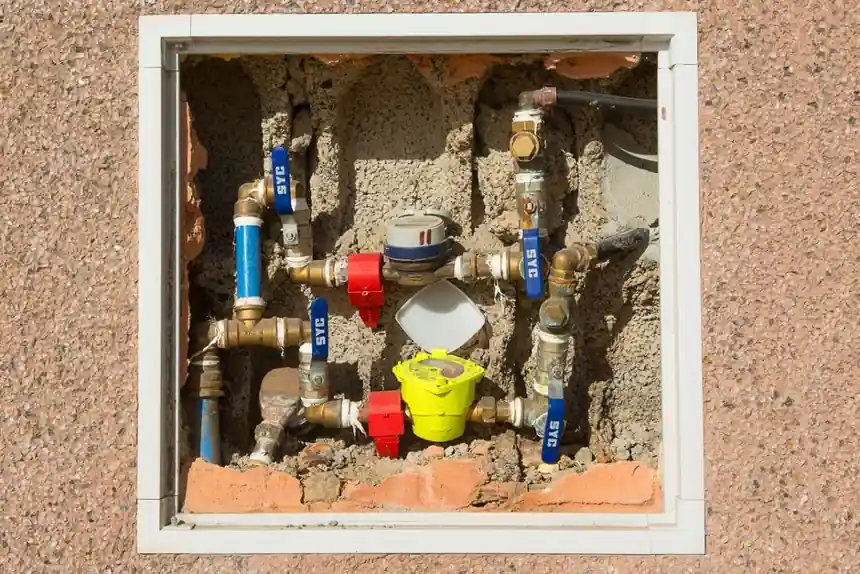
School projects differ from municipal trunk mains in two ways that hit the PE spec directly: campus loops are short (often under 2,000 ft of main per phase), so the cost driver is fitting count and trench restoration, not raw pipe footage; and building-service risers must transition to copper, CPVC or PEX at the slab, which forces a clean HDPE termination with a fusion-molded transition fitting [S3].
PE 4710 vs PE 2708: Which Code for Which School Main
ASTM D3035 and PPI TR-4 list only two codes as current: PE 4710 (HDS 1,000 psi, SCG cell class 7, minimum PENT 500 hours) and PE 2708 (HDS 800 psi) [S3][S5]. The older PE 3408/3608/3710/4608 codes are deprecated and should be excluded from school bid documents, even when a distributor still stocks the resin [S5].
For buried fire-service loops, irrigation headers and any main that sees a working pressure above 100 psi, specify PE 4710; for cold building service (50 psi or less) inside utility chases, PE 2708 is acceptable and costs less per foot [S5][S6]. Both codes use the same fusion parameters when the DR matches, so contractor qualification does not need to change between the two [S3].
Dimension Ratio (DR) Selection by Working Pressure
All PE 4710 pipe of the same DR and at 73.4 deg F carries the same pressure class regardless of diameter, so the spec table collapses to a single line per DR, per AWWA C906 [S3][S4]. At 73 deg F with the PPI 0.63 design factor, DR 17 = PC 130 (WPR 130 psi), DR 13.5 = PC 160 (WPR 160 psi), DR 11 = PC 200 (WPR 200 psi), and DR 9 = PC 250 (WPR 250 psi) [S4].
Most K-12 domestic-water and fire-service taps fall in the 100 to 150 psi range, so DR 17 to DR 13.5 is the workhorse band. A 6" DR 17 PE 4710 line weighs 3.64 lb/ft and runs an average ID of 6.039", while a 6" DR 11 line weighs 5.42 lb/ft and drops to 5.571" ID at the same OD [S4]. Going one DR step heavier (lower number) costs roughly 30 to 50 percent more in wall material and reduces ID by 8 to 12 percent, a tradeoff that should be checked against flow demand before the spec is frozen.
Diameter Range and Sizing Anchors for Campuses

Stock IPS HDPE runs from 3/4" through 54" OD, but school sitework lives almost entirely in the 2" to 12" band [S1][S7]. For a 500-student elementary, the domestic lateral is typically 4" (DR 17: 4.202" ID, 1.76 lb/ft); for a 2,000-student high school, 6" to 8" is the working range; for a multi-building campus with a shared loop, 10" to 12" (DR 17: 12" line at 7.19 lb/ft) is typical [S1][S4].
Match the nominal OD to ductile-iron outside-diameter (DIOD) when the school connects to an existing CI/DI main, or to IPS when tying into a PVC or HDPE lateral. The same 6" nominal can mean either a 6.625" IPS OD or a 6.90" DIOD, and the butt-fusion machine and the electrofusion coupling are not interchangeable across the two size systems [S1][S4].
Joining Method and School-Site Constraints
Butt fusion (ASTM F2620) is the default for 4" and larger straight runs because it has no consumable coupler and the joint is full-pressure rated. Electrofusion (ASTM F1055) is preferred where the trench is too narrow for the butt-fusion clamp, for repair sleeves, and for tapping tees on a live main during a school-occupied summer tie-in [S3]. For 2" and smaller service lines to a building, socket fusion or a compression coupling to copper/CPVC is the practical transition; HDPE itself is not solvent-welded [S3].
Heat-fusion joints must be made by a qualified operator per PPI TR-33, and the contractor's fusion machine must have a data-logger or barcode wand that records heater-plate temperature, soak time, and cool time; most school districts now require the same QC logs as the local water utility [S3].
Comparison: PE 4710 vs PE 2708 vs PVC for School Sitework
On cost per linear foot, 6" DR 18 PVC (C900) is the cheapest in many regions, but it cannot be fused, so every fitting is a bell-and-spigot gasket or a restraint. PE 4710 HDPE at 6" DR 17 costs roughly 20 to 40 percent more per foot but eliminates mechanical joints inside the run, which on a campus with seismic or expansive-soil risk is the deciding factor [S2][S3].
On pressure, PE 4710 at DR 11 is rated to 200 psi WPR, beating the 150 psi rating of DR 18 C900 PVC at the same nominal size [S4]. On corrosion and soil chemistry, HDPE is immune to the stray-current and aggressive-soil failures that hit ductile iron, and it tolerates pH 1.5 to 14 effluents, which matters for school chemistry buildings and pool backwash lines [S2]. On freeze tolerance, HDPE's flexibility lets it expand with ice plug formation, where PVC tends to crack; campuses in USDA Zone 5 and colder should default to HDPE for any above-grade or shallow-buried service [S2][S3].
Where HDPE Is the Wrong Choice
HDPE should not be specified for hot-water building distribution above 140 deg F on a continuous basis, because PE 4710's hydrostatic design stress drops as temperature rises, and the published pressure class is only valid at 73 deg F [S3][S4]. For hot-water recirculation, use CPVC or copper. HDPE also should not be used for any UV-exposed run longer than a few months without a protective wrap or paint; standard black PE 4710 with 2 to 2.5 percent carbon black is rated for long-term sunlight exposure, but colored stripe or non-black HDPE is not [S3].
Compressed-air or natural-gas service on a school campus uses a different PE code under ASTM D2513, with a yellow or striped marking and a separate qualification; do not cross-spec D3035 water-grade HDPE on a gas line [S5].
Standards, Markings and Submittal Checklist
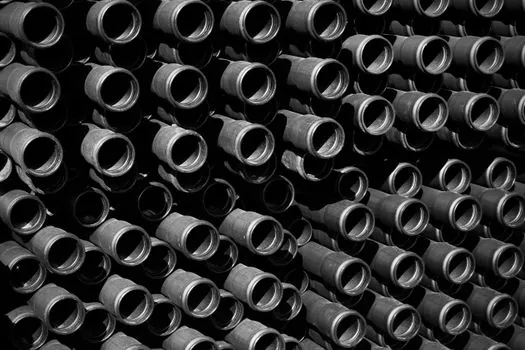
Every coil or straight length should arrive with five permanent marks: the PE material code (PE 4710 or PE 2708), the DR, the nominal size, the pressure class, and the applicable standard (ASTM D3035 for IPS sizes 1/2" to 65", AWWA C906 for 4" to 65" water transmission, or FM 1613 for fire-service mains) [S3][S4][S5]. Reject shipments that show the old "PE 3408" string or that lack a SCG cell-class marking [S5].
For school projects in seismic-design categories D, E or F, add ASTM F2620 fusion qualification and PPI TR-34 (or the latest MAB-01) seismic-resistance guidance to the spec; the flexibility of HDPE gives a measurable advantage, but only when the fusion joints are made to spec [S3]. One trackable signal in 2026 is the continued consolidation of PE codes around PE 4710, and any school district still carrying PE 3608/3710 inventory should treat it as obsolete on bid day [S5].
Closing reference node: pair this spec with a PP-R or stainless riser transition at the building penetration, and confirm the service-side connection detail at the meter or backflow preventer before the trench closes.
Background reading: Shuttle system selection for apparel distribution: pallet, box, and 4-way specs.