
Welding and thermal-cutting operations create an ignition-rich environment, so a perimeter alarm around a hot-work yard must filter arc-flash, grinding spark shower, and oxy-fuel flashback risks from genuine intrusion signals [S1][S2].
Perimeter intrusion detection splits into four families: buried seismic, fence-mounted, free-standing beam (IR or microwave), and camera analytics. Each reads a different physical signal, ground vibration, fence fabric movement, beam break, or video frame, to flag the same event: a person or vehicle crossing the boundary [S3].
Buried Seismic vs Fence-Mounted vs Free-Standing Beams
Buried seismic sensors are fully concealed, unaffected by rain, wind, or fog, and adapt to open ground, slopes, and vegetation; their adaptive algorithms filter wind, animals, and debris, which is exactly the noise profile a welding yard produces from grinding, transport vehicle vibration, and arc-strike spatter [S3].
Fence-mounted sensors require an existing rigid fence line, read cutting, climbing, and lifting, and are sensitive to wind-driven fabric vibration; IR and microwave beam systems need a straight, unobstructed sightline and degrade in fog, heavy rain, or snow, plus they can be crawled under or jumped over [S3]. The three-layer filtering on a sensor like the IRONCLAD fence alarm is engineered to separate cutting, climbing, and lifting from wind, rain, and traffic vibration, a real concern in yards where forklift traffic runs within metres of the fence [S2].
Welding-Specific Hazard Overlay
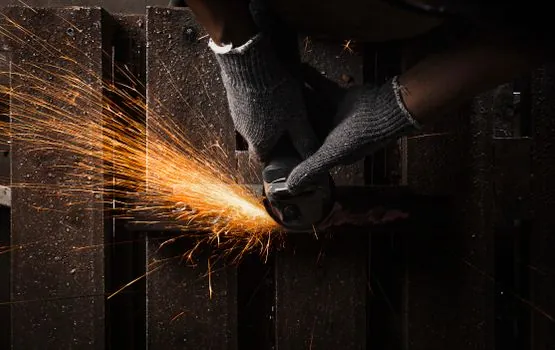
Hot-work yards add three non-typical loads to any perimeter detector: continuous electromagnetic interference from inverter welders up to 500 A, airborne conductive dust from grinding that can foul optical surfaces, and strict ATEX or IECEx zoning where solvent vapours, acetylene, or LPG are stored within the perimeter [S1][S3].
For welding and cutting tool storage compounds with acetylene cylinders, any IR or microwave beam posts inside the hazardous area must be rated to the zone classification, and fence-mounted electronics should sit outside Zone 1 boundaries or carry an Ex d / Ex e enclosure rating. A buried seismic cable run avoids surface-mounted electronics entirely, which simplifies zoning drawings and removes one ignition-source path from the permit package.
Camera-based analytics layered on the perimeter rely on IR illumination, which can be blinded by arc flash at distances under 30 m unless the camera is shuttered during welding cycles; for that reason, vendors position buried seismic as the primary detector and the camera as a verification layer cued to the exact detection point [S3].
Who It Is For, and Where It Fails
Buried seismic is the right call for open ground, irregular terrain, vegetated buffer zones, and any site where the fence line is porous (chain-link with gaps, palisade without anti-climb) or absent entirely [S3]. A welding yard with a 2.4 m welded-mesh perimeter, hardstand apron, and shared boundary with a public footpath typically fits this profile.
Fence-mounted detection is the right call when an existing rigid mesh or palisade fence is in good condition, when budget is constrained versus trenching, and when the security model assumes the fence itself is the delay layer. It is the wrong call for weld shops where arc-strike spatter damages sensor cabling or where frequent fence repairs would repeatedly take zones out of service [S2][S3].
Free-standing IR and microwave beam systems fit short, straight runs, gated entrances paired with perimeter alarm logic, and sterile corridors between buildings. They are the wrong call in fog-prone coastal yards, sites with seasonal vegetation growth across the beam path, or yards where a casual bypass (crawl-under, jump-over) would defeat the entire detection layer [S3].
Sourcing, Standards, and Integration Notes
Perimeter alarm panels typically feed a gas alarm controller or fire alarm control panel for site-wide event correlation, especially in yards where a perimeter breach during a gas leak or hot-work permit is an immediate evacuation trigger. [S1]
Detection performance should be quoted in probability of detection (Pd) and nuisance alarm rate (NAR) per metre per day, with vendor test data referenced to IEC 62676-4 or equivalent; for EN 50131 Grade 3 or Grade 4 sites, confirm the panel and signalling path meet the same grade so the perimeter event cannot be downgraded at the head end.
Buyers comparing Chinese perimeter alarm manufacturers for the welding sector should treat the same spec-first filter used in the rest of the industrial stack: a structured spec document beats a brochure, and the same logic in our explosion-proof electrical selection map applies when matching detector certification to the hot-work zone drawing.
Track three signals in the next sourcing cycle: any vendor Pd and NAR test reports published to a recognised standard, ATEX or IECEx certificate numbers for surface-mounted electronics inside the hot-work boundary, and reference sites running the same detector family within 50 km of your yard, since soil calibration for buried seismic is the single biggest on-site variable.